
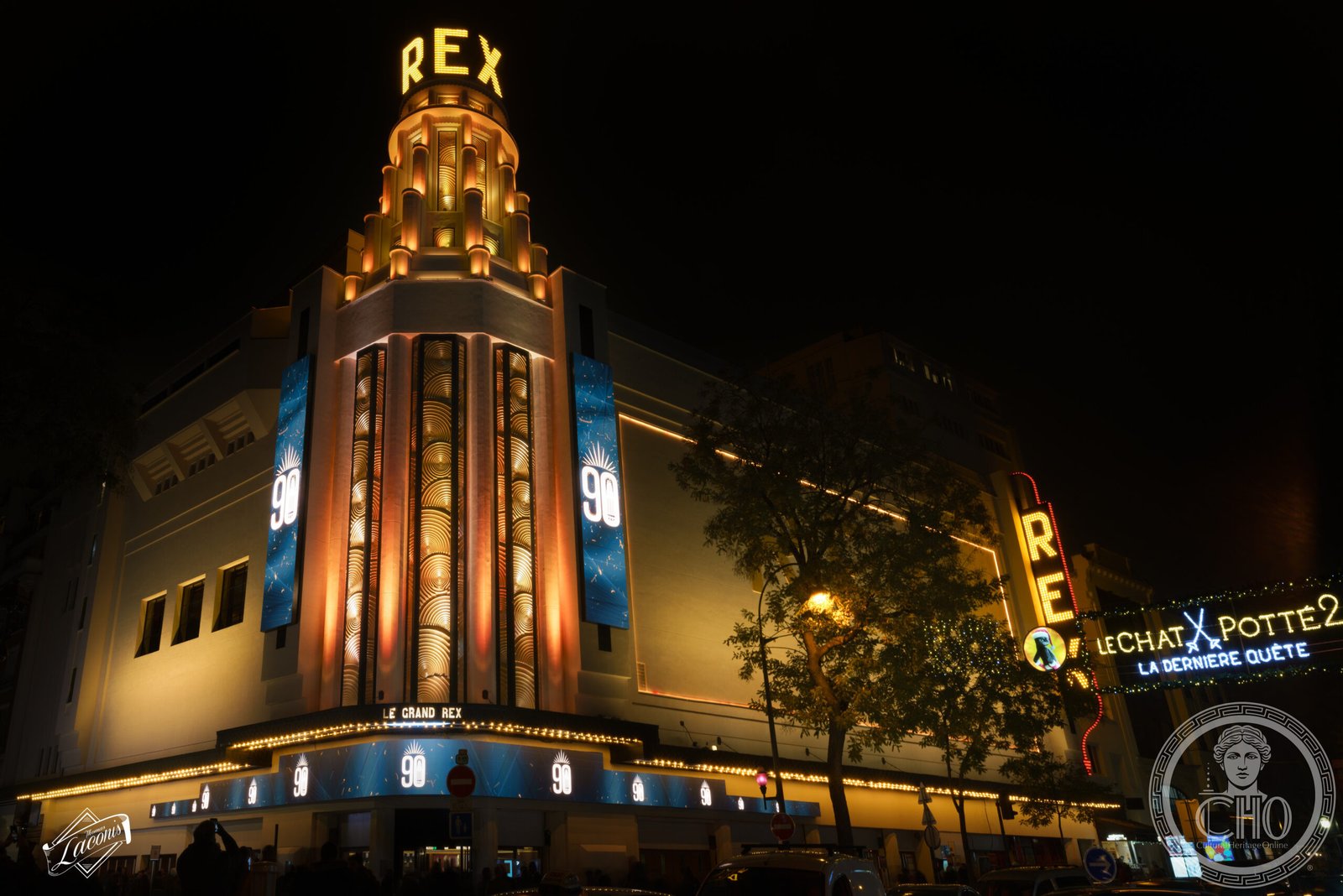
Le Grand Rex is the most spectacular Art Deco cinema in Europe and one of the great picture palaces of the world. Opened on 8 December 1932 on the Grands Boulevards, it was conceived as a monument to the golden age of cinema, capable of seating 2,702 spectators beneath a vast sky of simulated stars. Architects Auguste Bluysen and John Eberson — the American master of the atmospheric cinema — created an interior that reproduces the atmosphere of a Mediterranean courtyard under a deep blue night sky, complete with twinkling stars, wisps of projected cloud, and architectural details drawn from southern French and Moorish sources. The facade, recently restored to its 1932 appearance, is an emphatic exercise in Art Deco verticality: illuminated lettering, bold geometric ornament, and a stepped tower that dominates the boulevard. Still operating as a cinema and concert venue, Le Grand Rex is listed as a French historic monument and remains the largest single-screen cinema in Europe.
At a glance
- Type
- Cinema and concert venue (atmospheric theatre)
- Period
- Opened 8 December 1932
- Style
- Art Deco / Atmospheric cinema
- Location
- 1 boulevard Poissonnière, 2nd arrondissement, Paris, France
- Coordinates
- 48.8706° N, 2.3478° E
- Architect(s)
- Auguste Bluysen; John Eberson (interior concept)
Overview
Le Grand Rex sits at number 1, boulevard Poissonnière in Paris’s 2nd arrondissement, at the heart of the Grands Boulevards entertainment district. With a main auditorium capacity of 2,702 seats, it remains Europe’s largest single-screen cinema. The building houses seven screening halls, a concert and show venue, the Rex Club (a legendary electronic music club), and Rex Studios, an interactive cinema museum. Classified as a Monument Historique since 1981, the building is one of the defining landmarks of Paris’s nocturnal cityscape, its illuminated facade visible from afar along the boulevard.
History
Le Grand Rex was commissioned by impresario Jacques Haïk and opened with great fanfare on 8 December 1932. Haïk had visited the United States and was inspired by the great American picture palaces, particularly the atmospheric theatres designed by John Eberson. He hired Auguste Bluysen as lead architect and brought in Eberson to design the extraordinary interior. The cinema quickly became one of the premier entertainment venues in France. During World War II it continued operating under German occupation, screening both French and German productions. After the war it regained its status as a cultural landmark. In the 1970s and 1980s, declining cinema attendance threatened its future, but a strategic expansion into concert programming and the addition of extra screening halls secured its survival. The facade was restored and relighted for its 90th anniversary in 2022.
Architecture & Design
The exterior presents a bold Art Deco tower with stepped setbacks, bands of geometric ornament, and the cinema’s name spelled out in enormous illuminated letters — a composition that functions as a graphic landmark as much as a building. The interior is John Eberson’s masterwork in Europe: the concept of the atmospheric theatre, which he pioneered in the United States in the 1920s, creates the illusion of sitting in an open-air Mediterranean courtyard. The ceiling of the main auditorium is painted deep blue and fitted with fibre-optic stars that gently twinkle; projected clouds drift across it during screenings. The walls are adorned with Moorish arches, urns, and architectural fragments suggesting a Spanish or Italian palazzo. The combination of electric spectacle and romantic escapism made atmospheric cinemas the high-water mark of popular architectural theatre in the interwar period.
Cultural significance
Le Grand Rex is both the finest surviving atmospheric cinema in Europe and a defining monument of Art Deco Paris. Its listing as a Monument Historique in 1981 affirmed its status as irreplaceable national heritage. Culturally, the building embodies the inter-war belief that cinema was a democratic art deserving palatial surroundings — a philosophy that transformed the urban landscape of European cities in the 1920s and 1930s. Today it functions simultaneously as a working cinema, a concert hall, a nightclub, and a museum, making it one of the most programmatically diverse historic buildings in France.
Visiting today
Le Grand Rex shows films daily, including first-run international releases, and hosts concerts and special events. The Rex Studios interactive tour (Les Étoiles du Rex) allows visitors to explore the building’s history and behind-the-scenes spaces; it runs daily except Mondays and is suitable for all ages. The Rex Club in the basement operates as a nightclub on weekends. Check the official website (legrandrex.com) for the current programme. Booking in advance is recommended for popular screenings and the studio tour.
Getting there
Le Grand Rex is directly served by Bonne Nouvelle metro station (lines 8 and 9), a one-minute walk from the entrance. The Grands Boulevards station (lines 8 and 9) is equally close. Several bus lines serve boulevard Poissonnière. The building is within easy walking distance of the Opéra, the Marais, and the Centre Pompidou. Vélib’ (Paris bike-share) stations are located on the boulevard.
Sources & resources
Find it on the map
See this place and what’s around it →Record researched and written by Luigi De Marchi for Cultural Heritage Online, 2026.
📷 Become a Cultural Heritage Online photographer
Share your photos of places: they stay published under your name as the author. The more they're seen, the more you get noticed — and soon a contest will reward the most appreciated photos.
Log in or sign up free to add a photoIs this page about you?
This page is read by travellers and heritage enthusiasts who find it on Google. Tell us how you are connected to this place and we will take it from there.