
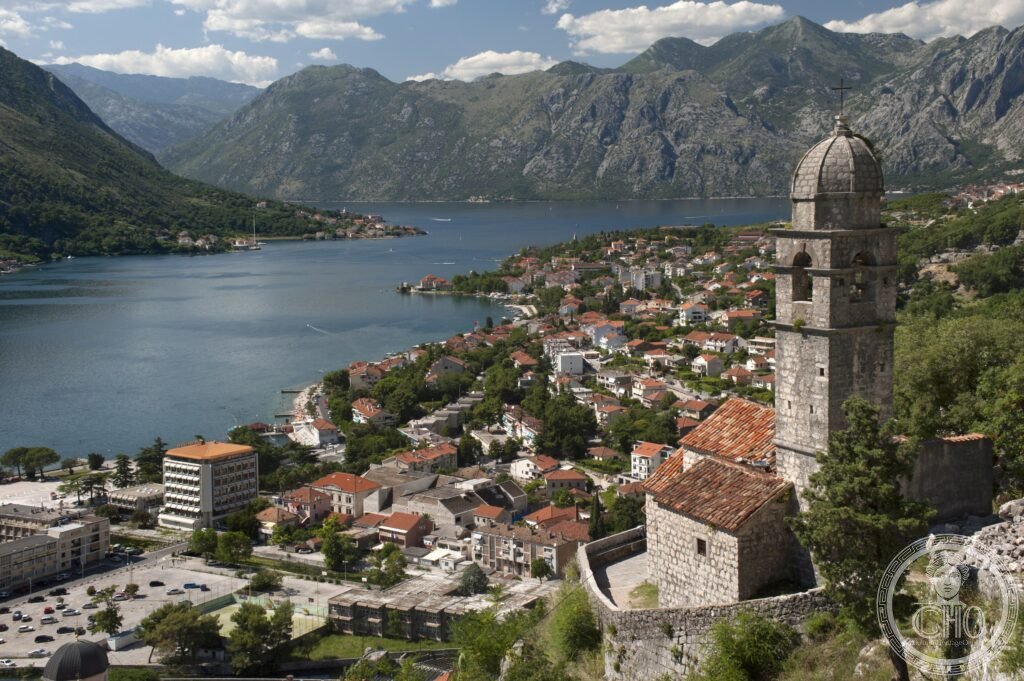
Kotor Old Town
The best-preserved medieval walled city in the eastern Adriatic and one of the most dramatically situated old towns in Europe — Kotor (Bay of Kotor, Montenegro; UNESCO WHS 1979) combines 1,000 years of Venetian, Byzantine, and Serbian ecclesiastical architecture within 3 km of intact medieval walls, at the foot of a vertical mountain that plunges directly into the deepest Adriatic bay.
At a glance
Kotor (the most precisely Kotor single Venetian 1420 1797 Boka Kotorska Bay fjord Adriatic 28km San Giovanni fortress 280m 3km walls 12th century Romanesque Saint Tryphon Cathedral 1166 CE Illyrian Roman Ragusan Venetian French Austrian Yugoslav Montenegrin UNESCO heritage: the geographical setting: the Bay of Kotor (Boka Kotorska; the largest and most complex bay on the Adriatic; 28 km deep; composed of two outer bays and two inner bays separated by the narrow Verige Strait (2.3 km wide); technically a drowned river valley (a ria) rather than a true glacial fjord, though it has the appearance of a fjord; the surrounding mountains (Montenegro in Slavic literally means “Black Mountain”; the mountains rising directly above Kotor reach 1,749m (Lovćen peak) and create the dramatic wall of black rock that defines the city’s setting (the mountain is black when wet and grey when dry; hence the name)); the old town (the medieval walled old town sits on the flat alluvial triangle at the inner corner of the Bay of Kotor where the Šuranj and Garder rivers enter the bay; the three sides of the old town are the medieval walls; the fourth side is the bay; the area inside the walls (1 km²) contains the cathedral, 12 other medieval churches, the bishop’s palace, and the densely packed stone houses of the patrician families who controlled Kotor’s trade for centuries) — the most precisely Kotor single Venetian 1420 1797 Boka Kotorska Bay fjord Adriatic 28km San Giovanni fortress 280m 3km walls 12th century Romanesque Saint Tryphon Cathedral 1166 CE Illyrian Roman Ragusan Venetian French Austrian Yugoslav Montenegrin UNESCO heritage in any UNESCO world heritage site)).
Key facts
- The City Walls: the most precisely Kotor single 3km walls Venetian medieval 14th 15th century San Giovanni fortress 280m 1350 steps view bay Adriatic mountains Montenegro UNESCO heritage — the most impressive surviving fortification system on the eastern Adriatic: the Kotor city walls (3 km total circumference; up to 15m high and 4.5m thick; the construction spans 900 years (from Byzantine foundations in the 6th century CE through the final Venetian additions of the 17th century CE); the walls climb from the bay directly up the cliff face of Mount Lovćen to a height of 280m (the fortress of San Giovanni at the top)); the stairway to San Giovanni (1350 steps carved into the rock face; the climb takes approximately 30-60 minutes; the view from the fortress at 280m is one of the great panoramas of the Adriatic — the entire Bay of Kotor visible from the inner bay to the Adriatic; cruise ships in the bay below look like bathtub toys from this height; sunset from San Giovanni is the finest view in Montenegro))
- GPS: 42.4236° N, 18.7713° E
History
From Illyrian Acruvium to Venetian Cattaro (the most precisely Kotor single Acruvium Roman Byzantine Ragusan Venetian 1420 Ottoman siege 1538 1657 French 1806 Austrian 1814 Yugoslav 1918 1979 earthquake UNESCO heritage: the historical sequence: the ancient city (the earliest settlement at the site of Kotor was called Acruvium (in Latin; the Illyrian and Roman name); the Romans built the first major city walls; the Byzantine period (535-867 CE); the Serbian medieval period (the Nemanjić dynasty of medieval Serbia controlled Kotor from approximately 1185 CE; the Cathedral of Saint Tryphon (dedicated to the patron saint of Kotor; built 1116 CE; the relics of Saint Tryphon, a 3rd-century CE Christian martyr from Campsada in Phrygia (modern Turkey), were purchased by Kotor merchants in the 9th century CE and brought to the city) was built during this period)); the Ragusan period (1391-1420 CE; Dubrovnik (Ragusa) controlled Kotor from 1391 CE); the Venetian period (1420 CE: the citizens of Kotor voluntarily offered the city to the Venetian Republic to avoid Ottoman attack; the Venetians called the city Cattaro; Venetian control lasted until 1797 CE (the fall of the Venetian Republic to Napoleon); the most important building period (the current old town layout and most of the surviving palaces were built under Venetian rule; the Venetian Lion of St Mark is carved above every city gate)); the Ottoman sieges (the Ottomans besieged Kotor three times (1538, 1657, and 1869 CE) but never took the city; the Venetian garrison and the walls held each time); the 1979 earthquake (April 15, 1979 CE; the Montenegro earthquake (6.9 magnitude; the most destructive earthquake in Balkan history in the 20th century); the old town of Kotor was severely damaged; the UNESCO inscription (1979 CE) was partly motivated by the need for international support for the restoration of the damaged monuments) — the most precisely Kotor single Acruvium Roman Byzantine Ragusan Venetian 1420 Ottoman siege 1538 1657 French 1806 Austrian 1814 Yugoslav 1918 1979 earthquake UNESCO heritage in any UNESCO world heritage site)).
What you see
Cathedral, gates, and the fortress climb (the most precisely Kotor single Cathedral Saint Tryphon Romanesque 1166 CE twin towers relics Treasury Sea Gate Clock Tower Square of Arms palace Bishop palaces San Giovanni fortress 1350 steps bay view UNESCO heritage: the visitor highlights: the Sea Gate (the main entrance to the old town from the bay; a triple-arched gate; the Venetian lion above the central arch; the clock tower (17th century CE) in the square behind the gate; the Piazza delle Armi (the Square of Arms; the largest public space in the old town; the principal gathering point; the arms stored here for the militia that defended the walls)); the Cathedral of Saint Tryphon (the most important Romanesque building in Montenegro; the twin towers with their Baroque-era stone caps; the interior (the 12th-century CE Romanesque nave; the 14th-century CE Gothic ciborium (the canopy above the high altar); the Treasury of the Cathedral (one of the finest collections of Byzantine and Western medieval goldsmithing in the Adriatic region; the reliquary bust of Saint Tryphon (13th century CE gilt-silver; one of the most important pieces of Byzantine silversmithing in Montenegro; the relics of the saint inside)); the San Giovanni fortress (the 1350-step stairway up the cliff face; 30-60 min climb; the ruined fortress at 280m; the panoramic view of the Bay of Kotor from a height); the cats (Kotor is famous for its large population of street cats — the local tradition holds that cats brought good luck to the sailors of Kotor; a cat museum in the old town (the Museum of Kotor Cats) celebrates this tradition) — the most precisely Kotor single Cathedral Saint Tryphon Romanesque 1166 CE twin towers relics Treasury Sea Gate Clock Tower Square of Arms palace Bishop palaces San Giovanni fortress 1350 steps bay view UNESCO heritage in any UNESCO world heritage site)).
Practical information
- Getting there: Tivat Airport (TIV; 8 km south of Kotor; direct flights from London (LGW/STN; easyJet, Ryanair; 3h15m), Vienna (VIE; Austrian Airlines; 2h), Frankfurt (FRA; Lufthansa; 2h), Moscow (SVO; Aeroflot; 2h30m)); Podgorica Airport (TGD; 80 km northeast; more international connections but further from Kotor; taxi to Kotor 1h20m approximately €60)); from Dubrovnik (Dubrovnik Airport (DBV); 55 km south of Kotor; the most popular travel combination: Dubrovnik-Kotor-Budva; 1h15m by car or bus along the spectacular Adriatic coastal road (the Jadranska magistrala)); the old town (the entire UNESCO walled city is car-free; the walls are easy to walk (3 km circumference); the Sea Gate entrance is the main access; cruise ships dock in the bay and bring large numbers of tourists daily in July-August (the old town can be very crowded 10:00-16:00; arrive early or visit in the evening when cruise passengers have left)); entry fee for the city walls/fortress (approximately €8 per person; the wall circuit is separate from the cathedral (€3) and other museums))
Getting there
Tivat (TIV, 8 km) or Dubrovnik (DBV, 55 km). Old town car-free. Walls circuit ~€8. Best May-June and September (cruise ship crowds in July-Aug). GPS: 42.4236, 18.7713.
Nearby
- Our Lady of the Rocks — 9 km across the bay (Perast; the man-made island with the baroque church; the island was created over 200 years by Perast sailors who piled rocks around a submerged reef each time they returned safely from sea; now a small artificial island with a 17th-century CE baroque church and a painting collection donated by seafarers (ex-voto style); boat trips from Perast (5 min))
- Budva Old Town — 25 km south (the resort town of Montenegro; the Venetian walls enclosing the old town on a small peninsula; popular beaches; the nightlife of Budva is the liveliest on the Montenegrin coast)
Sources
- Wikipedia, Kotor; Bay of Kotor; Cathedral of Saint Tryphon, accessed June 2026
- UNESCO, Natural and Culturo-Historical Region of Kotor, WHS reference 125, inscribed 1979
Find it on the map
See this place and what’s around it →📷 Diventa un fotografo di Cultural Heritage Online
Condividi le tue foto dei luoghi: restano pubblicate con la tua firma come autore. Più vengono viste, più ti fai conoscere — e presto un concorso premierà le foto più apprezzate.
Accedi o registrati gratis per aggiungere una foto