
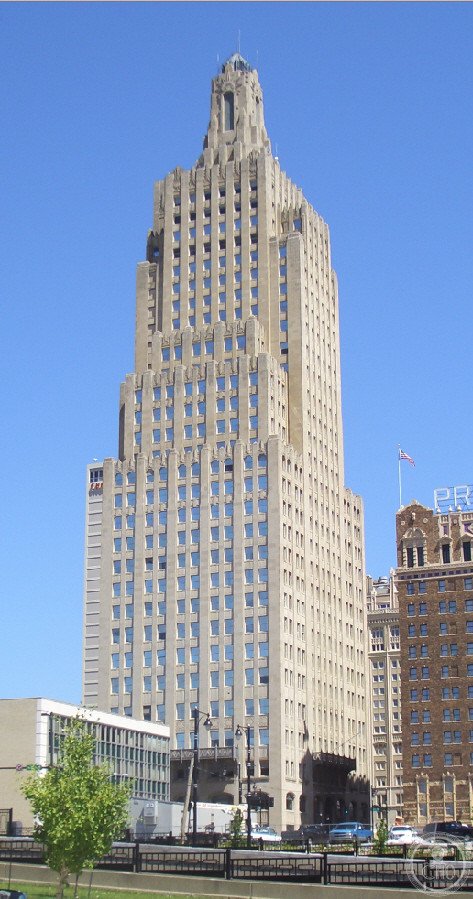
Few American skyscrapers of the interwar period achieved the iconic status of the Kansas City Power and Light Building. Completed in 1931 at the height of Art Deco ambition, this landmark tower was commissioned by Joseph F. Porter, president of Kansas City Power and Light, as both a corporate headquarters and a civic statement of economic confidence during the Depression years. Upon its completion it became the tallest building west of the Mississippi River, a title it held for three decades. Its most celebrated feature is the illuminated lantern crown, which bathes the Kansas City skyline in warm light each evening—an image so embedded in the city’s identity that it appears on promotional materials for the entire Power and Light District that grew up around it. The building remains one of the defining works of Midwest Art Deco, a monument to the era’s belief that commerce and beauty need not be in conflict.
At a glance
- Type
- Commercial skyscraper / Corporate landmark
- Period
- Completed 1931
- Style
- Art Deco
- Location
- Downtown Kansas City, Missouri, USA
- Coordinates
- 39.0975° N, 94.5847° W
- Architect(s)
- Hoit, Price & Barnes
Overview
The Kansas City Power and Light Building (also known as the KCP&L Building) rises in downtown Kansas City as one of the city’s most recognisable landmarks. Commissioned in 1931 to promote economic activity and project corporate confidence, the tower was designed by the local firm Hoit, Price & Barnes in a fully realised Art Deco idiom. At 476 feet upon completion it claimed the record as the tallest structure west of the Mississippi—a title that stood until the Space Needle’s completion in 1962. Its glowing crown at night has made it the unofficial symbol of the Power and Light entertainment district that developed around it.
History
The building was the project of Joseph F. Porter, an Edison Pioneer and president of Kansas City Power and Light, who conceived it as a generator of civic pride and economic activity at a moment when the United States was entering the Great Depression. Construction was completed in 1931, the same year as the Empire State Building, situating it within the final, triumphant wave of pre-Depression American skyscraper construction. For three decades it dominated the regional skyline, a visual claim to the importance of Kansas City as a Midwest commercial centre. As the Power and Light District was developed in the 2000s, the building’s illuminated crown became the district’s emblem, linking the city’s architectural heritage to its contemporary entertainment economy.
Architecture & Design
Hoit, Price & Barnes designed the tower with the characteristic Art Deco syntax of setbacks, vertical piers, and ornamental crowning that distinguished the style’s skyscraper applications. The lower floors feature a richly detailed limestone base with stylised geometric and naturalistic ornament; the shaft rises through a series of setbacks that accentuate the building’s verticality. The building’s defining element is its illuminated lantern crown, designed to be lit at night, transforming the tower from a daytime commercial building into a nocturnal beacon. The east facade directly addresses the Power and Light District, ensuring the landmark’s relationship with its urban surroundings remains legible from street level.
Cultural significance
The Kansas City Power and Light Building anchors the regional identity of Art Deco in the American Midwest. Kansas City built one of the nation’s finest concentrations of Art Deco architecture during the 1920s and 1930s, and this tower is the style’s most prominent expression in the city’s skyline. Its illuminated crown has become as recognisable a city symbol as the fountains for which Kansas City is famous. The building’s story—a Depression-era commission intended to create jobs and project optimism—also encapsulates the civic ambitions that drove American urbanism during the interwar period.
Visiting today
The building operates primarily as office space and is best experienced from the street and from the Power and Light District plaza to the east. The illuminated crown is most spectacular after dark and can be viewed from multiple vantage points across downtown. The surrounding Power and Light District offers restaurants, bars, and entertainment venues within a few minutes’ walk. Guided architectural walking tours of downtown Kansas City Art Deco frequently include the building as a centrepiece stop.
Getting there
The building stands in the heart of downtown Kansas City, Missouri, bounded by 12th Street, Baltimore Avenue, and Main Street. The KC Streetcar Main Street line stops at 11th & Main, one block away. By car, downtown Kansas City is easily reached via I-70 or I-35; public parking garages are available in the Power and Light District. Kansas City International Airport (MCI) is approximately 18 miles northwest; rental car, shuttle, and rideshare services connect the airport to downtown.
Sources & resources
Find it on the map
See this place and what’s around it →Record researched and written by Luigi De Marchi for Cultural Heritage Online, 2026.
📷 Become a Cultural Heritage Online photographer
Share your photos of places: they stay published under your name as the author. The more they're seen, the more you get noticed — and soon a contest will reward the most appreciated photos.
Log in or sign up free to add a photoIs this page about you?
This page is read by travellers and heritage enthusiasts who find it on Google. Tell us how you are connected to this place and we will take it from there.