
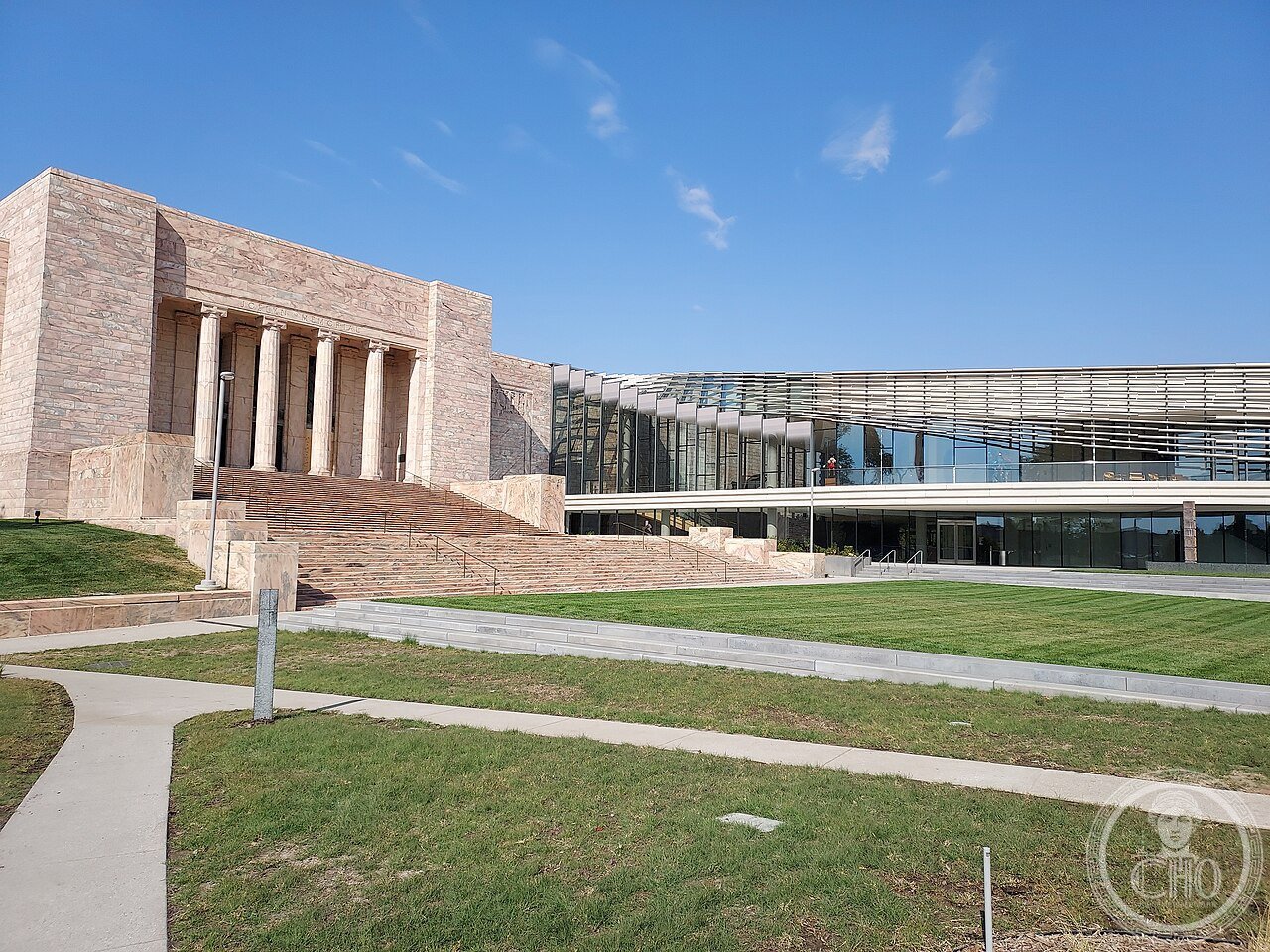
The Joslyn Art Museum stands on the edge of midtown Omaha like a temple dropped from a more glamorous civilization: 32,000 square metres of pink Georgia marble, its facades carved with stylized Art Deco figures and floral medallions, its bronze entrance gates gleaming in the flat Nebraska light. Sarah Joslyn built it in 1931 as a memorial to her husband George, the newspaper magnate who had made Omaha his empire — and she built it to rival anything in the East. Architects John and Alan McDonald gave her a building whose Art Deco ornament sits in formal tension with a classical symmetrical plan, creating a kind of renegade Beaux-Arts hybrid unique in the American Midwest. Inside, an acoustically superb concert hall serves the performing arts, while the permanent collection ranges from European old masters and nineteenth-century American landscapes to the finest collection of Karl Bodmer watercolors in the world — images of Missouri River Indigenous peoples painted in the 1830s that have no equal as documentary art.
At a glance
- Type
- Art Museum
- Period
- 1931
- Style
- Art Deco with Beaux-Arts classical plan
- Location
- Omaha, Nebraska, USA
- Coordinates
- 41.2572° N, 95.9622° W
- Architect(s)
- John and Alan McDonald
Overview
The Joslyn Art Museum occupies a full city block on Dodge Street in midtown Omaha. The original 1931 structure — the Memorial Building — is clad throughout in pink Georgia marble, with Art Deco bas-relief friezes running the full length of the facades. A 1994 expansion by Norman Foster added a modern pavilion and atrium that tripled gallery space without competing with the original. The museum holds approximately 11,500 objects spanning five millennia, with particular strengths in nineteenth-century American and European paintings, ancient art, and the unrivalled Bodmer collection. The Scott Pavilion concert hall hosts chamber music and recitals; its acoustic profile is regarded as exceptional. Free admission on Sundays; otherwise ticketed.
History
George Joslyn arrived in Omaha in the 1880s and built the Western Newspaper Union into the dominant force in American small-town newspaper publishing. When he died in 1916, his wife Sarah inherited an estate estimated at $20 million. She spent the next decade planning a memorial institution that would give Omaha a world-class cultural anchor. The architects McDonald were selected through competition; the building was dedicated on 30 October 1931, just two years after the stock market crash. Sarah Joslyn attended the opening — she had funded the entire construction personally. The museum struggled financially through the Depression but survived on the original endowment. The 1994 Foster expansion transformed it into a regional anchor institution, drawing visitors from across the Great Plains. A second expansion completed in 2023 added further gallery and conservation space.
Architecture & Design
McDonald designed the Memorial Building on a symmetrical H-plan — a classical move — but dressed every surface in Art Deco vocabulary. The exterior features continuous carved friezes of stylized human figures, geometric banding, and floral medallions in the Georgia marble. The bronze entrance gates carry the same grammar at a smaller scale. Inside, the concert hall is the most architecturally resolved space: a double-height room with coffered ceiling, Deco-profile mouldings, and a stage flanked by bronze organ pipes. The gallery sequence is more restrained, with high ceilings, oak floors, and top-lit rooms designed to show paintings without competing with them. The Foster pavilion responds to the pink marble with warm limestone and a glass atrium spine that floods the connection point with diffuse Nebraska light.
Cultural significance
The Joslyn is the finest Art Deco museum building in the American interior, and its Bodmer collection makes it a site of global importance for the history of Indigenous North America. Karl Bodmer accompanied the German explorer Prince Maximilian of Wied along the Missouri River in 1833–34; his 427 watercolors are the most precise and artistically accomplished visual record of the Mandan, Hidatsa, Lakota, and other nations before the catastrophic smallpox epidemic of 1837 wiped out entire peoples. The Joslyn holds the largest and finest portion of this archive. The building is listed on the National Register of Historic Places.
Visiting today
Open Tuesday–Sunday; closed Monday. Free admission on Sundays. The museum cafe and shop are inside the Foster atrium. The concert hall hosts a regular season of chamber performances — check the schedule before visiting. Allow two to three hours for the permanent collection. The Bodmer galleries require a dedicated visit: the watercolors are small and exquisitely detailed. Parking is available in the museum lot on Davenport Street.
Getting there
Omaha Eppley Airfield (OMA) is 10 km east; taxi or rideshare to the museum is straightforward. The museum is at 2200 Dodge Street in midtown Omaha — accessible by Metro Transit bus routes 2 and 13. Street parking and a dedicated museum lot are available. From downtown Omaha, the museum is a 10-minute drive west on Dodge Street. No direct rail service to Omaha from most US cities; Amtrak serves the city three times weekly.
Sources & resources
Find it on the map
See this place and what’s around it →Record researched and written by Luigi De Marchi for Cultural Heritage Online, 2026.
📷 Become a Cultural Heritage Online photographer
Share your photos of places: they stay published under your name as the author. The more they're seen, the more you get noticed — and soon a contest will reward the most appreciated photos.
Log in or sign up free to add a photoIs this page about you?
This page is read by travellers and heritage enthusiasts who find it on Google. Tell us how you are connected to this place and we will take it from there.