
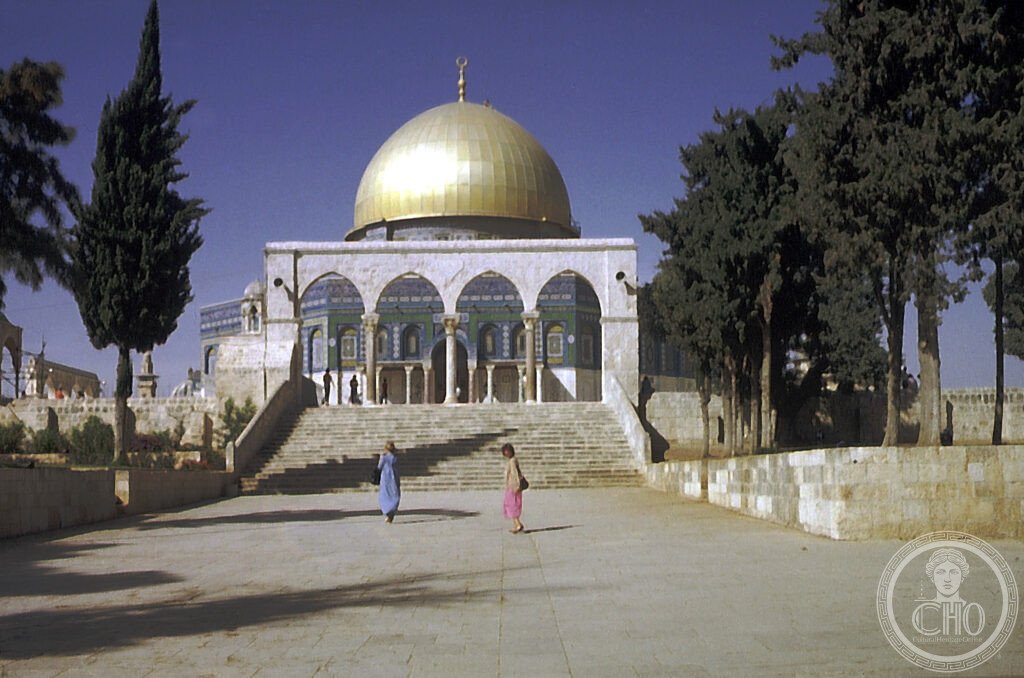
Jerusalem Old City
The walled city that is the geographical centre of three world religions — the Temple Mount where Jewish, Islamic, and Christian traditions locate the point where heaven and earth meet, its 220 hectares containing the Western Wall, the Dome of the Rock, the Church of the Holy Sepulchre, and the Via Dolorosa within a 900-year-old Crusader street plan overlaid on 3,000 years of earlier occupation.
At a glance
The Old City of Jerusalem is the 0.9 km² walled city at the eastern end of modern Jerusalem, enclosed by the Ottoman walls built under Suleiman the Magnificent in 1538–1541. Within these walls, divided into the Jewish, Muslim, Christian, and Armenian Quarters, are concentrated a density of religious and historical monuments unparalleled in any comparable area on earth: the Western Wall (the sole surviving element of the Second Temple platform); the Temple Mount/Haram al-Sharif with the Dome of the Rock (691 AD) and Al-Aqsa Mosque (715 AD); the Church of the Holy Sepulchre (4th century, rebuilt 12th century); and the Via Dolorosa, the traditional route of the Passion. The Old City has been continuously inhabited for at least 5,000 years; it is a UNESCO World Heritage Site (inscribed on the list of Sites in Danger, 1982).
Key facts
- Temple Mount (Jewish) / Haram al-Sharif (Muslim): the 37-acre elevated platform in the south-east corner of the Old City; for Jews, the site of Solomon’s First Temple (c. 950 BC, destroyed 586 BC) and Herod’s Second Temple (completed 20 BC, destroyed 70 AD); for Muslims, the site of the Prophet Muhammad’s Night Journey and the third holiest site in Islam
- Dome of the Rock: built 688–691 AD under the Umayyad Caliph Abd al-Malik ibn Marwan; an octagonal shrine over the rock from which, in Islamic tradition, Muhammad ascended to heaven; the tilework, mosaics, and calligraphy of the interior are among the finest surviving examples of early Islamic art; the gold dome (re-gilded 1994 with 80 kg of gold donated by King Hussein of Jordan) dominates the Jerusalem skyline
- Western Wall (HaKotel): the surviving section of the western retaining wall of Herod’s Temple Mount platform (not the Temple itself); the most sacred accessible site in Judaism; the Wall plaza below was created in 1967 after Israeli forces took the Old City
- Church of the Holy Sepulchre: built by Emperor Constantine over the sites of the Crucifixion (Golgotha) and the Resurrection (the tomb); the current building is the 12th-century Crusader church, incorporating 4th-century Constantinian elements; jointly administered by six Christian communities (Greek Orthodox, Roman Catholic, Armenian, Coptic, Ethiopian, Syriac) under the rules of the Status Quo (an 18th-century Ottoman agreement regulating shared ownership)
- Quarters: the four quarters of the Old City are the Muslim Quarter (largest, north-east), Christian Quarter (north-west, including the Holy Sepulchre), Jewish Quarter (south-east, below the Western Wall), and Armenian Quarter (south-west, the world’s oldest Armenian diaspora community, established 4th century)
- Heritage: UNESCO World Heritage Site (List of World Heritage in Danger), Old City of Jerusalem and its Walls, inscribed 1981, listed in danger 1982
- GPS: 31.7767° N, 35.2345° E
History
Jerusalem’s documented urban history begins c. 3500 BC; the city is first mentioned in Egyptian texts of the 19th century BC. The period of maximum religious significance begins with King David’s establishment of the city as his capital c. 1000 BC and Solomon’s construction of the First Temple c. 950 BC. The First Temple was destroyed by Nebuchadnezzar II of Babylon in 586 BC; the population was deported to Babylon; the temple was rebuilt on the return from exile (completed 516 BC). Herod the Great’s massive expansion of the Temple Mount platform (c. 20 BC–20 AD) created the retaining walls of which the Western Wall is a surviving section; the temple itself was destroyed by the Romans in 70 AD and has never been rebuilt. The site of the Temple’s Holy of Holies is now occupied by the Dome of the Rock, whose precise location over the Foundation Stone is one of the enduring geopolitical flashpoints in the world.
The Crusaders captured Jerusalem in 1099 after a siege and massacre of the Muslim and Jewish population; they rebuilt the Church of the Holy Sepulchre in its current Romanesque-Byzantine form and established the Kingdom of Jerusalem with its capital in the Old City. Saladin retook the city in 1187, largely without violence; the Crusaders retook it in 1229–1244 by negotiation; the Mamluks captured it definitively in 1244. Ottoman control began in 1517; Suleiman the Magnificent built the current city walls (1538–1541) and a network of public fountains. British forces under Allenby entered Jerusalem in 1917, ending four centuries of Ottoman rule; the Mandate period saw increasing Jewish immigration and Arab-Jewish tensions; after the 1948 Arab-Israeli War, the Old City was part of Jordan until Israel captured it in the 1967 Six-Day War.
UNESCO inscribed the Old City as a World Heritage Site in 1981 at the request of Jordan; the United States and Israel are not parties to the relevant UNESCO decision. The site was placed on the List of World Heritage in Danger in 1982 due to the political situation and ongoing construction. The political and legal status of Jerusalem — claimed by both Israel (which considers it its capital) and Palestinians (who claim East Jerusalem, including the Old City, as the capital of a future Palestinian state) — makes this one of the most contested UNESCO sites on earth and the subject of ongoing international legal and diplomatic disputes.
What you see
The Damascus Gate (Bab al-Amud) is the most monumental of the eight city gates, its Ottoman triple-arch facade rising from a Roman-period plaza excavated below street level. Through the gate, the Via Dolorosa runs east to the Church of the Holy Sepulchre, passing through the Muslim Quarter; the Stations of the Cross are marked by plaques on the walls, though their historical locations are uncertain (they were established in the medieval period). The Church of the Holy Sepulchre’s facade is 12th-century Crusader Romanesque; inside, the rotunda over the Edicule (the small structure enclosing the tomb) is the architectural heart of Christianity — the space where, since the 4th century, pilgrims have come to touch the stone where Christ was laid. The Edicule itself was reconstructed in 2016–2017, restoring the marble cladding and the ceiling.
The Temple Mount is accessible to non-Muslims only through the Mughrabi Gate and only during limited hours; on the platform, the Dome of the Rock’s exterior tilework (Suleimanic-period Iznik tiles on the drum, 1545) is followed by the gold dome above; the interior is not accessible to non-Muslims but the exterior circumambulation of the octagon reveals the full programme of the Quranic inscriptions and the Umayyad mosaic on the drum. From the rampart walk on the city walls (accessible from the Jaffa Gate or Damascus Gate), the topography of the Old City — the Temple Mount raised above the Jewish and Muslim Quarters, the Church of the Holy Sepulchre in the valley below — becomes comprehensible in a way that is impossible from within the streets.
Practical information
- Address: Old City of Jerusalem; Jaffa Gate is the main tourist entrance on the west side; Damascus Gate on the north
- Church of the Holy Sepulchre: daily 5 am–8 pm (9 pm in summer); free; extremely crowded on Sundays and Christian holidays; Easter Vigil (Holy Fire ceremony, Holy Saturday) is one of the most intense religious experiences in Christendom
- Temple Mount / Haram al-Sharif: open to non-Muslim visitors Sunday–Thursday, roughly 7:30–11 am and 1:30–2:30 pm (hours change frequently; verify with the Israeli Antiquities Authority or Jerusalem Municipality before visiting); the Dome of the Rock interior is not accessible to non-Muslims; modest dress required, shoes removed
- Western Wall: open 24 hours; men and women have separate sections; head covering required for men (provided); Friday evening prayers are particularly atmospheric
- Ramparts walk: NIS 18; tickets from the Jaffa Gate tourist office; two sections (north and south) give elevated views over the quarters and the Temple Mount
Getting there
Ben Gurion International Airport (TLV), Tel Aviv, is the main entry point; 1 hour by train + light rail to Jerusalem (high-speed rail to Jerusalem Yitzhak Navon station, then 2 stops by light rail to Jaffa Gate). From Tel Aviv by bus: 1 hour (frequent departures from Tel Aviv Central Bus Station). GPS: 31.7767, 35.2345.
Nearby
- Mount of Olives — the ridge immediately east of the Old City across the Kidron Valley; the best panoramic view of the Temple Mount and the Old City is from the summit; the Garden of Gethsemane at the foot of the hill; the Jewish cemetery on the slope (the largest in the world, with graves 3,000 years old) demonstrates the importance attributed to burial near the Temple for the resurrection
- Israel Museum, Jerusalem — includes the Shrine of the Book (housing the Dead Sea Scrolls) and a 1:50 scale model of Jerusalem in the Second Temple period (c. 66 AD); 3 km west of the Old City
- Yad Vashem — the World Holocaust Remembrance Center; the architectural sequence of the memorial museum designed by Moshe Safdie; 5 km west of the Old City
- Masada — the Herodian fortress on the Dead Sea escarpment where Jewish Zealots made their last stand against Rome in 73–74 AD; UNESCO WHS; 90 km south-east of Jerusalem
Sources
- Wikipedia, Old City of Jerusalem, accessed June 2026
- UNESCO, Old City of Jerusalem and its Walls, WHS reference 148, inscribed 1981 / listed in danger 1982
- Simon Sebag Montefiore, Jerusalem: The Biography, Weidenfeld & Nicolson, 2011 — the most comprehensive single-volume history
Find it on the map
See this place and what’s around it →📷 Diventa un fotografo di Cultural Heritage Online
Condividi le tue foto dei luoghi: restano pubblicate con la tua firma come autore. Più vengono viste, più ti fai conoscere — e presto un concorso premierà le foto più apprezzate.
Accedi o registrati gratis per aggiungere una foto