
Ephesus — Turkey
The best-preserved classical city in the Eastern Mediterranean — at its peak under Rome the third-largest city in the empire, with 250,000 inhabitants, a marble-paved main street, a library that held 12,000 scrolls, a theatre for 25,000 people, and a temple to Artemis that was one of the Seven Wonders of the World.
At a glance
Ephesus (Turkish: Efes) is an ancient Greek city on the coast of Ionia in western Turkey, near the modern town of Selçuk in Izmir Province. It was one of the twelve cities of the Ionian League; under the Roman Empire it was the capital of the province of Asia and at its peak in the 1st–2nd centuries AD one of the three largest cities in the empire (after Rome and Alexandria), with a population estimated at 200,000–250,000. The excavated site covers approximately 3 km² of the ancient city centre; the Library of Celsus, the Theatre, the Curetes Street with its marble paving and decorated facades, the Terrace Houses (insulae with intact mosaics and frescoes), and the Temple of Hadrian are the principal monuments. Ephesus is part of the UNESCO World Heritage Site of Ephesus, inscribed 2015.
Key facts
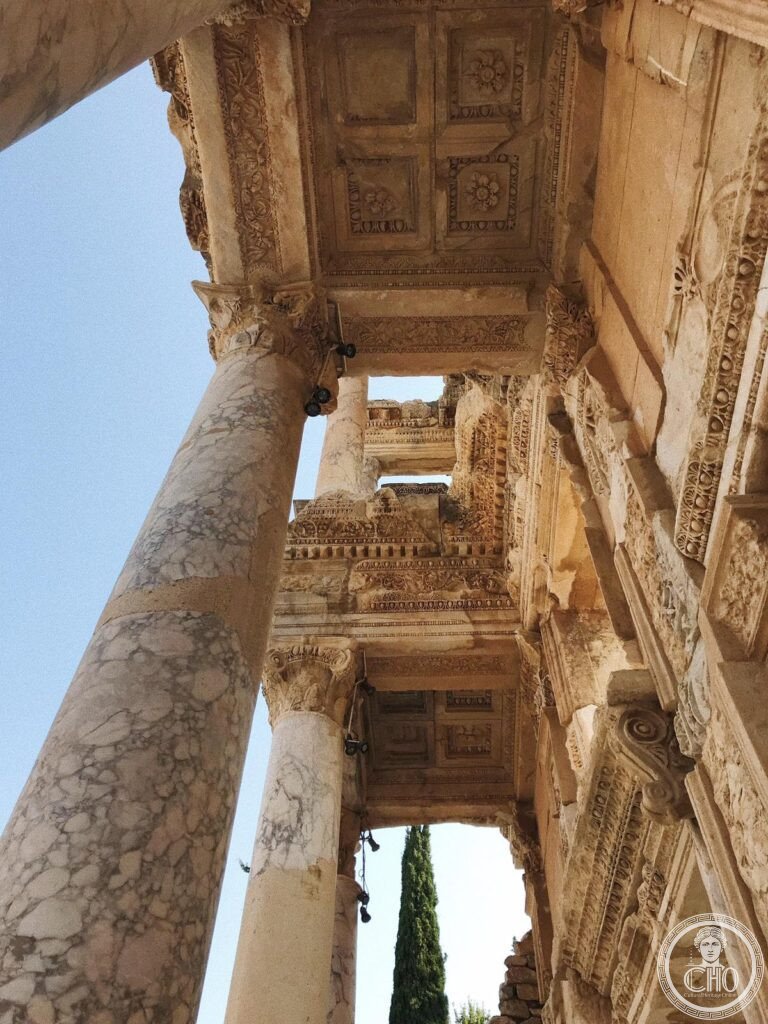
- Library of Celsus: built 110–135 AD as the mausoleum and memorial of the Roman governor of Asia Tiberius Julius Celsus; held approximately 12,000 scrolls in niches in the walls (with a double-wall construction to prevent humidity damage); the four female statues in the facade niches represent Sophia (Wisdom), Arete (Virtue), Ennoia (Thought), and Episteme (Knowledge); the facade was reconstructed 1970–1978 from the fallen stones
- Great Theatre: originally Hellenistic (3rd century BC), expanded under the Romans to seat 25,000; carved into the slope of Mount Pion; the stage building three storeys high; still used for the Ephesus International Festival; the Acts of the Apostles records a riot against St Paul in this theatre
- Temple of Artemis: one of the Seven Wonders of the Ancient World; its final form (c. 323 BC) measured 115 × 55 metres with 127 Ionic columns 19 metres tall; largely destroyed and the marble used for building material in the Byzantine period; the single reconstructed column and fragments in the site museum are all that remains above ground
- Terrace Houses (Yamaçevler): six multi-storey Roman apartment blocks on the south slope above the Curetes Street, inhabited from the 1st to 7th centuries AD; preserved by collapse debris rather than burial; contain the best-preserved Roman-period wall paintings and floor mosaics in Turkey; require a separate ticket
- St John’s Basilica: the 6th-century Byzantine basilica on the Hill of Ayasuluk above Selçuk, built by Justinian I over the supposed tomb of St John the Evangelist; one of the largest churches in the ancient world; partially restored
- Heritage: UNESCO World Heritage Site, inscribed 2015
- GPS: 37.9395° N, 27.3417° E
History
Ephesus was founded c. 1000 BC by Ionian Greek colonists, according to tradition under the leadership of Androklos, son of the Athenian king Codrus, who killed a boar on the site as interpreted by the Delphic oracle. The earliest city was on the coast; successive silting of the harbour mouth and the consequent economic decline led to repeated relocations of the city centre over the centuries. The Temple of Artemis — the first version dating from the 8th century BC, the final (Seven Wonders) version from the 4th century BC — was the economic and religious centre of the region, drawing pilgrims and trade from across the Greek world and ensuring that Ephesus remained wealthy regardless of which empire it was part of (Lydian, Persian, Macedonian, Pergamene, Roman).
Ephesus reached its maximum size and prosperity under the Roman Empire, particularly in the 1st–2nd centuries AD. The city’s role as the capital of the province of Asia (essentially all of western Turkey) and as the principal port of the Aegean made it the commercial and administrative hub of Rome’s most prosperous province. It is in this context that the New Testament references to Ephesus — St Paul’s letters to the Ephesians, the riot in the theatre described in the Acts of the Apostles, and the vision in the Book of Revelation — occur: Ephesus was one of the Seven Churches of Asia addressed in the Revelation. The Council of Ephesus (431 AD), held in the city’s great basilica, was the third ecumenical council of the Christian church, at which the title “Theotokos” (Mother of God) for the Virgin Mary was confirmed.
The progressive silting of the harbour — the city is now 5 km from the sea — led to economic decline from the 4th century onward; the city population had dropped dramatically by the 7th century. Arab raids from 654 AD and an earthquake in 614 AD accelerated the decline; the final occupation layers date from the 7th–8th centuries. The remains were progressively excavated by the Austrian Archaeological Institute from 1895, with significant work continuing today; major ongoing projects include the Terrace Houses conservation programme and the excavation of the harbour area.
What you see
The standard visit descends from the upper entrance (Magnesia Gate) along the Curetes Street to the Library of Celsus. The street is paved in marble with original inscriptions, drain covers, and the footprints of advertising columns; the facades of temples, fountains, and public buildings flank it. The Hercules Gate, the Fountain of Trajan (its two-storey basin still partially standing), and the Temple of Hadrian (an elegant early 2nd-century facade with a relief of the city’s founding and a remarkable Medusa arch) are the highlights of the street before the Library.
The Library of Celsus facade is the most photographed image in Turkey after Hagia Sophia and the Blue Mosque: its two-storey screen of coupled Corinthian columns, the four niches with their female personifications, and the grand broken pediment above the central door create a composition of great sophistication. The lower storey was the entrance to the reading room; below the floor of the apse is the marble sarcophagus of Celsus himself. From the Library, the lower agora (commercial market) leads to the Great Theatre, whose cavea carved into the hillside gives the best vantage point over the entire site.
Practical information
- Location: 3 km south-west of Selçuk town; the site has two entrances (upper and lower); most tours enter upper and exit lower, then take a shuttle back
- Hours: daily 8 am–7 pm (May–Oct); 8 am–5 pm (Nov–Apr)
- Admission: TRY 750 (approximately EUR 22); Terrace Houses TRY 350 additional (essential — don’t skip)
- Timing: arrive at opening (8 am) to avoid the cruise-ship crowds that arrive from Kuşadası from 10 am; the site is extremely crowded 10 am–4 pm in peak season (May–September)
- Combine with: the Ephesus Museum in Selçuk (excellent finds including the Artemis of Ephesus statues and inscriptions); the Basilica of St John on Ayasuluk Hill above Selçuk (same ticket)
Getting there
Izmir Adnan Menderes Airport (ADB) is the nearest international airport; 1 hour by train (TCDD Banliyö) or 1.5 hours by bus to Selçuk. From Selçuk, dolmuş or taxi to the site (3 km). Kuşadası, the nearest resort town and cruise port, is 17 km south (20 minutes). GPS: 37.9395, 27.3417.
Nearby
- Pamukkale / Hierapolis — the calcite terraces and Roman spa city 200 km east of Ephesus; the Roman theatre, necropolis, and Frontinus Gate at Hierapolis; the travertine pools are swimmable; UNESCO WHS; 2.5 hours by bus
- Priene — the well-preserved Hellenistic planned city on a hillside above the Büyük Menderes plain; the grid plan, agora, theatre, and Temple of Athena columns are largely intact; far less visited than Ephesus; 40 km south
- Miletus — the Ionian city that was Ephesus’s great rival; the Roman theatre (15,000 seats) is the best-preserved monument; the Didyma Temple of Apollo (one of the largest Greek temples ever built) is 20 km south of Miletus
- Kuşadası — the Aegean resort town and cruise port; beach access and boat trips to the Greek islands; 17 km south of Ephesus
Sources
- Wikipedia, Ephesus, accessed June 2026
- UNESCO, Ephesus, WHS reference 1018bis, inscribed 2015
- Austrian Archaeological Institute, Ephesus Excavations: oeai.at/ephesos
- Clive Foss, Ephesus after Antiquity, Cambridge University Press, 1979
Find it on the map
See this place and what’s around it →📷 Diventa un fotografo di Cultural Heritage Online
Condividi le tue foto dei luoghi: restano pubblicate con la tua firma come autore. Più vengono viste, più ti fai conoscere — e presto un concorso premierà le foto più apprezzate.
Accedi o registrati gratis per aggiungere una foto