
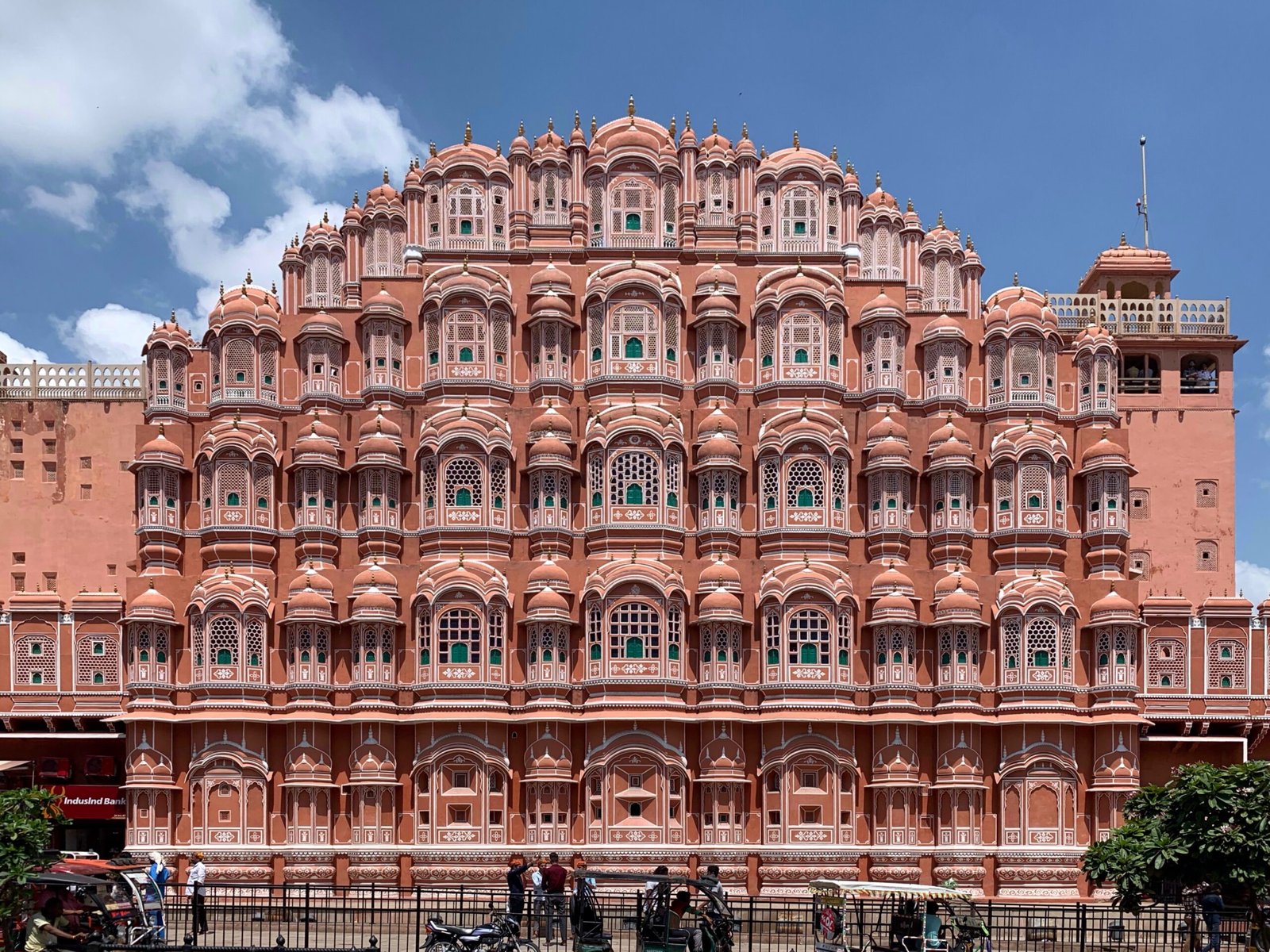
Jaipur City, Rajasthan
The Pink City of Jaipur is one of the earliest purpose-planned cities in India — an 18th-century grid of nine sectors laid out by astronomer-king Jai Singh II, its terracotta-pink facades frozen in time by royal decree, its skyline pierced by the honeycomb facade of the Hawa Mahal and the stone sundials of the Jantar Mantar observatory. UNESCO World Heritage Site since 2019.
At a glance
Founded in 1727 CE by Maharaja Jai Singh II of the Kachwaha Rajput dynasty, Jaipur was conceived as a new capital designed according to the ancient Sanskrit principles of Vastu Shastra and Shilpa Shastra. The rectangular walled city is divided into nine sectors by broad streets oriented along cardinal directions — an urban geometry almost unparalleled in India’s historic cities. The characteristic pink colour dates from 1876, when the entire city was painted terracotta-pink to welcome the Prince of Wales; a municipal ordinance has required the colour ever since. The historic walled city was inscribed as a UNESCO World Heritage Site in 2019 under criteria (ii), (iv), and (vi).
Key facts
- Founded: 1727 CE by Maharaja Jai Singh II, Kachwaha Rajput dynasty
- UNESCO inscription: 2019, criteria (ii)(iv)(vi)
- Elevation: approximately 431 metres above sea level
- Urban plan: Nine-sector rectangular grid, Vastu Shastra principles
- Pink colour origin: 1876 royal order for Prince Albert’s visit; maintained by city ordinance
- Population: over 3 million — capital of Rajasthan
History
Before Jaipur, the Kachwaha Rajput seat was Amber Fort, 11 km to the north in a narrow mountain valley. By the early 18th century Maharaja Jai Singh II — equally accomplished as a warrior, diplomat, and scientist — decided to build a new capital on the open plain below. He recruited the Bengali architect Vidyadhar Bhattacharya to design the city according to classical Sanskrit treatises, adapting their principles to local terrain. Construction began around 1727 and was substantially complete within a decade.
Jai Singh II was one of the most learned rulers of his era — he corresponded with European astronomers, built five Jantar Mantar observatories across India, and was versed in Ptolemaic, Islamic, and Hindu astronomical traditions. His Jaipur observatory, completed in 1734, remains the largest and best-preserved of the five. The Kachwaha dynasty maintained a complex relationship with Mughal power while preserving Rajput architectural and cultural identity.
The 1876 pink painting order came from Maharaja Ram Singh II, who had the entire walled city coated terracotta-pink for an elaborate reception for Prince Albert of Wales. The colour became so associated with Jaipur’s identity that city law now mandates it for buildings in the historic core. The UNESCO inscription in 2019 recognised the city’s exceptional urban planning integrity and its continuity as a living historic city.
What you see
Hawa Mahal, 1799: The Palace of the Winds — a five-story street facade of 953 small latticed windows with semi-octagonal stone balconies, built so that royal women could observe street festivals from behind a screen without being seen. It is essentially an elaborate curtain wall rather than a palace with interior rooms, designed by architect Lal Chand Usta as an extension of the City Palace.
City Palace, 1729 onwards: The royal residence of the Kachwaha maharajas, still partially occupied by the royal family. The complex opens to the public through museum galleries — including the 1902 Sawai Madho Singh II silver urns, two hand-hammered sterling-silver vessels of 340 litres each, filled with Ganges water for the maharaja’s voyage to England to maintain ritual purity. These are among the world’s largest silver objects.
Jantar Mantar, 1734: A monumental stone astronomical observatory with 19 architectural instruments. The Samrat Yantra — a right-triangle sundial 27 metres tall — is the world’s largest sundial, accurate to 2 seconds. The Jantar Mantar is also a separate UNESCO inscription from 2010.
The walled city bazaars: Johari Bazaar for gems and jewellery, Kishanpole Bazaar for lac bangles and lacquerware, and Bapu Bazaar for block-printed textiles. Jaipur is India’s largest gem-cutting and jewellery centre.
Practical information
- Getting in: Jaipur International Airport with domestic and international flights; Jaipur Junction railway station, major hub 5 hours from Delhi by express train
- City tour: Walled city walkable in sections; auto-rickshaws and cycle-rickshaws for the bazaars; major monuments within 2 km of each other
- Entry fees: Most monuments charge separately; composite Rajasthan ticket covers several sites
- Best time: October to March, mild 10 to 25 degrees C; avoid April to June heat; July to September is monsoon
- Dress code: Modest dress required at City Palace and religious sites
Getting there
Jaipur is well connected by air, rail, and road from Delhi and Mumbai. The Shatabdi and Vande Bharat express trains from Delhi take approximately 4 to 5 hours. Direct flights serve Delhi, Mumbai, Bangalore, and several international hubs. The Golden Triangle tourist circuit — Delhi, Agra, and Jaipur — is one of India’s most travelled itineraries; Agra is 240 km east of Jaipur.
Nearby
- Amber Fort — 11 km north; the original Kachwaha Rajput fortress-palace, a UNESCO WHS reached by jeep up the hillside
- Nahargarh Fort — 19 km northwest on the ridge above the city; panoramic views, especially at sunset
- Abhaneri Step Well — 95 km east; a 10th-century step well with 3,500 narrow steps descending 20 metres in a geometric lattice, one of the most photogenic in Rajasthan
- Agra — 240 km east; Taj Mahal and Agra Fort, part of the Golden Triangle circuit
Sources
Find it on the map
See this place and what’s around it →📷 Diventa un fotografo di Cultural Heritage Online
Condividi le tue foto dei luoghi: restano pubblicate con la tua firma come autore. Più vengono viste, più ti fai conoscere — e presto un concorso premierà le foto più apprezzate.
Accedi o registrati gratis per aggiungere una foto