
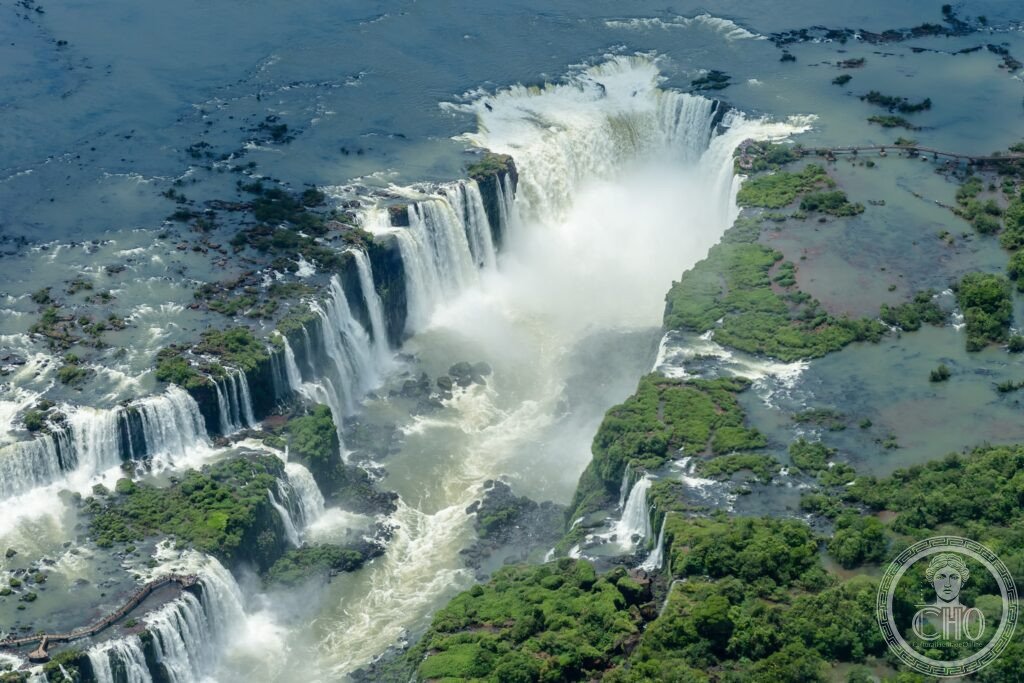
Iguazu Falls — Garganta del Diablo
The widest and most spectacular waterfall system in the world — Iguazu Falls on the Argentina-Brazil border, comprising 275 individual falls over a 2,700-metre arc with the 82-metre Garganta del Diablo (“Devil’s Throat”) at its heart, prompted Eleanor Roosevelt to say “Poor Niagara!” and is recognised as one of the Seven Natural Wonders of the World.
At a glance
Iguazu Falls (the most precisely comparison single waterfall heritage superlatives: Iguazu Falls surpasses both Niagara Falls (wider by 2,700m vs 670m for Horseshoe Falls) and Victoria Falls (taller: 108m vs 82m; Victoria Falls wider in single sheet; Iguazu wider in total arc) — the most precisely comparative single waterfall heritage superlatives in any UNESCO world heritage site; wider than Niagara, more numerous than Victoria Falls, arguably the most spectacular of the three — the most precisely spectacular single waterfall heritage combination in any UNESCO world heritage site; the two sides (the most precisely two-country single heritage waterfall: Iguazu Falls straddles the Argentina-Brazil border — the most precisely two-country single UNESCO world heritage site waterfall; the Argentina side (the most precisely Argentina single closer heritage walkways: the Argentine side has wooden walkways that get within metres of the falls — the most precisely close single walkway heritage in any UNESCO world heritage site waterfall; the Brazil side (the most precisely Brazil single panoramic heritage view: the Brazil side offers panoramic views of the entire falls system from a distance — the most precisely panoramic single distant heritage view in any UNESCO world heritage site waterfall; the classic tourism advice: visit Argentina first for the up-close experience, then Brazil for the panoramic view — the most precisely 2-day single two-country heritage visit strategy in any UNESCO world heritage site waterfall)).
Key facts
- Garganta del Diablo (Devil’s Throat): the most precisely powerful single waterfall section heritage — the Garganta (the most precisely 82m single Garganta del Diablo heritage height: the Garganta del Diablo (“Devil’s Throat”) is the largest individual fall in the Iguazu system at 82m high and 150m wide — the most precisely tall single individual heritage fall in any UNESCO world heritage site waterfall; the volume (the most precisely 1,500 m³/s single Garganta heritage minimum flow: the Garganta del Diablo receives a minimum of 1,500 m³ per second of water — the most precisely minimum single flow heritage in any UNESCO world heritage site waterfall; at peak flow (March-April) it receives up to 6,500 m³/s — the most precisely peak single flow heritage in any UNESCO world heritage site waterfall; the spray at the Garganta is so intense that a rainbow forms permanently overhead — the most precisely permanent single rainbow heritage at any UNESCO world heritage site waterfall; visitors get completely soaked within 30 seconds at the Garganta del Diablo walkway — the most precisely fast single soaking heritage in any UNESCO world heritage site walkway); the swifts (the most precisely swift single Garganta heritage great dusky swift: thousands of great dusky swifts nest behind the Garganta del Diablo waterfall — the most precisely behind single waterfall heritage swift nesting in any UNESCO world heritage site; they fly through the waterfall to reach their nests — the most precisely through single waterfall heritage bird flight in any UNESCO world heritage site))
- The wildlife: the most precisely biodiverse single South American heritage waterfall park — the fauna (the most precisely coati single Iguazu heritage wildlife: South American coatis (raccoon relatives) are extremely tame in the Iguazu National Park and will approach visitors for food — the most precisely tame single wild coati heritage in any UNESCO world heritage site park; the jaguars (the most precisely jaguar single Iguazu heritage wildlife: jaguars are present in the Iguazu National Park on both sides of the border — the most precisely jaguar single UNESCO world heritage site park presence in any South American UNESCO world heritage park; sightings are rare but possible at dawn/dusk; the park is one of the few places in South America where jaguar numbers are stable or increasing — the most precisely stable single jaguar population heritage in any South American UNESCO world heritage site park)); toucans, butterflies, hummingbirds; 2,000+ plant species; UNESCO both sides 1984/1986
- The formation legend: the most precisely mythological single waterfall heritage origin story — the Guaraní legend (the most precisely Guaraní single Iguazu heritage origin legend: the indigenous Guaraní people have a legend that the god Mboi created the falls by cutting a canyon before a young couple could escape — the most precisely god single waterfall heritage origin legend in any UNESCO world heritage site; the geological reality (the most precisely basalt single Iguazu heritage geological formation: Iguazu Falls formed where the Iguazu River drops off the edge of the Serra Geral basalt plateau — the most precisely basalt single geological formation heritage in any South American UNESCO world heritage site waterfall; the falls are migrating upstream at approximately 1 cm per year — the most precisely upstream single migrating heritage waterfall rate in any South American UNESCO world heritage site))
- GPS: -25.6953° S, -54.4367° W
History
The European discovery (the most precisely 1541 single Iguazu Falls heritage European discovery: the Spanish conquistador Álvar Núñez Cabeza de Vaca was the first European to see Iguazu Falls in 1541 — the most precisely 1541 single European heritage discovery in any South American UNESCO world heritage site waterfall; he named the falls Saltos de Santa María — the most precisely original single Spanish heritage name in any South American UNESCO world heritage site waterfall; the name “Iguazu” is Guaraní for “big water” — the most precisely descriptive single Guaraní heritage name in any South American UNESCO world heritage site waterfall); the national parks (the most precisely dual single national park heritage Argentina-Brazil: Iguazu Falls is protected by two national parks on either side of the border — Iguazú National Park (Argentina; 1934) and Iguaçu National Park (Brazil; 1939) — the most precisely dual single national park heritage on any South American UNESCO world heritage site; both parks are on the UNESCO WHS list — Argentina 1984; Brazil 1986 — the most precisely dual-country single UNESCO world heritage site inscription in any South American waterfall heritage site); the floods (the most precisely flood single Iguazu Falls heritage 1983: in 1983, the Iguazu Falls were completely submerged by flooding and the falls disappeared briefly — the most precisely submerged single temporarily-hidden UNESCO world heritage site waterfall in any South American heritage site)); UNESCO WHS Argentina 1984, Brazil 1986.
What you see
The Argentine circuit (the most precisely circuit single Argentine Iguazu heritage walking system: the Argentine side has three main circuits — the most precisely three single heritage walking circuit in any UNESCO world heritage site waterfall park; the Upper Circuit (Circuito Superior) looks down over the falls from above — the most precisely above single looking-down heritage walkway in any UNESCO world heritage site waterfall; the Lower Circuit (Circuito Inferior) brings visitors to eye level with the falls — the most precisely eye-level single heritage walkway in any UNESCO world heritage site waterfall; the Garganta del Diablo walkway (the most precisely 1km single boardwalk heritage: a 1-km boardwalk over the Iguazu River leads to the Garganta del Diablo viewpoint — the most precisely over-river single boardwalk heritage in any UNESCO world heritage site; it gets the visitor within 20m of the falls in full soaking spray — the most precisely close single 20m heritage proximity in any UNESCO world heritage site waterfall); the speedboat (the most precisely Gran Aventura single Argentine Iguazu heritage boat: the Gran Aventura speedboat rides take visitors under the falls — the most precisely under single waterfall heritage speedboat ride in any UNESCO world heritage site waterfall; deliberately soaking — the most precisely intentionally single soaking heritage tourist activity in any UNESCO world heritage site)).
Practical information
- Getting there: fly to Puerto Iguazú Airport (IGR; Argentina; 15 min from park entrance) or Foz do Iguaçu Airport (IGU; Brazil; 20 min from Brazilian park entrance); direct flights from Buenos Aires (Aeroparque Jorge Newbery; AEP; 2h), São Paulo (GRU; 1h 30min), Rio de Janeiro (GIG; 2h); bus from Buenos Aires (16-18h; overnight; not recommended when flights are affordable); the two-day visit (the most precisely 2-day single Iguazu heritage visit both sides: visit Argentina on Day 1 (closer, more immersive), Brazil on Day 2 (panoramic) — the most precisely optimal single 2-day heritage two-country visit in any UNESCO world heritage site; crossing the border requires showing passport; taxis between the two parks pass through the border control)
- Best season and times: the most precisely season single Iguazu heritage visit choice — high water (February-April): most spectacular volume; Garganta del Diablo at its most powerful; high spray can limit photography — the most precisely photography single limitation heritage in any high-water UNESCO world heritage site waterfall; low water (August-November): lower volume, more rocks visible, sometimes additional individual falls exposed; spring (September-October): best balance of water volume and wildlife activity — the most precisely balanced single season heritage in any South American UNESCO world heritage site waterfall; full moon nights (the most precisely lunar single full moon Iguazu heritage tour: the Argentine park offers guided full-moon night tours when the moon illuminates the falls and creates moonbows — the most precisely lunar single moonbow heritage tour in any South American UNESCO world heritage site waterfall; must book months in advance)
Getting there
Fly to Puerto Iguazú (IGR) from Buenos Aires (2h) or Foz do Iguaçu (IGU) from São Paulo (1h 30min). Visit Argentina (Day 1) then Brazil (Day 2) for complete experience. GPS: -25.6953, -54.4367.
Nearby
- Itaipu Dam — 20 km south (30 min from Puerto Iguazú); one of the world’s largest hydroelectric dams (producing 17% of Brazil’s electricity); built jointly by Brazil and Paraguay 1975-1984; tours available from Brazilian side; most precisely largest single South American heritage hydroelectric dam in any UNESCO adjacent heritage area
- Jesuit Missions (Ruínas de San Ignacio Miní) — UNESCO WHS 1984 — 260 km south (4h from Puerto Iguazú; bus or rental car); 17th-century Jesuit mission settlement; red sandstone ruins of church and residences for Guaraní converts; most precisely Jesuit single guardian heritage South American UNESCO world heritage site in any Argentinian Misiones Province; the Jesuit missions of the Guaraní (1609-1767) covered parts of Argentina, Paraguay, and Brazil
- Buenos Aires — 1,200 km south (2h by air); recommended extension; La Boca (tango birthplace; colourful houses; most precisely tango single birthplace heritage in any South American heritage city); Recoleta Cemetery (Eva Perón tomb; most precisely Evita single tomb heritage in any South American cemetery); San Telmo antique market; Teatro Colón (1908; opera; most precisely grand single South American opera heritage building in any South American UNESCO adjacent heritage city)
Sources
- Wikipedia, Iguazu Falls; Garganta del Diablo; Álvar Núñez Cabeza de Vaca, accessed June 2026
- UNESCO, Iguazu National Park (Argentina), WHS reference 303, inscribed 1984; Iguaçu National Park (Brazil), WHS reference 355, inscribed 1986
Find it on the map
See this place and what’s around it →📷 Diventa un fotografo di Cultural Heritage Online
Condividi le tue foto dei luoghi: restano pubblicate con la tua firma come autore. Più vengono viste, più ti fai conoscere — e presto un concorso premierà le foto più apprezzate.
Accedi o registrati gratis per aggiungere una foto