
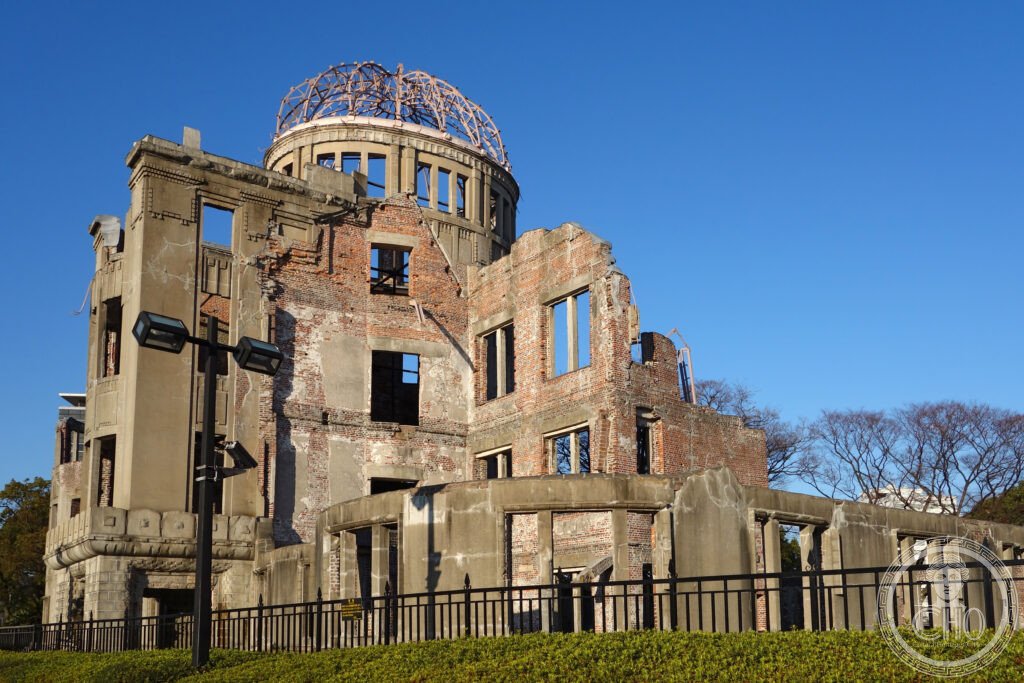
Hiroshima Peace Memorial
The most important monument to peace and nuclear disarmament in the world — the skeletal remains of a 1915 exhibition hall that stood directly below the hypocentre of the first atomic bomb used in warfare (6 August 1945, 8:15 am), preserved as a permanent ruin at the request of the citizens of Hiroshima to stand as a witness to the destruction of an entire city in a single instant and as a plea that such destruction never be repeated.
At a glance
The Hiroshima Peace Memorial (Japanese: 原爆ドーム, Genbaku Dōmu, “Atomic Bomb Dome”; formal name: Hiroshima Peace Memorial) is a ruined building in the Hiroshima Peace Memorial Park, Hiroshima, Japan. The building was the Hiroshima Prefectural Industrial Promotion Hall, designed by Czech architect Jan Letzel and completed in 1915; at 8:15 am on 6 August 1945, the United States Army Air Forces detonated the first atomic bomb used in warfare (Little Boy, uranium gun-type, 15 kilotons) approximately 600 metres above the building and 160 metres to its south-east; the building was the only structure near the hypocentre to remain standing in any recognisable form. It was preserved as a memorial, inscribed by UNESCO as a World Heritage Site in 1996. The adjacent Hiroshima Peace Memorial Museum (opened 1955) documents the history and aftermath of the bombing.
Key facts
- The atomic bombing: on 6 August 1945, at 8:15 am local time, a USAAF B-29 Superfortress bomber (Enola Gay, piloted by Colonel Paul Tibbets) released the bomb “Little Boy” over Hiroshima; the bomb exploded at an altitude of 580 metres above the target (the Aioi Bridge, 160 metres north-west of the Industrial Promotion Hall); the temperature at the hypocentre reached approximately 4,000°C; the blast wave generated winds of 440 m/s; the fireball was visible from 50 km away; approximately 70,000 people died immediately; total deaths by December 1945 (including acute radiation syndrome) are estimated at 90,000–166,000 out of a total population of approximately 350,000
- Why the building survived: the Genbaku Dome survived because the bomb exploded almost directly overhead (rather than at a horizontal distance); the near-vertical pressure wave collapsed the roof and internal structures but the outer walls, subjected to vertical rather than horizontal force, remained standing; all other buildings within 500 metres of the hypocentre were completely destroyed; the skeletal iron dome (which had originally supported a copper-covered dome) collapsed partially but remained; the ruins were preserved in almost exactly the condition they were in immediately after the bombing
- The decision to preserve: the ruins were initially scheduled for demolition along with all other damaged buildings in the post-war reconstruction of Hiroshima; the campaign to preserve them was led by Hiroshima mayor Shinzo Hamai, who in 1966 persuaded the city assembly to vote to preserve the building permanently; the Japanese national government and UNESCO subsequently recognised the building as a heritage site; the dome is currently undergoing continuous structural reinforcement to prevent deterioration
- The Peace Memorial Park: the 12-hectare park surrounding the dome was designed by architect Kenzo Tange (his first major work, 1949) on the site of a residential and commercial neighbourhood that was completely destroyed by the bomb; the park axis runs from the dome through the cenotaph (the Memorial Monument for Hiroshima, City of Peace, designed by Tange — an arched saddle structure containing a chest with the names of all bomb victims) to the flame of peace (which has burned continuously since 1964 and will burn until all nuclear weapons are abolished) and to the Children’s Peace Monument (the Sadako Sasaki crane monument, 1958)
- The Peace Memorial Museum: the primary documentary museum of the bombing and its aftermath; the East Building (ground floor) covers the history of Hiroshima before 1945 and the context of the Pacific War; the Main Building covers the bombing itself, the immediate aftermath (with artefacts — a watch stopped at 8:15, burned children’s clothing, shadow photographs of people vaporised against walls), the long-term effects of radiation exposure (hibakusha, the bomb survivors, many of whom survived for decades), and the global context of nuclear arsenals; the museum receives approximately 1.2 million visitors annually
- Heritage: UNESCO World Heritage Site, Hiroshima Peace Memorial (Genbaku Dome), inscribed 1996
- GPS: 34.3955° N, 132.4536° E
History
The building was constructed in 1915 as the Hiroshima Prefectural Commercial Exhibition Hall (renamed the Industrial Promotion Hall in 1933); it was designed by Jan Letzel, a Czech architect working for a Japanese construction firm, and was one of the first Western-style reinforced-concrete buildings in the city. Hiroshima in August 1945 was the headquarters of the Second Army and the Chugoku Regional Army of the Imperial Japanese Army, with a military population of approximately 40,000 alongside the civilian population of roughly 350,000.
The selection of Hiroshima as the primary target for the first atomic bomb (from a shortlist that also included Kyoto, Kokura, Nagasaki, and Niigata) was made by a USAAF targeting committee in July 1945; Kyoto was removed from the list at the insistence of Secretary of War Henry Stimson, who had visited the city and recognised its cultural significance. The decision to use the atomic bomb was made by President Harry S. Truman; the stated rationale was that it would end the war more quickly than a conventional invasion of Japan (Operation Downfall), which military planners estimated would cause 1.7–4 million Allied casualties and 5–10 million Japanese casualties; the decision and its justification remain among the most debated moral questions of the 20th century.
A second atomic bomb (“Fat Man,” plutonium implosion, 21 kilotons) was detonated over Nagasaki on 9 August 1945; Japan surrendered on 15 August 1945. The post-war reconstruction of Hiroshima was rapid: the city was largely rebuilt within a decade; the Peace Memorial Park and the rebuilt city were carefully separated, with the park occupying the formerly densest residential neighbourhood near the hypocentre and the rebuilt city developing around it. The hibakusha (atomic bomb survivors) have organised continuously since 1945 to press for global nuclear disarmament; the Hiroshima Peace Declaration, delivered annually by the Mayor of Hiroshima on 6 August, has called for nuclear abolition every year since 1947.
What you see
The Genbaku Dome is approached from the Peace Memorial Museum (east) or from the Aioi Bridge (west, the intended target of the bomb); the building is set in the Peace Memorial Park on an island formed by two branches of the Ota River. The skeletal iron dome and the shell of the outer walls are visible through chain-link fencing (close approach is restricted to protect the structure); the interior is not accessible. The most striking view is from the T-shaped Aioi Bridge, looking north along the river axis with the dome in the background: from this angle, the structure reads as simultaneously ruined and intact, the dome frame against the sky.
The Cenotaph (150 metres south of the dome, in the park axis) is a horizontal concrete arch containing a stone chest with 330,000+ names of identified victims; looking through the arch, the dome and the flame are aligned on the park axis — the visual composition that Tange designed to permanently connect the living memorial flame to the ruined dome. The Peace Bell (cast in 1964) is rung by visitors. The Sadako Sasaki Children’s Peace Monument (cranes and the young Hiroshima girl who died of radiation-induced leukaemia in 1955 while folding 1,000 paper cranes as a wish for recovery) is covered daily in origami cranes sent from schools across Japan and the world.
Practical information
- Admission: the Genbaku Dome and Peace Memorial Park are free and open at all times; the Peace Memorial Museum charges ¥200 adult (€1.20); the museum should be visited first (approximately 2 hours) before walking to the dome and the park; audio guides in English are available at the museum
- Getting there: Hiroshima is served by Hiroshima Airport (HIJ), 45 km east (bus to Hiroshima Station, 50 minutes); Hiroshima is on the Sanýō Shinkansen line from Tokyo (4 hours, Hikari) or Osaka (1.5 hours, Kodama); from Hiroshima Station, the park is 20 minutes by tram (Line 2 or 6 to Genbaku-Dōmu-mae stop); from the Shinkansen exit, tram is the most convenient transport
- Visiting on 6 August: the anniversary ceremony (6 August, begins at 8:00 am) is attended by 50,000+ people; it includes a minute of silence at 8:15 (the moment of the bomb), the Peace Declaration by the Mayor of Hiroshima, the releasing of doves, and a programme of music and speeches; visiting on the anniversary requires very early arrival to find a position near the Cenotaph; the atmosphere is profoundly solemn and respectful; non-Japanese visitors are welcomed
Getting there
Hiroshima Station is on the Sānyō Shinkansen (from Tokyo 4h, from Osaka 1.5h). Tram Line 2 or 6 from Hiroshima Station to Genbaku-Dōmu-mae (20 min). The Peace Memorial Museum is immediately south of the park. GPS: 34.3955, 132.4536.
Nearby
- Miyajima Island (Itsukushima Shrine) — 25 km south-west of Hiroshima by ferry (25 minutes from Miyajima-guchi pier; accessible from Hiroshima by tram + ferry in 1 hour total); the floating torii gate of the Itsukushima Shrine (the main gate stands in the sea at high tide, revealing the sea floor at low tide) is one of the most iconic images in Japan; the island has a Shinto shrine complex (8th century) and a Buddhist pagoda (5-storey Gojunoto), wild deer, and a mountainous interior; UNESCO WHS 1996
- Hiroshima Castle — 1 km north of the Peace Memorial Park; a 16th-century Sengoku-period castle (original 1589, destroyed by the atomic bomb, reconstructed in ferro-concrete in 1958); the reconstruction is historically accurate in exterior appearance; the interior is a museum of the history of the castle town and the city; the castle ‘moat’ (water surrounding the inner citadel) and the reconstructed gate complex give the best context for the military history of Hiroshima before 1945
- Shukkeien Garden — 1.3 km east of the Peace Memorial Park; a traditional Japanese landscape garden (established 1620) that survived the atomic bomb with significant damage and was restored; the garden uses the technique of ‘borrowed scenery’ (shakkei), incorporating the distant hills into the garden composition; the ponds, islands, and pavilions reflect the Chinese-influenced aesthetic of 17th-century Japanese garden design
Sources
- Wikipedia, Hiroshima Peace Memorial; Atomic bombings of Hiroshima and Nagasaki, accessed June 2026
- UNESCO, Hiroshima Peace Memorial (Genbaku Dome), WHS reference 775, inscribed 1996
- John W. Dower, Cultures of War: Pearl Harbor, Hiroshima, 9-11, Iraq, W.W. Norton, 2010
- Gar Alperovitz, The Decision to Use the Atomic Bomb, Vintage, 1996
Find it on the map
See this place and what’s around it →📷 Diventa un fotografo di Cultural Heritage Online
Condividi le tue foto dei luoghi: restano pubblicate con la tua firma come autore. Più vengono viste, più ti fai conoscere — e presto un concorso premierà le foto più apprezzate.
Accedi o registrati gratis per aggiungere una foto