
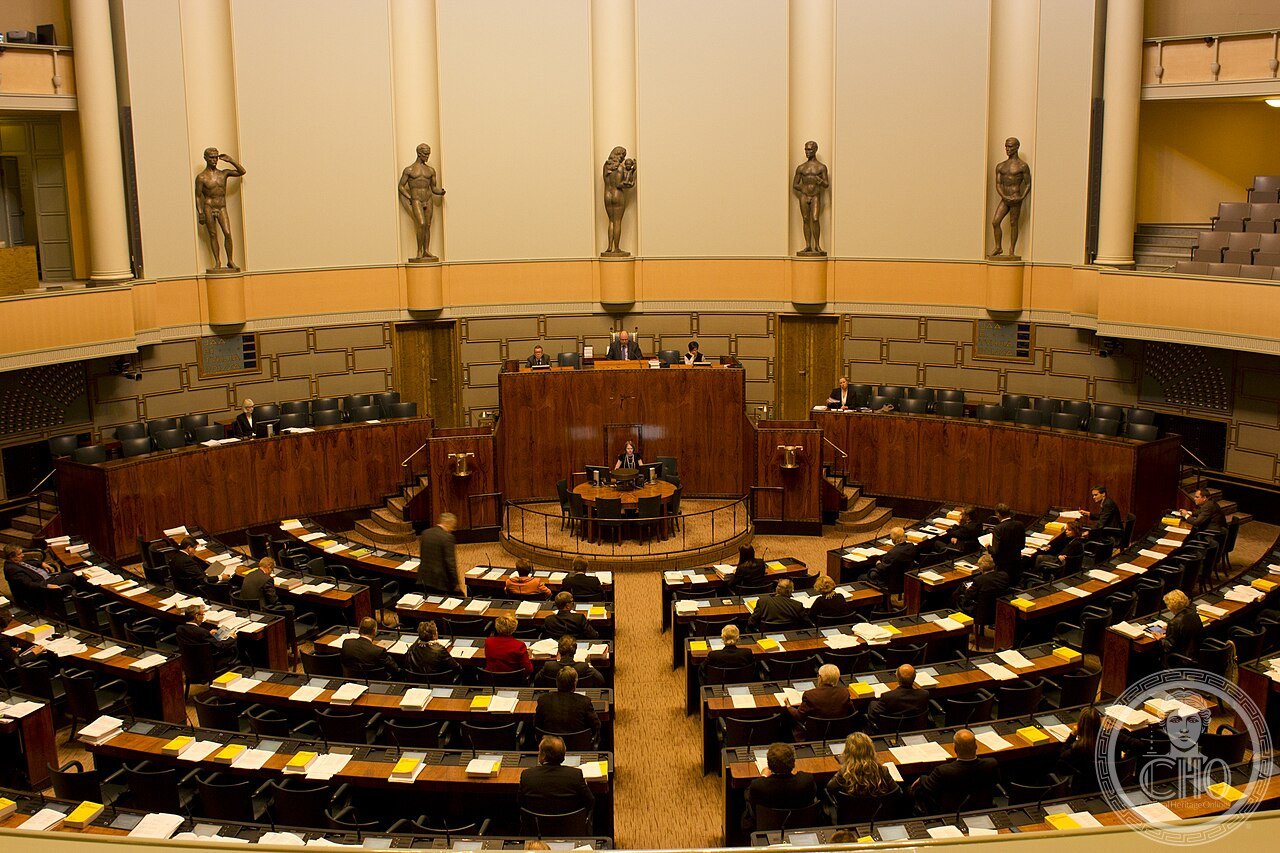
Helsinki Parliament House
The Helsinki Parliament House is one of the defining monuments of Nordic Classicism—a strain of interwar architecture that sought to synthesise the rationalism of antiquity with the northern European landscape and the aspirations of newly independent nations. Designed by Johan Sigfrid Sirén and inaugurated in 1931, the building served as a deliberate counterstatement to the Functionalism sweeping European architecture at the time. Finland had gained independence in 1917, and the Parliament House was conceived as a permanent, dignified expression of that sovereignty—a building that would project institutional seriousness and civic permanence on the world stage. Fourteen monumental Corinthian columns in Finnish granite dominate the facade, rising above Mannerheimintie and framing a structure whose scale and authority are tempered by the refined restraint characteristic of Scandinavian classicism.
At a glance
- Type
- Legislative building / Parliament
- Period
- Inaugurated 1931
- Style
- Nordic Classicism / Interwar Neoclassical
- Location
- Mannerheimintie 30, Helsinki, Finland
- Coordinates
- 60.1705° N, 24.9337° E
- Architect(s)
- Johan Sigfrid Sirén
Overview
The Parliament House of Finland (Finnish: Eduskuntalo) has served as the seat of the Eduskunta, Finland’s unicameral legislature, since its inauguration in 1931. Situated on Mannerheimintie at the heart of Helsinki’s monumental civic core, it faces the National Museum of Finland and the Kiasma contemporary art museum, anchoring a streetscape that traces the arc of Finnish public architecture from the nineteenth century to the present. The building houses the plenary chamber, committee rooms, and parliamentary offices behind a facade of fourteen Corinthian columns in Hanko granite, one of Finland’s most prized building stones.
History
Finland declared independence in December 1917, and within years the new state turned its attention to creating institutions worthy of its sovereignty. An architectural competition for a parliament building was held, and Johan Sigfrid Sirén’s Neoclassical design was selected over Functionalist rivals—a deliberate choice reflecting the parliament’s desire for a building that communicated permanence and democratic dignity rather than modernist novelty. Construction proceeded through the 1920s using Finnish granite quarried at Hanko; the building was inaugurated on 7 March 1931. It has served continuously as the seat of government since, witnessing Finland’s navigation of the Second World War, the Cold War, and European integration.
Architecture & Design
Sirén’s design places fourteen Corinthian columns across the main facade, supporting an entablature of classical proportions executed in warm red-brown Hanko granite. The choice of Finnish stone was both practical and symbolic: it grounded an international architectural language in specifically Finnish material. The plan organises the building around a central plenary hall lit by a glazed ceiling, with committee rooms and offices arranged in a rational circuit around it. Interior spaces feature restrained Neoclassical detailing—coffered ceilings, marble floors, bronze fittings—reflecting the Nordic preference for sobriety over baroque excess. The overall composition responds to Helsinki’s street grid without imposing an axial grandeur foreign to the city’s character.
Cultural significance
The Parliament House represents the architectural moment at which a young democracy chose tradition over experiment as the language of state. In doing so it aligned Finland with a broader Nordic Classicism practised across Scandinavia in the 1920s—a movement that used the vocabulary of antiquity to express northern European values of clarity, craftsmanship, and civic responsibility. For Finnish national identity, the building is inseparable from the story of independence and self-determination. Its granite columns have become as emblematic of the Finnish state as the blue-and-white national flag that flies above them.
Visiting today
The Parliament House offers free guided tours in Finnish, Swedish, and English on selected days when the parliament is in session and during recess periods. Tours cover the plenary hall, committee rooms, and the building’s architectural history. Advance booking is recommended, particularly during peak tourist season. The main entrance on Mannerheimintie is flanked by the granite columns; visitors should bring identification. The parliament’s visitor centre provides exhibition materials on Finnish democracy and the building’s history.
Getting there
The Parliament House is centrally located on Mannerheimintie in Helsinki, easily accessible on foot from the city centre and the Central Railway Station (approximately 800 metres). Tram lines 2, 3, 4, and 7 stop on Mannerheimintie within a short walk. The Helsinki metro serves the Rautatientori stop nearby. From Helsinki Airport, the Ring Rail Line connects to the city centre in approximately 30 minutes; taxis and rideshare are also readily available.
Sources & resources
Find it on the map
See this place and what’s around it →📷 Diventa un fotografo di Cultural Heritage Online
Condividi le tue foto dei luoghi: restano pubblicate con la tua firma come autore. Più vengono viste, più ti fai conoscere — e presto un concorso premierà le foto più apprezzate.
Accedi o registrati gratis per aggiungere una foto