
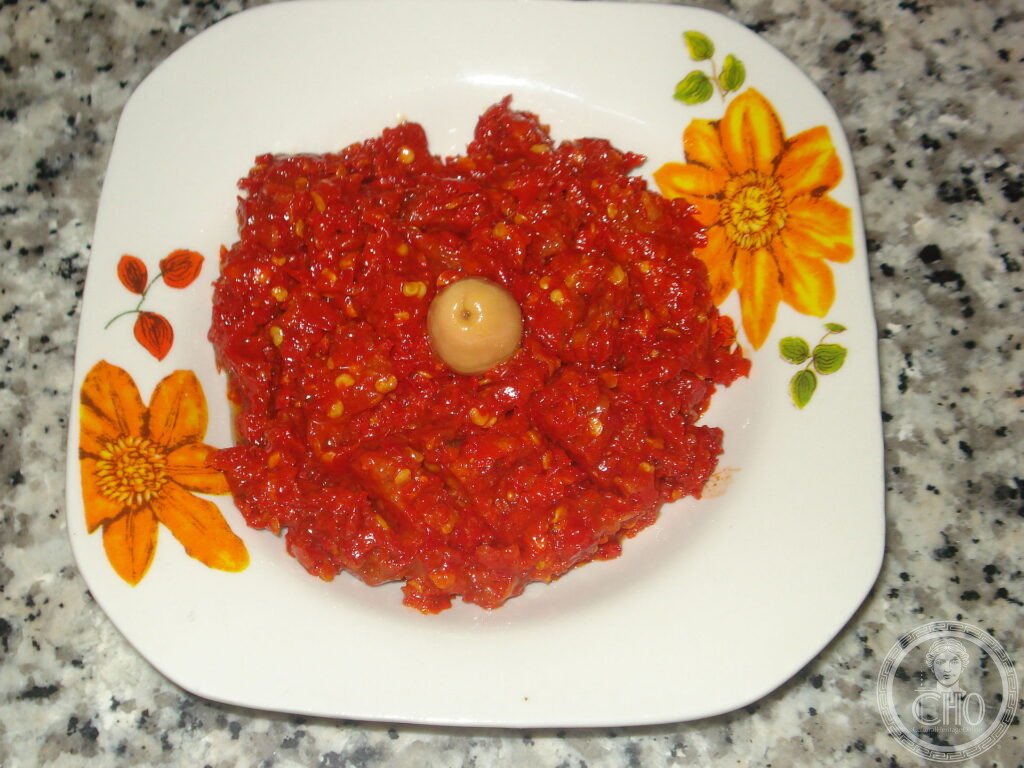
A fiery red chili pepper paste that embodies centuries of Tunisian culinary tradition, harissa carries the heat and complexity of roasted peppers, aromatic spices, and olive oil into everyday meals and festive tables across North Africa.
At a glance
Harissa is Tunisia’s most celebrated condiment and a cornerstone of Mediterranean and North African cuisine. Made from roasted red peppers, Baklouti peppers, garlic, caraway, coriander, cumin and olive oil, it transforms simple ingredients into a paste of bold flavor and cultural significance. The knowledge and skills surrounding its preparation—from pepper selection to grinding and seasoning—belong to communities across Tunisia, with Nabeul recognized as its primary center of production.
Origins & history
Harissa arrived in Tunisian cuisine through the Columbian exchange, presumably during the Spanish occupation of Hafsid Tunisia between 1535 and 1574. Chili peppers, unknown to the region before the encounter with the Americas, were first grown in the Cape Bon Peninsula—the condiment’s birthplace. Over centuries, Tunisians transformed this imported ingredient into a distinctly local culinary practice, embedding it so deeply in daily life that harissa became inseparable from Tunisian identity.
The practice
Harissa begins with the careful selection and roasting of red and Baklouti peppers, whose skins char and blister over heat. The peppers are then peeled, ground, and blended with garlic paste and a precise balance of ground caraway seeds, coriander seeds and cumin. Olive oil is folded through to carry the fat-soluble spices and preserve the paste. The result is glossy, dense, and fiery—ranging in heat depending on the maker’s hand and preference. Home cooks and commercial producers alike guard their techniques, passing methods down through families and communities. The paste appears on tables as condiment, dip, and ingredient, stirred into couscous, spread on bread, or mixed into stews.
Cultural significance
Harissa is far more than a flavoring; it is a practice woven through Tunisian social and culinary life. Preparing it by hand—grinding spices in a mortar, roasting peppers to precise color, tasting and adjusting—connects cooks to generations before them. The knowledge travels through families, neighborhoods, and markets, transmitted orally and by example. Tunisia exports prepared harissa worldwide, making it an ambassador of Tunisian taste, yet the deepest significance lies in its daily presence at the Tunisian table, uniting rich and humble, ancient and modern.
Key facts
- Primary ingredients: roasted red peppers, Baklouti peppers, garlic paste, caraway seeds, coriander seeds, cumin, olive oil
- Anchor heartland: Nabeul, Tunisia
- UNESCO ICH inscription: 2023 (reference 01710)
- Tunisia is the world’s biggest exporter of prepared harissa
- Presumed arrival in Tunisia: between 1535 and 1574, via Spanish occupation
Where to experience it
Harissa is encountered throughout Tunisia, most authentically in Nabeul, where producers and markets showcase the paste in all its regional variations. You will find it at Tunisian tables as a daily condiment, at spice souks where it is sold fresh or in jars, and through home cooks and families who prepare it according to methods passed down through generations. The practice is not confined to a single venue or season; it is lived knowledge, present wherever Tunisian food is made and shared.
Sources & resources
- Harissa – Wikipedia
- Harissa: knowledge, skills and culinary and social practices – UNESCO Intangible Cultural Heritage
- Cultural Heritage Online
Find it on the map
See this place and what’s around it →📷 Become a Cultural Heritage Online photographer
Share your photos of places: they stay published under your name as the author. The more they're seen, the more you get noticed — and soon a contest will reward the most appreciated photos.
Log in or sign up free to add a photo