
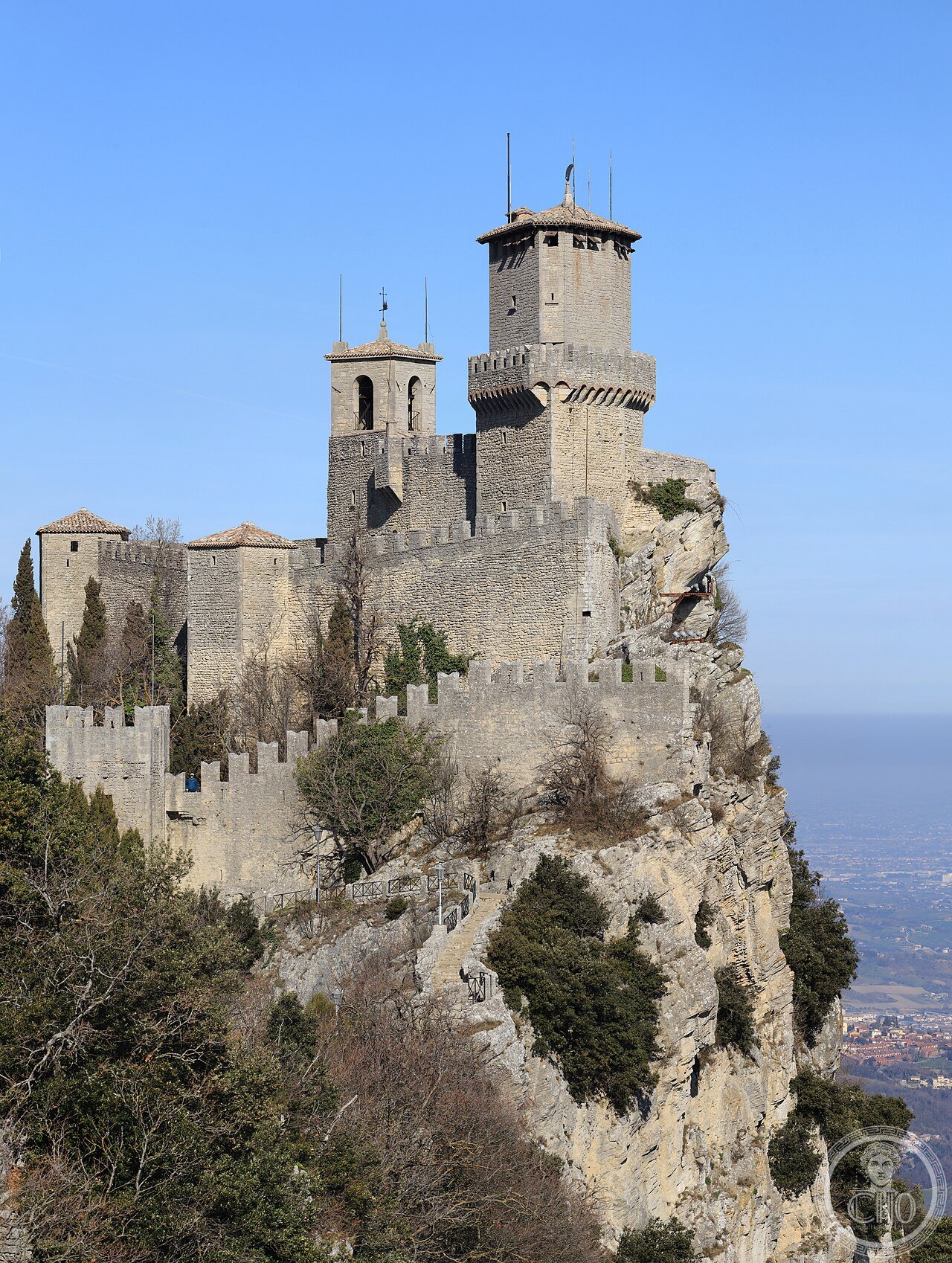
Guaita Tower (First Tower of San Marino)
The oldest and most iconic of the Three Towers of San Marino, crowning Mount Titano above the world’s oldest republic.
At a glance
- Style
- Medieval Military
- Built
- 11th century (expanded 14th century)
- UNESCO
- World Heritage Site 2008
- Elevation
- 756 m
- Coordinates
- 43.9356° N, 12.4476° E
Overview
The Guaita Tower is the oldest and most famous of the Three Towers of San Marino — the enduring symbol of the world’s oldest surviving republic. Perched on the rocky summit of Mount Titano at 756 metres, the tower dominates the surrounding plain and has stood watch over San Marino for nearly a thousand years. Together with Cesta and Montale, the Three Towers were inscribed as a UNESCO World Heritage Site in 2008 as part of the Historic Centre of San Marino and Mount Titano. The microstate itself claims founding in 301 AD by the Christian stonemason Marinus of Rab, and it has maintained independence through centuries of European upheaval — even declining Napoleon’s offer of annexation. The towers appear on the national coat of arms, the flag, and every euro coin minted by the republic.
History
The Guaita was first constructed in the 11th century as a watchtower and defensive fortification on the highest point of Mount Titano. It was substantially rebuilt and enlarged during the 14th century, including the addition of a second outer wall that created a double-ring fortification. From the 14th to the 18th century the tower served as a state prison — a role that ended only in the modern era. The fortress withstood multiple sieges, most famously repelling Cesare Borgia’s forces in 1503. In 1739 Cardinal Giulio Alberoni of the Papal States occupied San Marino briefly, but international pressure — including support from France — restored Sammarinese independence within months, a precedent that shaped the republic’s diplomatic tradition of neutrality.
Architecture
The Guaita consists of a central cylindrical keep of pale limestone enclosed by two concentric defensive walls, forming an inner and outer bailey. Arrow slits pierce the walls at intervals, and the battlemented parapet follows the Ghibelline style with square merlons. The outer wall follows the natural contour of the rocky ridge, making the approach from below nearly impossible without artillery. A covered walkway once connected the three towers along the ridge; today a reconstructed palisade path allows visitors to walk between Guaita and Cesta.
Cultural significance
The Three Towers of Mount Titano are the defining image of San Marino and one of the most recognisable medieval skylines in Europe. The Guaita in particular has become a global shorthand for the republic’s extraordinary longevity. The UNESCO inscription recognises the outstanding universal value of the historic centre and its towers as an exceptionally well-preserved example of a medieval fortified hill-town that has retained its political and social institutions intact. The site draws over three million visitors annually to one of the world’s smallest countries.
Visiting today
The Guaita Tower is open to visitors year-round, with longer hours in summer (April–October roughly 08:00–20:00, November–March 09:00–17:00). A combined ticket covers all three towers. The interior houses a small museum with armour, weapons, and documents relating to the tower’s history as a prison. Allow at least half a day to walk the ridge between Guaita and Cesta and explore the historic centre of the city of San Marino below.
Getting there
San Marino is accessible by road from Rimini (25 km, roughly 30 minutes by car or bus). Regular Bonelli Bus services connect Rimini railway station to San Marino city centre. No commercial airport serves the republic directly; the nearest international airports are Rimini Federico Fellini (RMI) and Bologna Guglielmo Marconi (BLQ). From the city centre, the Guaita is a short uphill walk along the Via della Fratta and the Passo delle Streghe.
Sources
Find it on the map
See this place and what’s around it →📷 Diventa un fotografo di Cultural Heritage Online
Condividi le tue foto dei luoghi: restano pubblicate con la tua firma come autore. Più vengono viste, più ti fai conoscere — e presto un concorso premierà le foto più apprezzate.
Accedi o registrati gratis per aggiungere una foto