
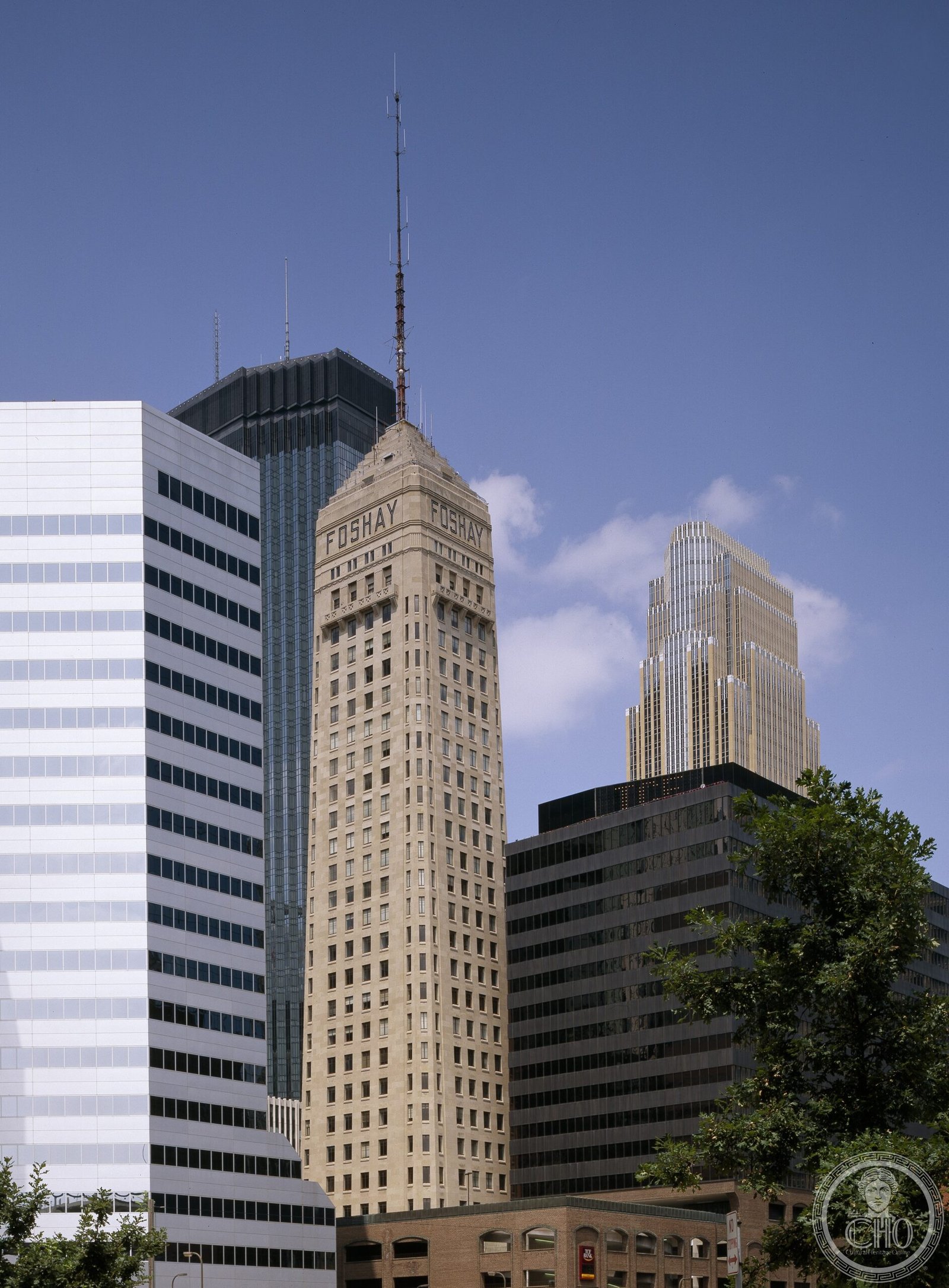
The only American skyscraper built in the form of a Washington Monument obelisk — opened in September 1929 to a John Philip Sousa march, and closed its first year with its builder on his way to federal prison.
At a glance
Willard Foshay commissioned this 32-storey tower as both an advertisement for his utility-holding empire and a monument to his admiration of George Washington. His architects, the Minneapolis firm of Magney & Tusler, reproduced the tapering obelisk proportions of the Washington Monument in steel, stone and Art Deco ornament at 447 feet — tall enough that the name FOSHAY, spelled in large letters on all four faces, was visible from half of downtown Minneapolis. The opening celebration in September 1929 included 147 simultaneous radio broadcasts, a bespoke march by John Philip Sousa, and a three-day party. Weeks later the stock market collapsed, Foshay’s cheques began to bounce, and the spectacle unravelled into one of the decade’s more instructive cautionary tales.
Key facts
- Address: 821 Marquette Ave S, Minneapolis, MN 55402
- Architects: Magney & Tusler (Minneapolis)
- Completed: 1929
- Style: Art Deco (obelisk form)
- Height: 447 feet (136 m); 32 floors
- Status: National Register of Historic Places
- Current use: W Minneapolis — The Foshay (hotel)
- GPS: 44.9753°N, 93.2724°W
History
Willard Foshay built his fortune through the W.B. Foshay Company, a utility holding firm that aggregated small electrical and water utilities across the western United States during the 1920s. He conceived the tower as a statement of personal grandeur — having admired the Washington Monument on a visit to the capital, he instructed his architects to reproduce its proportions at 32 storeys. The setbacks that define the silhouette approximate the taper of the original obelisk so precisely that the relationship is unmistakable from any approach.
The opening celebration in September 1929 was among the most elaborate building dedications in American history. John Philip Sousa composed “The Foshay Tower Washington Memorial March” specifically for the occasion and conducted its premiere himself, having been engaged at a fee of $20,000. Foshay’s cheque to Sousa subsequently bounced. Sousa, according to accounts preserved at the Sousa Archives, vowed that the march would not be performed again publicly until the debt was honoured — an embargo that lasted decades.
Foshay’s company, it emerged, had been sustained by selling securities to new investors to pay earlier ones. When the market crashed in October 1929 the scheme collapsed. Foshay was convicted of mail fraud in 1932 and sentenced to federal prison. The tower passed through several owners, remained Minneapolis’s tallest building for more than 30 years, and was converted to a W Hotels property in 2008 after a comprehensive renovation.
What you see
The obelisk silhouette is the building’s most arresting quality from a distance. The setbacks articulating the shaft are not merely decorative — they follow the taper of the Washington Monument closely enough that the building reads as a genuine obelisk rather than a conventional stepped skyscraper. The name FOSHAY on all four facades, in letters scaled to be legible from the ground, gives the composition a directness unusual even among the period’s most self-confident commercial buildings.
At ground level the tower shifts register. Art Deco ornament of restrained quality frames the entrances — bronze surrounds, polished marble in the lobby, geometric motifs at the pilaster capitals. The 30th-floor observation deck, open to hotel guests and to paying visitors from outside, presents a panorama that takes in the Mississippi River corridor, the lakes defining the metropolitan landscape to the south, and on clear days the first ridge of the western Minnesota plain.
Practical information
- Observation deck: open seasonally; admission fee; accessible from the W Hotel lobby
- W Hotel bar and restaurant: open to non-guests; lobby viewable freely
- Time needed: 30 minutes for lobby; 1 hour if including the observation deck
- Best visit: late afternoon, when low sun catches the obelisk faces from the west
Getting there
The Foshay Tower stands on Marquette Avenue in the heart of downtown Minneapolis, between 9th and 10th Streets South. Minneapolis-Saint Paul International Airport (MSP) is approximately 12 miles south via I-35W or Hwy 62. The Metro Blue Line light rail runs directly from MSP to downtown Minneapolis; the Government Plaza station is three blocks from the tower. The Nicollet Mall bus rapid transit corridor runs one block west.
Nearby
- Nicollet Mall — The pedestrianised commercial street one block west, the main retail spine of downtown Minneapolis.
- Minneapolis City Hall (1906) — Richardsonian Romanesque civic building three blocks north, with a 345-foot clock tower and one of the largest unsupported rotunda domes in the United States.
- Target Field — Home of the Minnesota Twins, eight minutes on foot; the ballpark’s proximity gives the Foshay neighbourhood a lively calendar from April through October.
- Hennepin Theatre District — Four restored historic theatres on Hennepin Avenue including the State (1921), the Orpheum (1921) and the Pantages / Cosmos (1916), within a 10-minute walk to the northwest.
Sources
- National Register of Historic Places nomination, Foshay Tower, Hennepin County, Minnesota
- Sousa Archives and Center for American Music, University of Illinois, Urbana-Champaign — correspondence on “The Foshay Tower Washington Memorial March”
- Minnesota Historical Society, W.B. Foshay Company records
- Larson, Paul Clifford, The Spirit of H.H. Richardson on the Midland Prairies (regional context)
- W Minneapolis — The Foshay, property historical notes
Find it on the map
See this place and what’s around it →📷 Become a Cultural Heritage Online photographer
Share your photos of places: they stay published under your name as the author. The more they're seen, the more you get noticed — and soon a contest will reward the most appreciated photos.
Log in or sign up free to add a photoDo you manage this place?
This page is read by travellers and heritage enthusiasts who find it on Google. Keep it accurate — and make it work for you. Free for non-profit heritage institutions.