
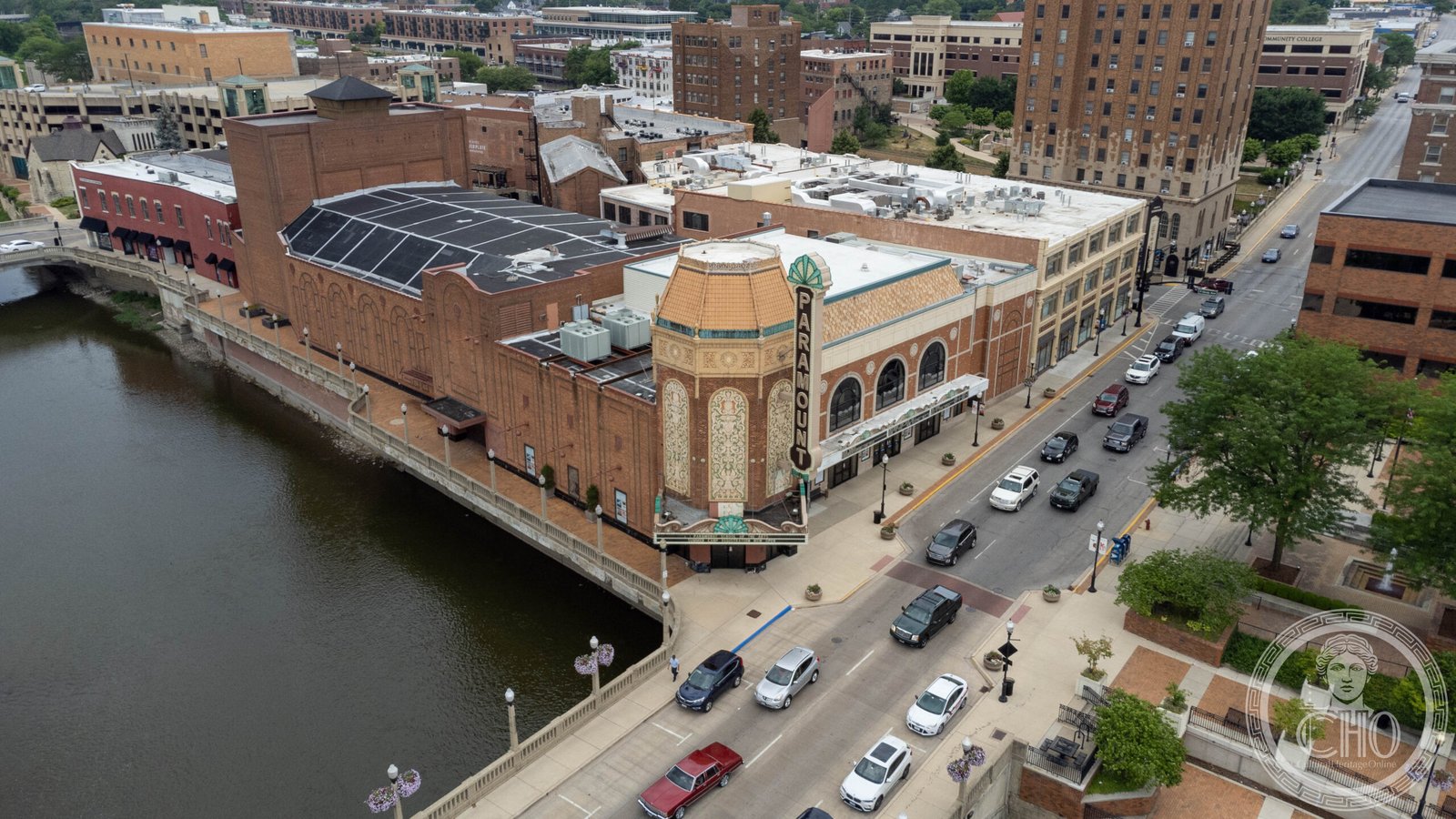
The Paramount Theatre on East Galena Boulevard in Aurora, Illinois, is one of the best-preserved Art Deco movie palaces in the American Midwest, its twin towers and illuminated marquee still commanding the Fox River streetscape ninety years after opening.
At a glance
Designed by the Chicago architectural firm Rapp & Rapp for the Balaban and Katz / Paramount circuit and opened on September 1, 1931, the Paramount Theatre at 23 East Galena Boulevard occupies a prominent corner site above the Fox River in Aurora, Illinois, 35 miles west of Chicago. The building presents a striking Art Deco facade of terracotta and limestone, with two flanking towers and a broad vertical marquee that remains illuminated for performances. The auditorium—a sophisticated blend of Art Deco geometry and warm theatrical lighting—seats approximately 1,888 across two levels. After a restoration funded by the City of Aurora in the 1970s, the Paramount has operated continuously as a performing arts centre, making it one of the few surviving Rapp & Rapp theatres in active use.
Key facts
- Address: 23 East Galena Boulevard, Aurora, IL 60505
- Opened: September 1, 1931
- Architects: Rapp & Rapp (Cornelius W. and George L. Rapp, Chicago)
- Style: Art Deco
- Capacity: approximately 1,888 seats
- Heritage listing: National Register of Historic Places
- Current operator: City of Aurora / Paramount Theatre Arts Centre
History
Aurora, Illinois, earned the nickname “City of Lights” in the 1880s as one of the first American municipalities to use electric street lighting—the same civic pride that led city leaders to embrace the Paramount project enthusiastically when Balaban and Katz brought the theatre proposal in the late 1920s. Rapp & Rapp, the Chicago firm that had become the house architects for the Balaban and Katz and Paramount circuits, submitted a design that combined the geometric rigour of full Art Deco with the programmatic requirements of a 1,900-seat commercial movie palace.
The Paramount opened on September 1, 1931, during the depths of the Great Depression, offering Aurora residents a weekly escape from economic anxiety for the price of a cinema ticket. Paramount Pictures and the Balaban and Katz circuit supplied first-run Hollywood films directly from the studios, giving the theatre an immediate commercial advantage over its local competitors. The theatre thrived through the 1930s and 1940s but, like most single-screen palaces, saw attendance erode through the 1950s and 1960s as suburban multiplexes multiplied and downtown commercial districts declined.
Rather than see the Paramount demolished, the City of Aurora purchased and restored the building in the 1970s, converting it from a cinema to a multi-use performing arts centre. The restoration preserved the original Art Deco exterior and much of the auditorium’s decorative scheme. The Paramount has since expanded its programming to include Broadway touring productions, concerts, stand-up comedy, and community events, establishing itself as the cultural anchor of Aurora’s revitalised downtown. A separate producing arm, Paramount Theatre, was established to create original Chicago-area theatre productions.
What you see
The exterior on East Galena Boulevard is defined by two flanking towers of terracotta-clad concrete that rise above the main entrance marquee. The towers are Art Deco in their geometric ornament—stylised foliate bands, stepped corbels—but disciplined in their verticality: they read as the frame of a civic monument rather than the entertainment architecture of a Hollywood palace. The marquee and blade sign are backlit with contemporary LED replacement of the original incandescent lamps, maintaining the night-time impact that made the building a visual anchor of the Fox River corridor.
The auditorium continues the Art Deco vocabulary in warm terracotta and gold tones, with geometric panels articulating the side walls between pilasters. The ceiling is a smooth curved vault punctuated by recessed lighting rather than the atmospheric sky effects of earlier Atmospheric theatres—by 1931 the Atmospheric had given way to a cleaner, more geometric Deco interior that depended on controlled lighting and refined plasterwork rather than elaborate trompe-l’oeil. The two-level seating bowl has good sightlines throughout, which is why the building functions effectively both as a cinema revival house and as a 1,900-seat concert venue.
Practical information
- Season: Year-round; Broadway series September–June; concerts and comedy throughout the year
- Tours: Group tours available; the Paramount Arts Centre offers periodic architectural tours; check website
- Parking: Several city-operated car parks within a short walk of the theatre; free evening street parking on Galena Boulevard
- Access: Fully accessible; elevator access to mezzanine; designated wheelchair seating at multiple levels
Getting there
Aurora is 35 miles west of downtown Chicago on I-88 / I-290 (approximately 45 minutes by car in non-peak traffic). The Metra BNSF Railway serves Aurora Station from Chicago Union Station with frequent departures (travel time approximately 75 minutes); the Paramount Theatre is a 10-minute walk from Aurora Metra station along East Galena Boulevard. Chicago O’Hare International Airport (ORD) is 40 miles northeast; Midway Airport (MDW) is 28 miles east. The Fox River Trolley Museum operates seasonal rides along the Fox River near the downtown area.
Nearby
- Phillips Park (1911) — Aurora’s historic municipal park on the east bank of the Fox River, featuring a zoo, bandshell, and lakeside paths that have served as a public recreation area since the early twentieth century.
- Leland Hotel (1927) — A six-storey Art Deco residential hotel on West Galena Boulevard, contemporary with the Paramount, converted to condominiums in recent decades but retaining its original Deco facade.
- Aurora Historical Society Museum — Documents the city’s electric-lighting history, industrial heritage, and the Fox Valley’s role in the Chicago suburban corridor.
- Fermilab National Accelerator Laboratory — The high-energy physics research facility, 15 miles north in Batavia, includes Wilson Hall (1974)—Robert R. Wilson’s brutalist tower designed to recall the great Gothic cathedrals—open for public visitor tours on weekdays.
Sources
- National Register of Historic Places nomination, Paramount Theatre, Aurora, Illinois
- Paramount Theatre Arts Centre, institutional history documentation
- Naylor, David. American Picture Palaces: The Architecture of Fantasy. Van Nostrand Reinhold, 1981
- Chicago Architecture Foundation records on Rapp & Rapp
- Aurora Historical Society, “City of Lights” documentation
Find it on the map
See this place and what’s around it →Record researched and written by Luigi De Marchi for Cultural Heritage Online, 2026.
📷 Become a Cultural Heritage Online photographer
Share your photos of places: they stay published under your name as the author. The more they're seen, the more you get noticed — and soon a contest will reward the most appreciated photos.
Log in or sign up free to add a photoIs this page about you?
This page is read by travellers and heritage enthusiasts who find it on Google. Tell us how you are connected to this place and we will take it from there.