

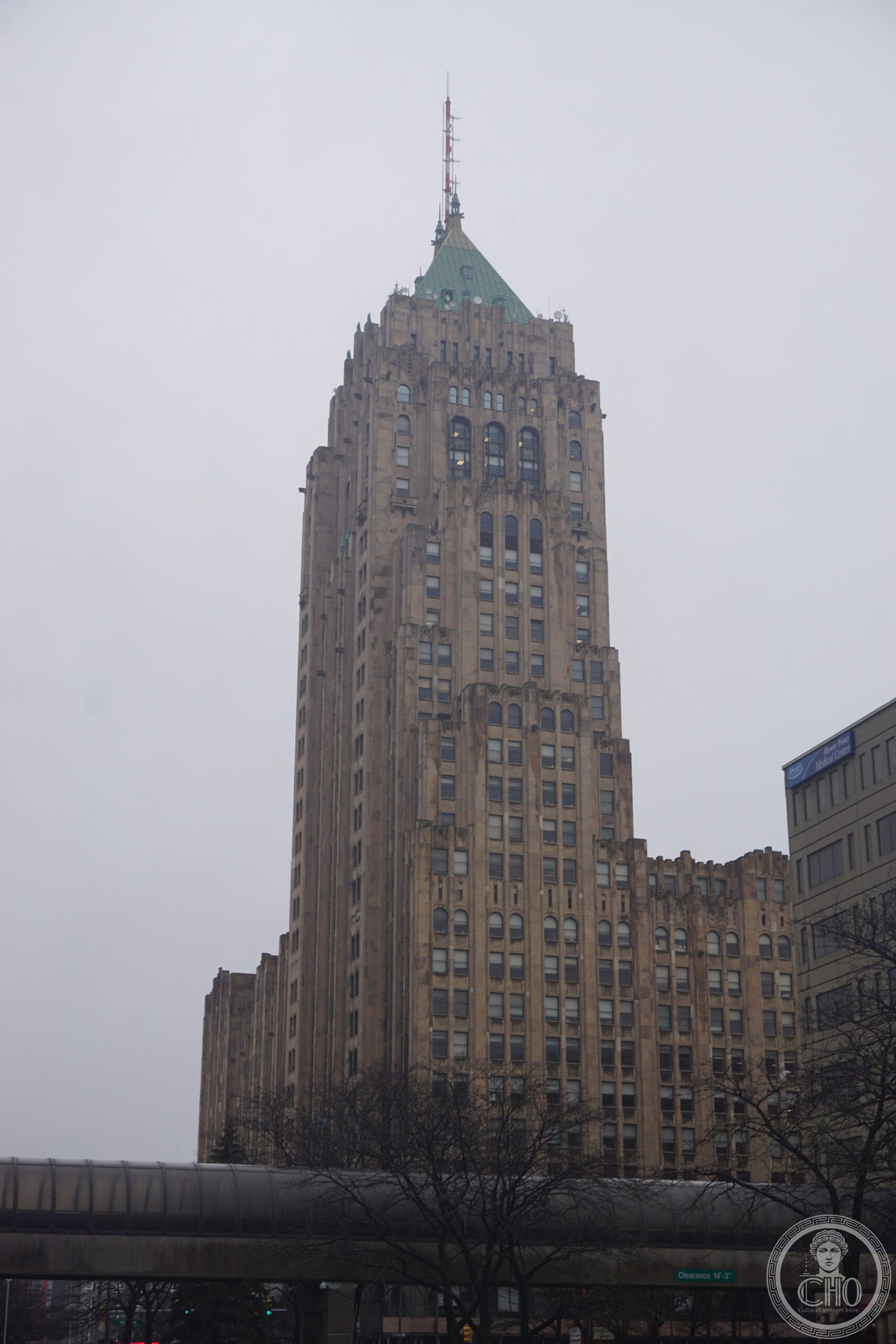
Rising thirty stories above Detroit’s New Center district, the Fisher Building is one of the most extravagant skyscrapers of the American Art Deco era. Designed by Albert Kahn and completed in 1928, it was commissioned by the seven Fisher brothers — the automotive body manufacturers whose fortune reshaped industrial America. Clad in limestone, granite, and more than forty types of marble, the tower is an essay in applied luxury: mosaic-tiled vaults, bronze storefronts, and a triumphal-arch base anchor a shaft that tapers toward a gilded lantern top. The building houses the Fisher Theatre, one of Detroit’s landmark performing arts venues, alongside offices, restaurants, and the headquarters of Detroit Public Schools. Designated a National Historic Landmark in 1989, it remains a living emblem of the city’s industrial golden age and its ambition to match Chicago and New York as a world-class metropolis.
At a glance
- Type
- Office tower / theatre complex
- Period
- 1928
- Style
- Art Deco / Neo-Gothic Deco
- Location
- West Grand Boulevard, New Center, Detroit, Michigan, USA
- Coordinates
- 42.3693° N, 83.0769° W
- Architect(s)
- Albert Kahn
Overview
The Fisher Building stands as the jewel of Albert Kahn’s commercial portfolio and the most opulent skyscraper Detroit ever produced. Its thirty-story mass is animated by a Neo-Gothic silhouette — setbacks, finials, and a pyramidal cap — while every interior surface is a lesson in Art Deco craft: forty-three species of marble line the lobby arcade, Pewabic-inspired tile covers the vaulted ceilings, and bronze detailing runs from elevator doors to window frames. The Fisher Theatre at its base has hosted Broadway premieres and has been renovated multiple times without sacrificing its layered ornamental character. Today the building is managed by Walbridge and continues to attract tenants who prize its address in the emerging Midtown-New Center corridor.
History
The Fisher brothers — Fred, Charles, William, Alfred, Howard, Lawrence, and Edward — made their fortune supplying automobile bodies to General Motors and acquired a site on West Grand Boulevard to anchor a planned civic campus. Albert Kahn, already the architect of choice for Detroit’s auto industry, was commissioned in 1927; the building opened in 1928 after just over a year of construction. An even taller companion tower was planned but the 1929 crash cancelled it. The Fisher Theatre, originally a movie palace, was converted to a legitimate theatre in 1961 by the Nederlander organization and received a Beaux-Arts-into-Art-Deco interior redesign. The building was designated a National Historic Landmark in 1989 and underwent major infrastructure renewal in the 2000s and 2010s as part of Detroit’s broader downtown revival.
Architecture & Design
Kahn’s design marries structural rationalism with decorative excess. The steel frame is clad in light Minnesota granite at the base and Indiana limestone above, keeping the silhouette crisp against the Detroit sky. The base is a tripartite arcade of shop fronts and theatre entries framed in bronze and travertine. The lobby vault — technically a covered arcade linking the two street frontages — is the building’s showpiece: a barrel-vaulted passage whose ceiling glitters with glass mosaic in golds, greens, and blues, and whose walls are panelled in forty-three varieties of marble sourced from three continents. The gold-leaf lantern at the summit originally housed mechanical equipment but reads from street level as a crown, giving the tower an almost ecclesiastical presence in the flat Midwestern streetscape.
Cultural significance
The Fisher Building crystallises the moment when Detroit’s automobile fortunes translated directly into civic grandeur. It was nicknamed “Detroit’s largest art object” by local boosters at its opening, a label that has stuck in the popular imagination. For historians of American architecture it is canonical evidence that the Midwest could sustain Art Deco ambition equal to Rockefeller Center or the Chrysler Building. Its National Historic Landmark designation underscores its importance not only as architecture but as industrial heritage — a monument to the Fisher Body Company and the vertically integrated automotive economy it served. The building also anchors New Center’s identity as a cultural district distinct from downtown proper.
Visiting today
The building’s lobby arcade is accessible during business hours at no charge and is widely regarded as one of the finest free architectural interiors in the United States. The Fisher Theatre presents Broadway touring productions and hosts a regular season; tickets are available through the Nederlander box office. Several restaurants and cafes occupy the ground-floor retail arcade. The building is located on the QLINE streetcar route and is easily walkable from Wayne State University and the Detroit Institute of Arts.
Getting there
Address: 3011 West Grand Boulevard, Detroit, MI 48202. By QLINE streetcar: Grand Boulevard stop, a short walk west. By bus: DDOT routes 16 and 53 stop on West Grand Boulevard directly in front of the building. By car: I-75 to the Warren Avenue exit, then north; paid parking in the Fisher Building garage off Second Avenue. From Downtown Detroit allow approximately 15 minutes by car or 25 minutes via QLINE.
Sources & resources
Find it on the map
See this place and what’s around it →Record researched and written by Luigi De Marchi for Cultural Heritage Online, 2026.
📷 Become a Cultural Heritage Online photographer
Share your photos of places: they stay published under your name as the author. The more they're seen, the more you get noticed — and soon a contest will reward the most appreciated photos.
Log in or sign up free to add a photoIs this page about you?
This page is read by travellers and heritage enthusiasts who find it on Google. Tell us how you are connected to this place and we will take it from there.