
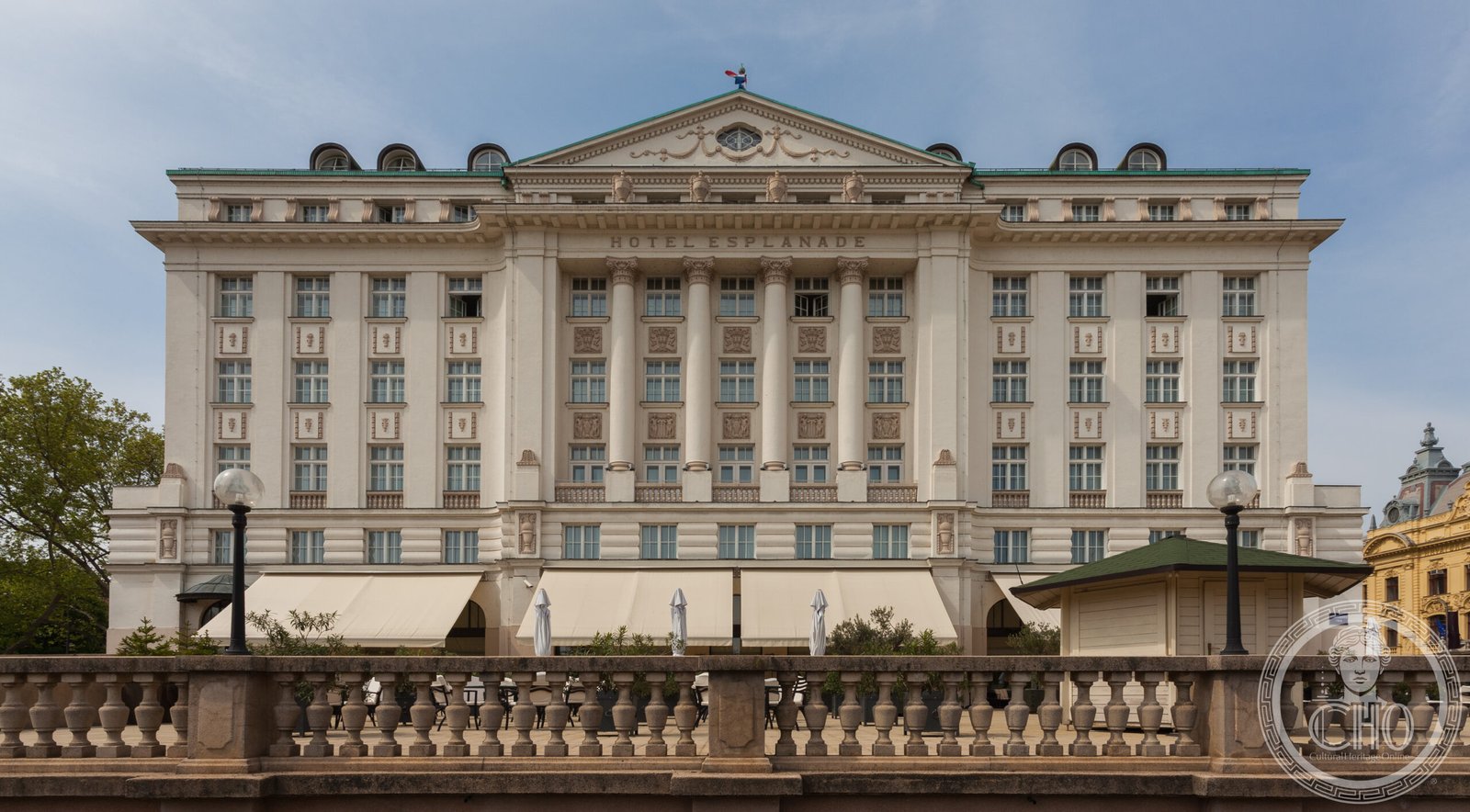
Opened on 22 April 1925, the Esplanade was conceived for Orient Express travellers who required a hotel worthy of the most celebrated train in Europe. One century later it remains Croatia’s pre-eminent grand hotel.
At a glance
The Esplanade Zagreb Hotel stands on Starčević Square, directly opposite the main railway station, its creamy rusticated stone base and rhythmic fenestration signalling serious European hotel tradition. Zagreb architect Dionis Sunko (1879–1935) completed it in just twenty-six months; an international tender had been won in 1917 by German architect Otto Rehnig, whose scheme Sunko refined. The result is a five-storey palazzo that anchors the south end of the Lenuci Horseshoe, Zagreb’s ring of 19th-century parks and public buildings. It has 208 rooms, two restaurants, and a history dense enough to span empires, occupations, and a Hollywood-worthy cast of guests.
Key facts
- Built: 1922–1925 by Dionis Sunko (1879–1935), based on a competition scheme by Otto Rehnig
- Style: Belle Époque
- Status: Luxury hotel, 208 rooms, fully operating
- Address: Mihanovićeva 1, 10000 Zagreb, Croatia
- GPS: 45.8053, 15.9758 — Open in Google Maps
- UNESCO/Listed: No national listing; named Best European Historic Hotel of the Year, European Hotel Awards 2019
History
The Esplanade’s origins lie in a practical calculation: the Orient Express stopped at Zagreb station, and its passengers needed accommodation commensurate with the journey. An international architectural competition was held in 1917; Otto Rehnig of Germany submitted the winning entry, and local architect Dionis Sunko adapted the plans for construction. Work began in 1922 and the hotel opened on 22 April 1925, becoming the first luxury hotel in Croatia.
The 20th century was turbulent. During the Second World War the building was commandeered by the Gestapo and Wehrmacht; it later served as a soup kitchen for Zagreb’s residents. The hotel joined the InterContinental Hotels chain in November 1964 following a major renovation, and Croatia’s first casino opened within its walls in 1967. It left the InterContinental group in 1975 and was privatised in the 1990s. Austrian company WSF-Gruppe acquired the property in 2002 and undertook a complete restoration; the hotel reopened as The Regent Esplanade Zagreb in May 2004. It has operated independently since 2012.
The Esplanade received the Best European Historic Hotel of the Year award at the European Hotel Awards in 2019, recognition that its century of continuous hospitality has not diminished its standing.
What you see
The street façade presents a composed, five-storey elevation in pale stone with rusticated quoins, arched ground-floor openings, and a regular bay system that accelerates slightly towards the central entrance canopy. The roofline is capped by a plain cornice rather than a Baroque skyline, giving the building a restrained solidity unusual among Central European grand hotels of the period. The entrance hall signals scale immediately: high ceilings, articulated column screens, and the kind of polished stone floor that amplifies the sound of a well-heeled arrival.
The principal dining room and the Zinfandel’s restaurant retain period proportions and ornamental plasterwork that the 2004 restoration carefully preserved. The emerald-green Emerald Ballroom — named for the colour of its original décor — is the social heart of the building, its double-height volume intact from the original construction.
Practical information
- Hotel guests only for rooms; restaurants and bar open to the public
- Best visited in spring or autumn; Zagreb’s climate is continental with warm summers
- Guided city walks through Zagreb’s Green Horseshoe frequently pass the exterior
- Estimated visit time: 1–2 hours (restaurant lunch or afternoon tea)
Getting there
Zagreb Franjo Tuđman Airport is approximately 17 km south of the city centre; the shuttle bus reaches Ban Jelačić Square in around 30 minutes. The Esplanade stands directly opposite Zagreb Glavni kolodvor (main railway station) on Mihanovićeva street — one minute on foot from the train platform. Trams 2, 4, 6, 13 and 14 stop immediately outside.
Nearby
- Zagreb Main Railway Station (Glavni kolodvor): Neo-Renaissance terminal across the square, completed 1892, a monument in its own right.
- Botanical Garden: Part of the Lenuci Horseshoe, 5-minute walk south — 4.7 hectares of landscaped grounds dating from 1889.
- Croatian National Theatre: Neo-Baroque opera house on Marshal Tito Square, 10-minute walk north-west.
- Mimara Museum: Major fine art collection in a Neo-Renaissance palace, 10-minute walk north-west.
Sources
Find it on the map
See this place and what’s around it →📷 Become a Cultural Heritage Online photographer
Share your photos of places: they stay published under your name as the author. The more they're seen, the more you get noticed — and soon a contest will reward the most appreciated photos.
Log in or sign up free to add a photoIs this page about you?
This page is read by travellers and heritage enthusiasts who find it on Google. Tell us how you are connected to this place and we will take it from there.