

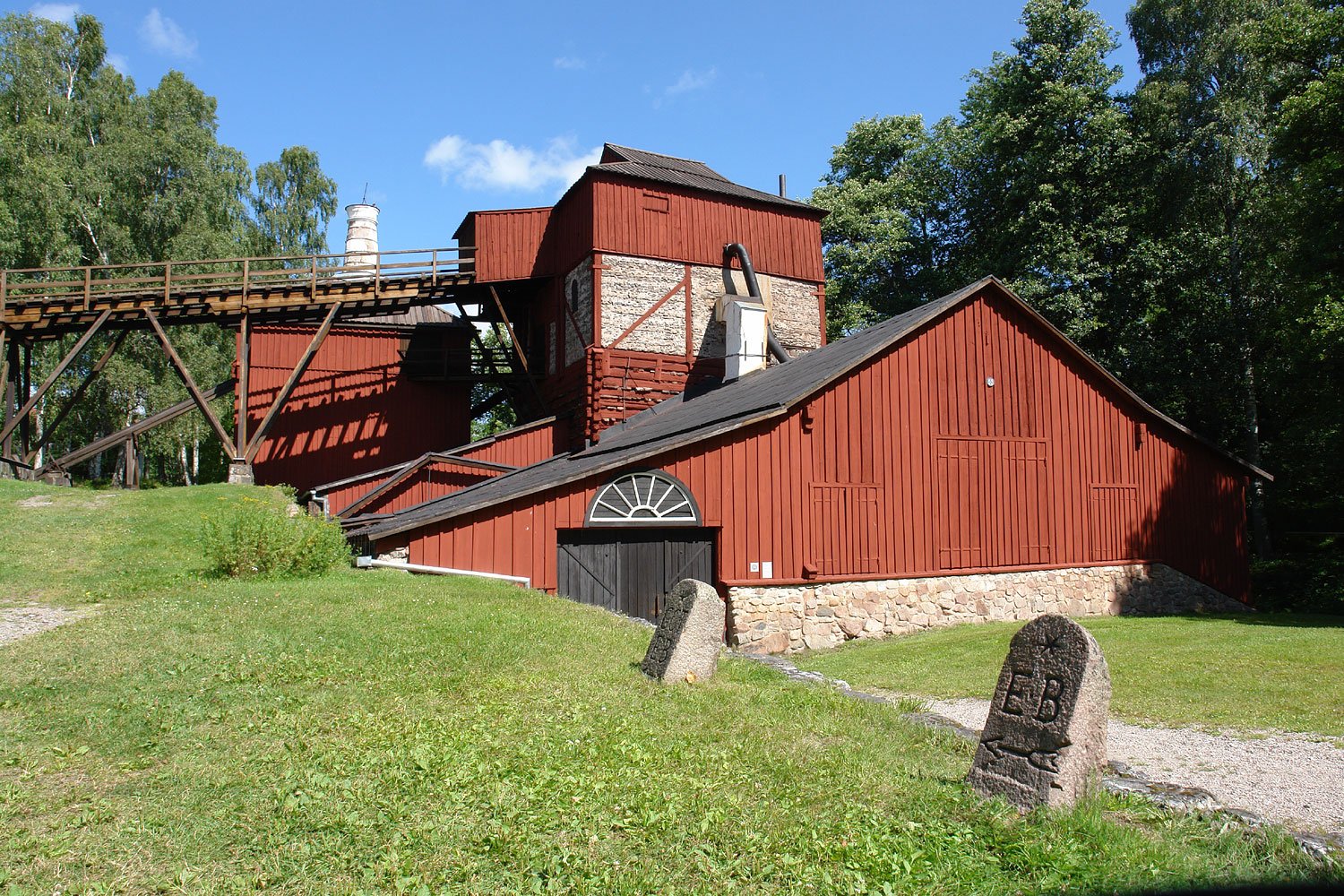
The world best-preserved pre-industrial ironworks — a complete 18th-century Swedish iron-making estate frozen in time since 1919, with both blast furnaces, water-powered forging hammers, workers housing, and a church still standing exactly as they were left, inscribed as a UNESCO World Heritage Site in 1993.
At a Glance
Engelsberg Ironworks in Fagersta municipality, Västmanland County, central Sweden, represents the apex of the Bergslagen iron-making tradition that dominated world iron production in the 17th and 18th centuries. Unlike most industrial heritage sites that preserve only partial remains, Engelsberg survived intact because its final owners chose to maintain — rather than demolish or repurpose — the entire estate after the last blast furnace was extinguished in 1919. The result is a complete material record of a pre-industrial community organised entirely around iron production: from the furnaces and forging hammers to the charcoal stores, workers cottages, managers residence, church, and agricultural outbuildings.
Key Facts
- UNESCO inscription: 1993, World Heritage Site #556
- Location: Ängelsberg, Fagersta municipality, Västmanland County, central Sweden
- Operational period: 1681–1919 CE (238 years)
- Industrial output: High-quality wrought iron (osmundjärn) for European markets
- Preserved structures: 2 blast furnaces, forging hammers, kolhus (charcoal store), workers housing, managers residence, church
- Power source: Water wheels on the Ängelsberg stream
- Owner families: Hedin and later Bedoire families maintained the site as a museum after 1919
- Bergslagen region: Historically the centre of Swedish iron production, supplying Britain, Holland, and France
History
The Bergslagen mining and ironworking district of central Sweden had been producing iron for export since the medieval period, but it was the 17th century that transformed Swedish iron into the dominant global product. The combination of high-quality local iron ore, abundant charcoal from Swedish forests, and advanced smelting techniques (the Walloon process, introduced by Belgian ironmasters) produced a wrought iron of exceptional purity and consistency — known as osmundjärn or Swedish bar iron — that commanded premium prices across European markets.
Engelsberg was established in 1681 and quickly became one of the most productive ironworks in Bergslagen. Under the Hedin family, the works expanded to include two blast furnaces, multiple forging hammers powered by water wheels on the Ängelsberg stream, and a complete supporting settlement. Swedish ironworks (bruk) of this era were deliberately designed as self-contained feudal communities: the owner provided housing, food, spiritual care, and education to the workers in exchange for their labour. At Engelsberg this meant not only the ironworking infrastructure but a workers village, a managers villa, a chapel, grain stores, and extensive farmland.
The iron produced at Engelsberg was sold primarily to Britain, the Netherlands, and France, where it was used by blacksmiths, manufacturers, and eventually the early industrial workshops that preceded the Industrial Revolution. In a precise historical irony, the Swedish pre-industrial ironworks provided the raw material that fuelled the British industrial transformation that would eventually render those same Swedish ironworks obsolete.
Engelsberg ceased iron production in 1919 when it could no longer compete with modern steelworks. Rather than demolish or sell off the infrastructure for scrap, the Bedoire family maintained the entire estate in preservation, treating it as a monument to industrial heritage decades before such thinking was widespread. This decision made possible the exceptional completeness of the site today.
What You See
The two blast furnaces are the centrepiece of the site: one has been preserved in working condition, with its complete internal structure, tuyeres (air injection nozzles), and taphole intact. The forging hammers — massive water-powered trip hammers for working blooms of iron into bars — stand in their original timber-framed sheds with the water channels and wheel pits still visible. The kolhus (charcoal storage building) is one of the largest timber structures on the site, preserving the wooden charcoal containers used to maintain the critical fuel supply.
The workers housing consists of a row of low, red-painted timber cottages (typical of Swedish vernacular architecture) flanking the industrial core. The managers villa is a grander structure reflecting the social hierarchy of the bruk system. A small chapel provided spiritual care for the community — an element that reinforced the paternalistic self-sufficiency of the Swedish ironworks model.
The surrounding landscape of water meadows, forest, and the Ängelsberg stream provides the ecological and hydraulic context for the entire operation, making Engelsberg one of the few industrial heritage sites where the relationship between natural resources and industrial production is fully legible.
Practical Information
- Open: Guided tours available in summer (June–August); check current season schedule at the World Heritage Site office
- Entry: Fee-based guided tours; advance booking recommended in peak season
- Time needed: 2–3 hours for a guided tour of the main ironworks complex
- Language: Guides available in Swedish and English
- Accessibility: The site is partially accessible; uneven industrial surfaces in furnace areas
Getting There
Ängelsberg is approximately 185 km northwest of Stockholm. By train: take the Sala–Fagersta regional line to Ängelsberg station (via Västerås), with connections from Stockholm Central. By road: follow E18 west from Stockholm to Västerås, then route 66 north to Fagersta and local roads to Ängelsberg. The nearest large town is Fagersta (8 km), which has basic accommodation.
Nearby
- Skinnskatteberg — 20 km south: Bergslagen heritage trail connecting multiple ironworks and mining sites through the forest landscape
- Norberg — 25 km southeast: medieval mining town and another Bergslagen ironworks heritage site with a medieval church and mine shafts
- Västerås — 70 km southeast: regional capital with a medieval cathedral and Viking-era burial mounds at Anundshög, one of the largest in Sweden
Sources
- UNESCO World Heritage List: Engelsberg Ironworks, Property #556 (1993)
- Magnusson, Gert. Ironworking in the Bergslagen. Swedish National Heritage Board, 1995.
- Wikipedia: “Engelsberg Ironworks”. Retrieved June 2026.
Find it on the map
See this place and what’s around it →📷 Become a Cultural Heritage Online photographer
Share your photos of places: they stay published under your name as the author. The more they're seen, the more you get noticed — and soon a contest will reward the most appreciated photos.
Log in or sign up free to add a photo