
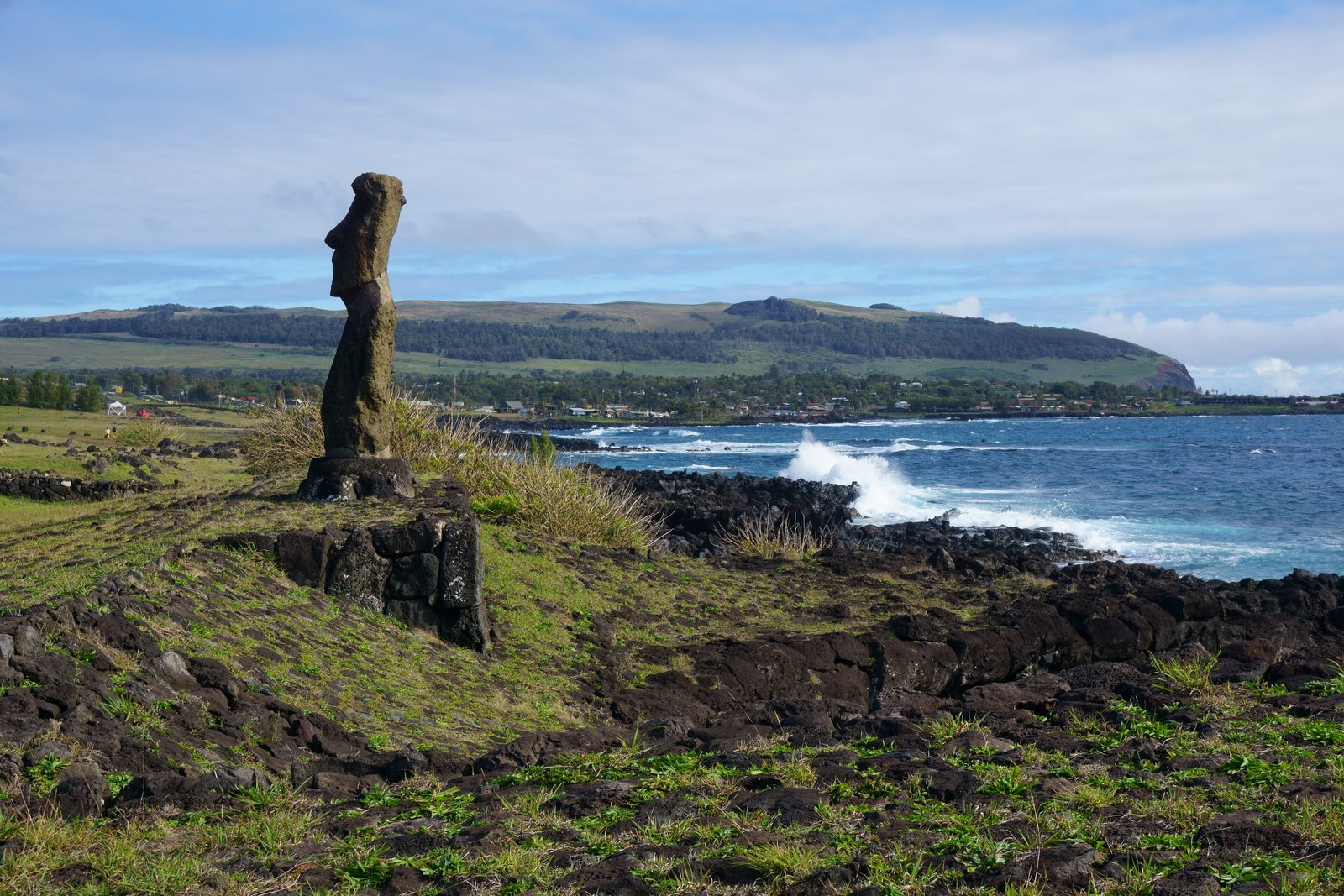
At a glance
Easter Island — Rapa Nui in the indigenous Polynesian language — is a Chilean territory in the southeastern Pacific Ocean, 3,512 kilometres west of mainland Chile and among the most remote inhabited islands on Earth. Its fame rests on 887 inventoried moai: monolithic stone figures carved by the Rapa Nui people between roughly 1200 and 1800 AD to embody their deified ancestors. The island was inscribed as a UNESCO World Heritage Site in 1995 for its exceptional testimony to a now-vanished civilisation.
Key facts
- Location
- Valparaíso Region, Chile — 27°7′S, 109°21′W
- Period
- c. 1200–1800 AD (Rapa Nui civilisation)
- UNESCO status
- World Heritage Site, inscribed 1995
- Moai inventoried
- 887 statues (400 still in Rano Raraku hillside)
- Largest moai
- El Gigante, 21.6 m — quarried but never erected
- Largest standing moai
- Paro at Ahu Te Pito Kura, 10 m, 82 tonnes
- Key site
- Ahu Tongariki — 15 moai restored 1992–1996
- Administration
- Rapa Nui National Park (CONAF)
History
Polynesian navigators reached Rapa Nui around 1200 AD, the current scholarly consensus based on radiocarbon and botanical evidence. Their descendants, the Rapa Nui people, divided into competing clans and built the ahu — stone ceremonial platforms — on which they erected moai representing deified ancestors. Contrary to common assumption, the statues face inland, watching over the living, not toward the sea.
The moai were carved from compressed volcanic tuff at the single quarry of Rano Raraku, then transported across the island. Experiments conducted in 2011 confirmed that large teams could “walk” the statues upright using ropes, rocking them side to side — consistent with oral traditions describing the moai moving under their own power. During the 18th-century civil war known as Huri mo’ai (the Toppling of the Moai), rival clans deliberately pushed over each other’s statues; by 1840 every standing moai had been toppled.
Dutch navigator Jacob Roggeveen sighted the island on Easter Sunday, 5 April 1722, giving it its European name. Thor Heyerdahl’s 1947 Kon-Tiki theory proposing South American origins for the Rapa Nui people has since been disproven by genetic studies confirming Polynesian ancestry. Ahu Tongariki’s 15 moai, swept inland by a 1960 tsunami, were restored between 1992 and 1996 with funding from a Japanese crane manufacturer.
What you see
The quarry of Rano Raraku is the island’s most haunting landscape: roughly 400 moai remain embedded in the hillside at every angle and stage of completion, as if a production line were frozen mid-shift. The weight of Paro — the tallest successfully erected moai, recumbent since the 19th century at Ahu Te Pito Kura — is visceral at close range: 82 tonnes of grey volcanic stone, its pukao (red scoria topknot) lying nearby. Ahu Akivi, in the island’s interior, is notable for seven moai that do face the ocean, aligned with the equinoctial sunset. The volcanic crater of Rano Kau, at the island’s southwestern tip, holds a freshwater lake and the ceremonial village of Orongo, site of the Birdman cult that superseded moai culture after the civil war.
Practical information
- Entry fee
- National park pass required (charged at arrival airport); includes two visits each to Rano Raraku and Orongo
- Opening hours
- Daily; most sites sunrise to sunset
- Guided tours
- Available from Hanga Roa, the island’s sole town; local Rapa Nui guides recommended for cultural context
- Best time
- February (Tapati festival) for cultural immersion; September–November for milder weather and smaller crowds
- Photography
- No climbing on moai; tripods permitted in most areas
Getting there
LATAM Airlines operates daily flights from Santiago de Chile (approximately 5 hours) and seasonal flights from Lima, Peru. The airport, Mataveri International (IPC), is 2 km from Hanga Roa. No ferry service exists. All visitors require a Chilean tourist card; Chilean nationals need only a national identity document.
Nearby
- Ahu Akivi — the only ahu with moai facing the sea; 11 km northwest of Hanga Roa
- Ahu Nau Nau (Anakena Beach) — four restored moai with original coral-and-obsidian eyes, the only known beach landing point for early settlers
- Orongo ceremonial village — stone houses of the Birdman cult, perched on the rim of Rano Kau crater
- Museo Antropológico Sebastián Englert — Hanga Roa; houses one of the original coral eyes from Ahu Nau Nau
Sources
- Easter Island — Wikipedia
- Rapa Nui National Park — UNESCO World Heritage
- Parque Nacional Rapa Nui — CONAF (official)
Find it on the map
See this place and what’s around it →📷 Diventa un fotografo di Cultural Heritage Online
Condividi le tue foto dei luoghi: restano pubblicate con la tua firma come autore. Più vengono viste, più ti fai conoscere — e presto un concorso premierà le foto più apprezzate.
Accedi o registrati gratis per aggiungere una foto