
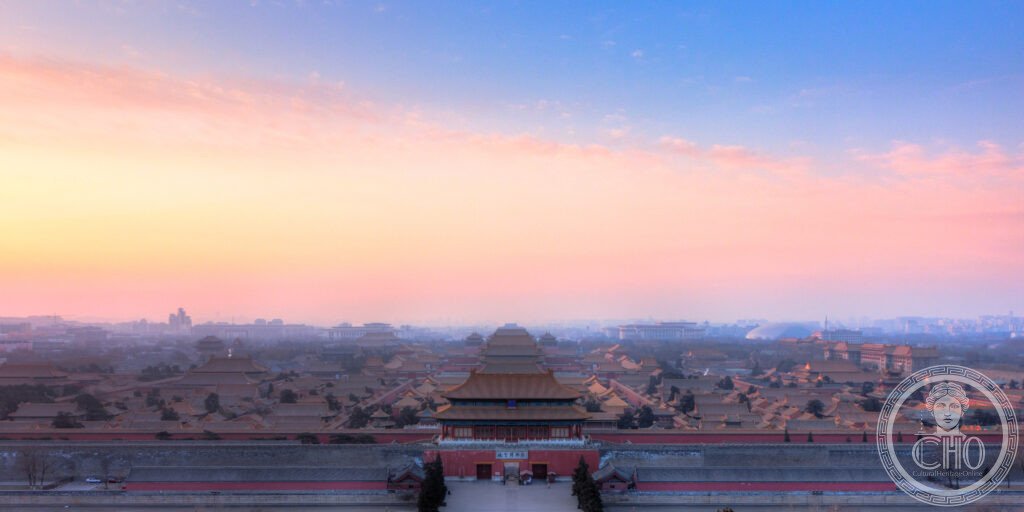
Forbidden City — Beijing
The largest palace complex in the world — 980 surviving buildings on 72 hectares, surrounded by a moat 52 metres wide, built over fifteen years by a million workers for the Emperor Yongle and housing China’s emperors for five centuries, now the most-visited museum on earth.
At a glance
The Forbidden City (Zijin Cheng, “Purple Forbidden City”) occupies the geographical and political centre of Beijing, an 800-metre by 960-metre rectangle surrounded by a 52-metre-wide moat and a 10-metre-tall wall with a gate tower at each compass point. Construction was ordered by the Yongle Emperor in 1406; over a million workers — craftsmen, labourers, and corvée conscripts — completed the complex in 1420. The Emperor moved the capital of the Ming dynasty from Nanjing to Beijing in the same year. The complex consists of 980 surviving buildings (originally approximately 1,000) arranged along a precise north-south axis that continues through Tiananmen Square to the south and the imperial ancestral temples to the east. It served as the home of 24 Chinese emperors — 14 Ming and 10 Qing — from 1420 until the abdication of Puyi in 1912. The Palace Museum, established in 1925, now houses the world’s largest collection of Chinese imperial artefacts; the Forbidden City was inscribed as a UNESCO World Heritage Site in 1987 and receives approximately 17–19 million visitors annually.
Key facts
- Builder: Emperor Yongle (Zhu Di), Ming dynasty; construction 1406–1420; over 1 million workers employed
- Scale: 720,000 m² total area; 961 buildings; 8,886 rooms (traditional count; modern surveys suggest approximately 8,707); moat 52 metres wide, 3.8 km in perimeter
- Materials: lumber from Yunnan and Sichuan; floor tiles from Suzhou; marble from Hebei; yellow glazed roof tiles (yellow was the imperial colour, forbidden to all others); the central axis aligned north-south to within 2 minutes of arc
- Hall of Supreme Harmony (Taihedian): the largest wooden hall in China; 37.44 metres high; the throne room where the emperor held court, received foreign ambassadors, and observed the ceremonial life of the state
- Palace Museum collection: approximately 1.8 million objects; only a fraction on display at any time; the collection includes bronzes, ceramics, paintings, imperial archives, clocks, and jade carvings
- Heritage: UNESCO World Heritage Site, inscribed 1987
- GPS: 39.9163° N, 116.3972° E
History
The decision to move the capital northward — from Nanjing, which had served as the Ming capital since 1368, to Beijing — was both political and strategic. The Yongle Emperor had seized the throne from his nephew in a civil war and was uncomfortable in Nanjing, which was associated with his predecessor. Beijing, closer to the Mongol frontier in the north, was also his power base. The construction of a new imperial palace in Beijing was the physical statement of the new arrangement; the scale of the project, which consumed the timber of entire forests in southern China and mobilised construction labour on a national scale, asserted imperial authority in the most visible possible form.
The complex burned and was rebuilt several times during the Ming dynasty; the major buildings in the outer court date from Qing dynasty restorations of the 17th–18th centuries rather than from the original Ming construction. The Qing emperors (who came from Manchuria) maintained the Forbidden City as the ritual and administrative heart of their empire while also constructing the Summer Palace and other suburban complexes; the Qianlong Emperor (r. 1735–1796) was particularly active in expanding the collection of art objects, which he gathered from across the empire.
The last Emperor, Puyi, abdicated in 1912 following the Republican Revolution but continued to live in the Inner Court (the residential northern half of the complex) until 1924, when a Republican warlord evicted him. The Palace Museum was established in 1925. During the Second World War, the most important objects in the collection were evacuated to Taiwan; approximately 600,000 objects are now in the National Palace Museum in Taipei — the result of the Nationalist government’s decision to take them with them when they retreated to Taiwan in 1949. The collection that remained on the mainland forms the Palace Museum’s current holdings.
What you see
The approach through Tiananmen Gate — the southern gate where Mao Zedong’s portrait hangs over the entrance to the Forbidden City — leads through a series of gates and courtyards before reaching the Meridian Gate (Wu Men), the formal entrance to the palace. Beyond, the Outer Court consists of three vast halls on raised marble terraces: the Hall of Supreme Harmony (throne room), the Hall of Central Harmony (preparation room), and the Hall of Preserving Harmony (examination hall). The central axis is designed to be experienced as a sequence of expanding and contracting spaces, each gate and courtyard calibrated to produce a specific spatial effect.
The roofs — uniformly yellow-glazed tile in the imperial precincts, green for the princes’ residences, black for the libraries — are the building’s primary colour and material. The upturned eave ends carry rows of decorative figurines, the number of which indicates the rank of the building (the Hall of Supreme Harmony has the maximum of ten). The view from Coal Hill (Jingshan Park) to the north — a mound of earth excavated from the moat — reveals the entire complex in plan and gives the definitive image: the yellow roofline extending from gate tower to gate tower across the Beijing plain.
Practical information
- Address: No. 4 Jingshan Front Street, Dongcheng, Beijing 100009, China
- Hours: Tuesday–Sunday 8:30 am–5 pm (October–March) or 8:30 am–6 pm (April–September); closed Mondays except national holidays
- Admission: CNY 60 (April–October); CNY 40 (November–March); some special exhibitions extra; mandatory online booking at pm.org.cn — visitors without tickets are turned away; daily capacity limited to 80,000
- Duration: 3–4 hours minimum for the main axis; half a day for thorough exploration of side courts
- Coal Hill: Jingshan Park (CNY 2 admission) immediately north; the best panoramic view of the complex and almost always less crowded than the palace itself
Getting there
Metro Line 1 to Tiananmen East or Tiananmen West (south entrance, through the square) or Line 8 to Zhongguancun; the north gate (Shenwu Gate) is accessible on foot from Beihai Park. From Beijing Capital Airport: Line 10 to Guomao, transfer to Line 1; approximately 1 hour. GPS: 39.9163, 116.3972.
Nearby
- Tiananmen Square — the world’s largest city square, immediately south; bordered by the National Museum of China, the Great Hall of the People, and Mao’s Mausoleum
- Temple of Heaven (Tiantan) — the Ming and Qing imperial altar where the emperor offered sacrifices to Heaven; 4 km south; UNESCO WHS
- Summer Palace (Yiheyuan) — the lakeside imperial garden 15 km north-west; UNESCO WHS; the best surviving Qing garden-palace complex
- Beihai Park — the imperial pleasure lake and garden immediately west of the Forbidden City; the White Pagoda is the landmark; free access from Houhai area
Sources
- Wikipedia, Forbidden City, accessed June 2026
- Palace Museum official site: pm.org.cn
- UNESCO, Imperial Palace of the Ming and Qing Dynasties in Beijing and Shenyang, WHS reference 439, inscribed 1987
- Evelyn Rawski and Jessica Rawson (eds.), China: The Three Emperors 1662–1795, Royal Academy of Arts, 2005
Find it on the map
See this place and what’s around it →📷 Diventa un fotografo di Cultural Heritage Online
Condividi le tue foto dei luoghi: restano pubblicate con la tua firma come autore. Più vengono viste, più ti fai conoscere — e presto un concorso premierà le foto più apprezzate.
Accedi o registrati gratis per aggiungere una foto