
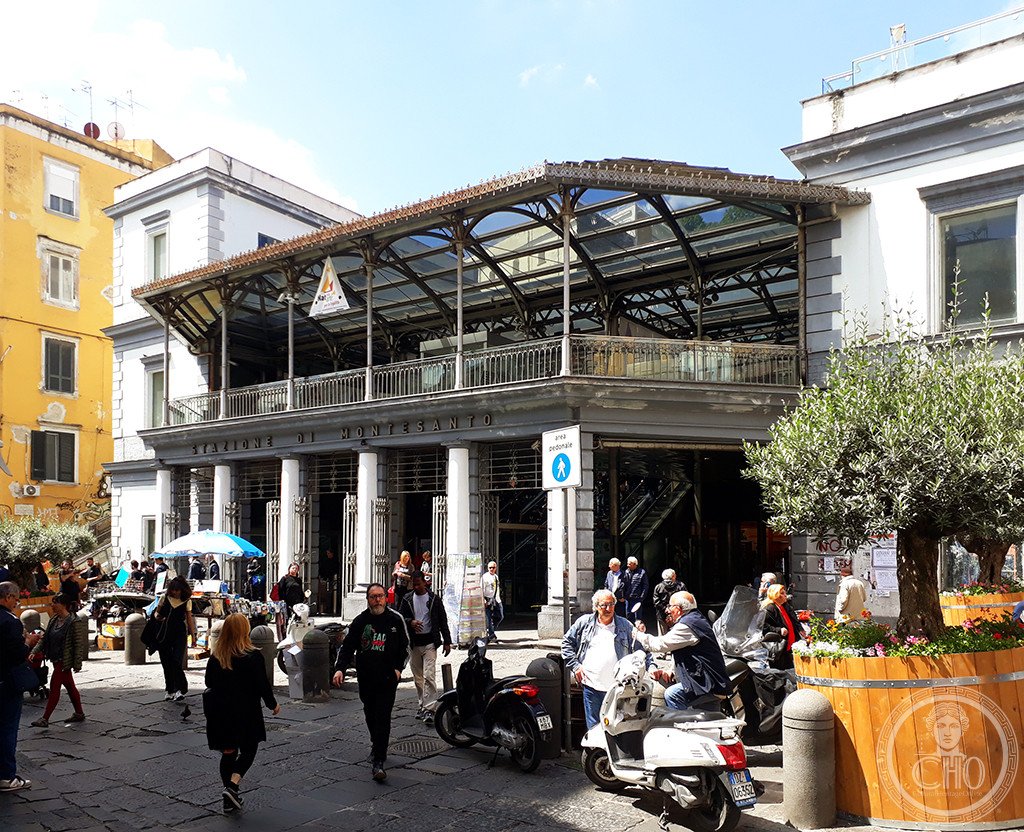
Church of Santa Maria di Montesanto
The Church of Santa Maria di Montesanto is a seventeenth-century Baroque church in the historic centre of Naples, situated near the famed Piazza del Gesù Nuovo. Built by the Carmelite order between 1678 and 1707, it occupies one of the two matching churches that frame the via Toledo perspective — the other being Santa Maria delle Grazie — forming one of the most celebrated Baroque urban set-pieces in the city. The church is renowned for its distinctive oval plan and elliptical dome, and for the devotional image of the Madonna di Montesanto venerated within.
At a glance
- Type
- Roman Catholic church, Carmelite order
- Period
- Built 1678–1707
- Style
- Neapolitan Baroque; elliptical plan
- Location
- Historic centre of Naples, Campania, Italy
- Coordinates
- 40.8476° N, 14.2455° E
- Architects
- Cosimo Fanzago (initial design); completed by later Baroque architects
- Dedication
- Madonna di Montesanto
Overview
Santa Maria di Montesanto stands at one of the key visual hubs of Baroque Naples, facing across the piazza towards its twin church Santa Maria delle Grazie in a paired composition that exemplifies seventeenth-century urban planning on the grand scale. Together with the towering guglia dell’Immacolata obelisk, the two churches create one of the most photographed perspectives in the city’s historic centre. The church preserves an active cult of the Madonna di Montesanto, a devotional image that draws both local worshippers and pilgrims to this UNESCO-listed district.
History
Construction of the church began in 1678 under the patronage of the Carmelite order, which was granted this site in the expanding western district of the old city. The commission was associated with the architect Cosimo Fanzago, the dominant figure of Neapolitan Baroque, whose influence shaped many of the city’s most important seventeenth-century religious buildings. Work continued into the early eighteenth century, with the church consecrated in 1707. The elliptical plan — unusual for a parish church of this period — reflects the experimental boldness of Neapolitan Baroque architects, who pushed spatial invention further than many of their Roman contemporaries. The pairing with Santa Maria delle Grazie across the square was a deliberate urban gesture that framed the approach to the via Toledo and the Spanish Viceregal district.
What you see
The facade presents a restrained Baroque elevation in the Neapolitan tradition, with pilasters, a central portal richly carved in local piperno stone, and a curved pediment that echoes the oval geometry of the interior. Inside, the elliptical nave is wrapped by side chapels set within curved niches, their altarpieces representing the work of Neapolitan painters of the seventeenth and early eighteenth centuries. The dome above the main body of the church floods the interior with diffuse light characteristic of the Baroque oval-plan church type. The high altar hosts the venerated Madonna di Montesanto, framed by marble dressing and votive offerings accumulated over three centuries of popular devotion.
Cultural significance
Santa Maria di Montesanto is an integral component of the UNESCO World Heritage Site covering the historic centre of Naples, inscribed in 1995. It represents both the architectural ambition of Neapolitan Baroque — one of the most inventive regional expressions of the style in Europe — and the enduring tradition of Marian devotion that has shaped the religious landscape of southern Italy for centuries. The church’s prominent position in the urban fabric makes it a landmark of daily life for Neapolitans as much as a monument for cultural visitors.
Practical information
- Address
- Piazza del Gesù Nuovo area, 80134 Napoli NA, Italy
- Access
- Open for Masses and religious services; check with the church or the Archdiocese of Naples for visiting hours
- Admission
- Free entry for religious visits; check for any guided tour arrangements
Getting there
The church is located in the heart of the historic centre of Naples, a UNESCO-listed pedestrian zone. The nearest Metro station is Dante (Line 1), approximately 5 minutes on foot. From Naples Centrale railway station (Piazza Garibaldi), take the Metro Line 1 to Dante or walk via the Spaccanapoli axis. Buses on the via Toledo corridor also stop within easy walking distance. The area is best explored on foot; the narrow lanes of the centro storico are closed to most vehicle traffic.
Sources & resources
- UNESCO Naples Historic Centre — UNESCO World Heritage entry 726
- Archdiocese of Naples — diocesinapoli.it
- Cultural Heritage Online — culturalheritageonline.com
Find it on the map
See this place and what’s around it →📷 Diventa un fotografo di Cultural Heritage Online
Condividi le tue foto dei luoghi: restano pubblicate con la tua firma come autore. Più vengono viste, più ti fai conoscere — e presto un concorso premierà le foto più apprezzate.
Accedi o registrati gratis per aggiungere una foto