
The original church of Saint Mary of Zion is believed to have been built during the reign of Ezana, the first Christian ruler of the Kingdom of Axum, in the fourth century AD, under the episcopate of Frumentius, the first bishop of Axum; it has since been destroyed and rebuilt at least once or twice, by tradition. According to the faith of the Ethiopian Orthodox Church, the Queen of Sheba came from this very region, and when her son Menelik I went to visit his father Solomon in Palestine, he is said to have brought back with him the Ark of the Covenant, placing it in safety at Axum around 950 BC. Today the Ark is said to be kept in a small chapel beside the church, accessible to one man only: the guardian monk, who withdraws there for the rest of his life, praying before the Ark and offering incense, never coming out again until his death. If the guardian dies without having named a successor, the monks of the monastery elect a new one. Most historians do not consider this tradition reliable, but local Ethiopian Orthodox Christians go on believing it with absolute firmness.
About the Church of Our Lady Mary of Zion
The Church of Our Lady Mary of Zion, an Ethiopian Orthodox Tewahedo church in the town of Axum in Ethiopia’s Tigray Region, is believed to have been originally built during the reign of Ezana, the first Christian ruler of the Kingdom of Axum, in the 4th century CE, under the episcopacy of Frumentius, the first Bishop of Axum. Since its founding, the church has been destroyed and rebuilt at least once, and according to tradition possibly twice, reflecting the region’s long and often turbulent history. The church’s extraordinary fame rests above all on its claimed connection to the Ark of the Covenant, the sacred biblical vessel said to contain the tablets of the Ten Commandments. According to deeply held Ethiopian Orthodox tradition, the Queen of Sheba herself originated from this region, and when her son Menelik I travelled to visit his father, King Solomon, in ancient Israel, he is said to have brought the Ark back with him to Ethiopia for safekeeping, arriving in Axum around 950 BCE. Ethiopian Orthodox belief holds that the Ark has remained in Axum ever since, now kept within a small, heavily guarded chapel standing adjacent to the main church complex — a structure that only a single individual is permitted to enter. This designated guardian monk, once appointed, is confined to the chapel of the Ark for the remainder of his life, spending his days in prayer before the sacred object and offering incense, never again leaving the chapel until his death. Should the incumbent guardian die without having named a successor, the monastery’s wider community of monks convenes to elect a replacement. While most professional historians remain unconvinced of the claim’s historical authenticity, finding no independent verification that the Ark was ever physically transported to Ethiopia, the belief remains an unshakeable article of faith among Ethiopian Orthodox Christians, for whom Axum’s status as guardian of the Ark forms a central pillar of national and religious identity.
Key facts
- 4th century CE: original church founded under King Ezana of Axum
- Tradition: Menelik I, son of Solomon and the Queen of Sheba, brings the Ark to Axum c. 950 BCE
- Chapel of the Ark: a separate structure accessible only to the guardian monk
- Guardian’s role: lifelong confinement, praying before the Ark until death
- Succession: a new guardian elected by the monastery’s monks if none is named
- 1960s: “New Church” built at the site under Emperor Haile Selassie
- Scholarly view: most historians consider the Ark tradition unverified
History
The tradition linking Axum to the Ark of the Covenant via Menelik I forms one of the foundational narratives of Ethiopian national and religious identity, recorded in the Kebra Nagast, the medieval Ethiopian national epic, and reinforced across centuries of Ethiopian Orthodox liturgical and cultural practice. Axum’s status as the ancient capital of the powerful Kingdom of Axum, one of the major trading civilisations of the late antique world, lends historical weight to the site’s broader significance even where the specific Ark tradition remains historically unverified.
The institution of a single lifelong guardian, permanently confined to the chapel and permitted no successor’s designation without the monastic community’s formal election, represents an extraordinarily rare and rigorous form of religious custodianship, one of the strictest and most enduring guardianship traditions associated with any claimed sacred relic anywhere in the world.
What you see
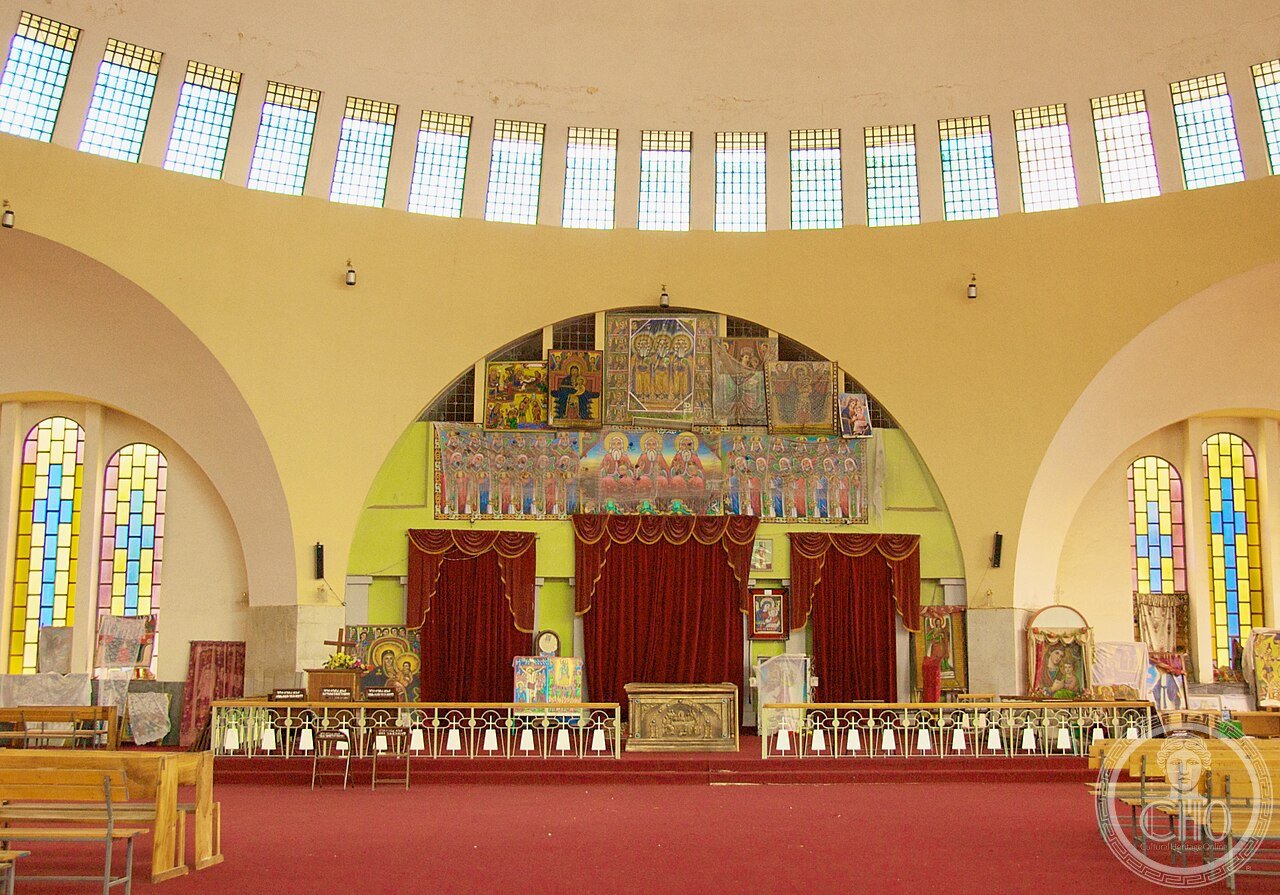
The complex today includes the Old Church, largely reflecting 17th-century restoration work with its own frescoes, and the New Church, a large domed structure built in the 1960s under Emperor Haile Selassie specifically to accommodate greater numbers of worshippers and pilgrims. The small, separate Chapel of the Ark, closed to all but the guardian monk, stands within the wider church precinct, its interior never seen by outside visitors or, indeed, by any other member of the church hierarchy.
Practical information
- Opening hours: the main church complex is generally open to visitors with seasonal variation; the Chapel of the Ark itself is never open to visitors; check current hours before visiting
- Address: Center Market area, Axum, Tigray Region, Ethiopia
Getting there
The Church of Our Lady Mary of Zion stands in the town of Axum, in Ethiopia’s northern Tigray Region, reachable by domestic flight to Axum Airport or by road. GPS: 14.1295° N, 38.7193° E.
Nearby
- Obelisks of Axum — UNESCO-listed ancient stelae, in the centre of Axum
- Queen of Sheba’s Palace ruins — archaeological site associated with the legendary queen, nearby
- Axum Archaeological Site — the wider ancient royal complex surrounding the town
Sources
- Wikipedia — “Church of Our Lady Mary of Zion” (en.wikipedia.org)
- Live Science — “Sorry Indiana Jones, the Ark of the Covenant Is Not Inside This Ethiopian Church” (livescience.com)
- Tablet Magazine — “Is the Ark of the Covenant in Ethiopia?” (tabletmag.com)
Find it on the map
See this place and what’s around it →📷 Become a Cultural Heritage Online photographer
Share your photos of places: they stay published under your name as the author. The more they're seen, the more you get noticed — and soon a contest will reward the most appreciated photos.
Log in or sign up free to add a photo