
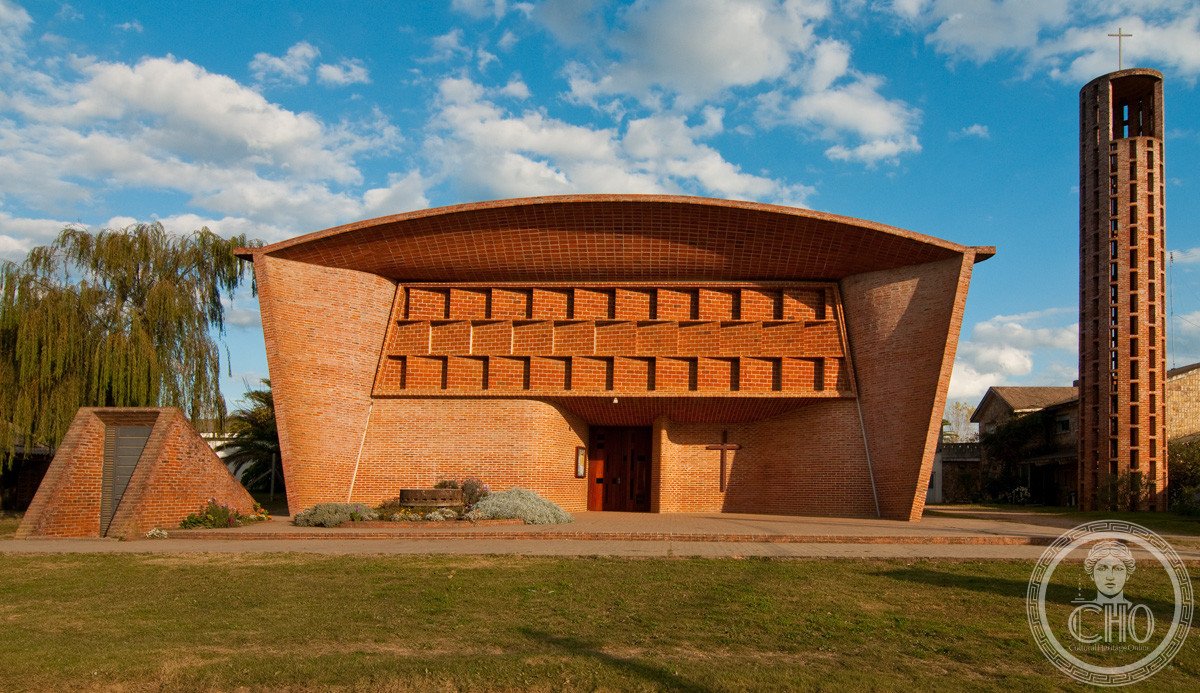
Eladio Dieste’s church of undulating brick – a UNESCO World Heritage masterpiece built from the humblest material by a provincial engineer who reinvented architecture.
At a glance
- Type
- Parish church
- Period
- 1958-1960
- Style
- Modern structural ceramics (reinforced brick)
- Location
- Estacion Atlantida, Canelones, Uruguay
- Coordinates
- -34.7633, -55.7517
- Engineer
- Eladio Dieste
Overview
The Church of Christ the Worker and Our Lady of Lourdes at Atlantida, 45 km from Montevideo, is built entirely of exposed brick in undulating walls and a wave-form roof that seem to defy structural logic. Engineer Eladio Dieste developed his own technology – ceramica armada, reinforced brickwork – to achieve forms of astonishing lightness with local materials and local labour. UNESCO inscribed the church on the World Heritage List in 2021 as a touchstone of modern architecture in Latin America.
History
A devout Catholic and self-described provincial engineer, Dieste accepted the commission for a workers’ parish on the Uruguayan coast and used it as a manifesto: great architecture need not be expensive, imported, or concrete. Completed in 1960, the church remained little known outside engineering circles for decades before critics recognized it as one of the great sacred buildings of the 20th century.
Architecture and Design
The side walls rise from straight foundations into sinusoidal curves of single-thickness brick, gaining stability from geometry rather than mass; the roof is a sequence of double-curvature brick vaults post-tensioned with thin steel. The freestanding bell tower of openwork brick and the underground baptistery lit by an alabaster oculus complete the ensemble. Light enters through onyx-glazed openings, washing the brick in gold.
Cultural significance
The Atlantida church proved that structural innovation could emerge from the global South with humble means – an inversion of the usual flow of architectural influence. Dieste’s reinforced ceramics influenced engineers worldwide, and the building’s 2021 UNESCO listing recognized what Kenneth Frampton called the most moving church interior of the modern era.
Visiting today
The church functions as an active parish; visitors are welcome outside Mass times, and a small interpretation center serves World Heritage visitors. The Atlantic beaches of Atlantida resort are ten minutes away.
Getting there
Buses on the Interbalnearia highway from Montevideo’s Tres Cruces terminal stop at Atlantida (about one hour); the church stands at Estacion Atlantida, inland from the beach town.
Sources and resources
Find it on the map
See this place and what’s around it →Record researched and written by Luigi De Marchi for Cultural Heritage Online, 2026.
📷 Become a Cultural Heritage Online photographer
Share your photos of places: they stay published under your name as the author. The more they're seen, the more you get noticed — and soon a contest will reward the most appreciated photos.
Log in or sign up free to add a photoIs this page about you?
This page is read by travellers and heritage enthusiasts who find it on Google. Tell us how you are connected to this place and we will take it from there.