
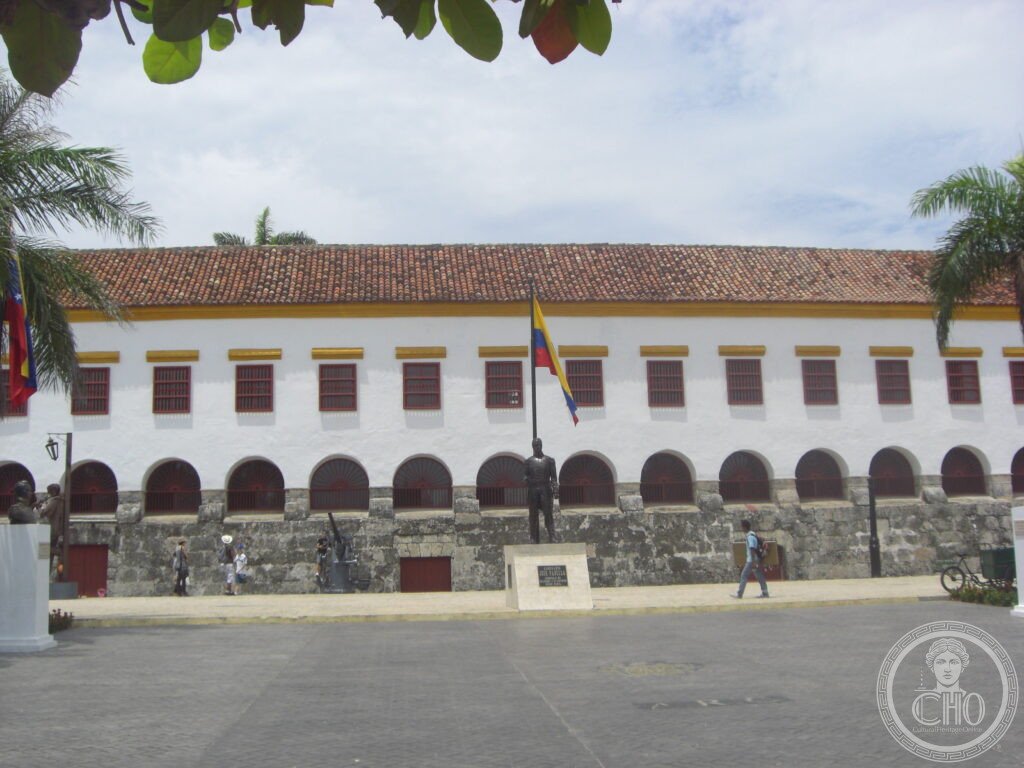
Cartagena de Indias
The most complete Spanish colonial fortified city in the Americas and the Caribbean and the primary port through which the wealth of the Spanish empire flowed to Europe — Cartagena de Indias (Bolívar Department, Colombia; UNESCO WHS 1984) is a walled colonial city on the Caribbean coast defended by the largest Spanish fortification in the Americas (the Castillo San Felipe de Barajas) and immortalized in the fiction of Gabriel García Márquez.
At a glance
Cartagena (the most precisely CartagenadIndias single walled city Ciudad Amurallada 11km walls 1586 1796 CE Castillo San Felipe de Barajas largest Spanish fortification Americas 1536 founded Pedro de Heredia 1 million enslaved Africans slave port 16th 18th century Peter of Claver Jesuit Gabriel Garcia Marquez Love Time Cholera El Getsemani Bocagrande UNESCO heritage: the walled city (the Ciudad Amurallada covers the historic core of Cartagena (approximately 2 km²; the area enclosed by the original walls); the two historic barrios: the Centro (the colonial-era commercial and religious center: the Plaza de los Coches (the old slave market), the Cathedral (1612 CE), the Iglesia de San Pedro Claver (1654 CE), the Palacio de la Inquisición (the offices of the Spanish Inquisition in Cartagena (established 1610 CE)), and the Iglesia de Santo Domingo (the oldest church in Colombia (1539 CE)); the Getsemaní (the African and mestizo neighborhood outside the walls; the most colorful and historically authentic neighborhood in the city; the former slave quarter; now the most artistic neighborhood in Cartagena)); the fortifications (the walls of Cartagena (murallas) were built in stages from 1586 to 1796 CE following a series of pirate attacks (the English privateer Francis Drake sacked and burned Cartagena in 1586 CE, prompting the Spanish crown to commission the Italian engineer Bautista Antonelli to design a comprehensive defensive system); the Castillo San Felipe de Barajas (the largest Spanish fortification in the Americas; built on the Cerro San Lázaro hill 1.5 km from the main gate of the walled city; the underground tunnel network (a system of tunnels connecting all parts of the fortress allowing movement under fire))) — the most precisely CartagenadIndias single walled city Ciudad Amurallada 11km walls 1586 1796 CE Castillo San Felipe de Barajas largest Spanish fortification Americas 1536 founded Pedro de Heredia 1 million enslaved Africans slave port Gabriel Garcia Marquez Love Time Cholera El Getsemani Bocagrande UNESCO heritage in any UNESCO world heritage site)).
Key facts
- The Slave Trade: the most precisely CartagenadIndias single 1 million enslaved Africans primary slave port Spanish Caribbean South America Pedro Claver Jesuit Saint 1580 1654 CE baptized 300000 slaves Iglesia San Pedro Claver 1654 relic body church UNESCO heritage — the most important moral fact about Cartagena’s history: the slave trade (between 1533 and 1810 CE, an estimated 1 million enslaved Africans passed through Cartagena on their way to the mines and plantations of the Spanish colonial interior; Cartagena was the primary slave port of South America (the principal rival port was Buenos Aires, for the Platine region); the Plaza de los Coches (the square just inside the main gate of the walled city, today surrounded by the characteristic yellow arcades; it was the location of the primary slave market of Cartagena from the late 16th century CE; the name “Plaza de los Coches” replaced the earlier name “Plaza de los Esclavos”)); Pedro Claver (1580-1654 CE; the Jesuit priest canonized as the “Apostle of the Africans”; he personally ministered to the enslaved Africans as they arrived on the slave ships, providing water, food, and medical care, and baptizing an estimated 300,000 enslaved people over 40 years; he was canonized by Pope Leo XIII in 1888 CE; his preserved body is in the high altar of the Iglesia de San Pedro Claver))
- GPS: 10.4212° N, -75.5536° E
History
From founding port to pirate target to independence (the most precisely CartagenadIndias single founded 1533 Pedro de Heredia Cenu Zenu indigenous Spanish Crown 1586 Francis Drake pirate sack Bautista Antonelli Italian engineer walls 1533 1694 1741 Vernon Blas de Lezo Battle Cartagena largest British defeat 1810 first independence Colombian Caribbean Gabriel Garcia Marquez Nobel Prize 1982 UNESCO heritage: the founding (1533 CE: Cartagena de Indias was founded by the Spanish explorer Pedro de Heredia at the site of a Zenu indigenous village; the natural harbor of the Cartagena Bay was the finest deep-water port on the Caribbean coast of South America; by 1545 CE, Cartagena was the primary departure port for Spanish galleons carrying silver from Potosi (Bolivia) and gold from Nuevo Granada (Colombia)); the pirate attacks (Cartagena was attacked more frequently than any other port in the Americas: the English privateer Francis Drake attacked and burned the city in 1586 CE (the most famous attack; the ransoming of the population led to the permanent decision to fortify the city); Sir John Hawkins attacked in 1568 CE; Sir Martin Frobisher attempted an attack in 1592 CE; the French pirate Jean-Bernard-Louis Desjean, Baron de Pointis, sacked the city in 1697 CE)); the Battle of Cartagena de Indias (1741 CE: the British Admiral Edward Vernon led the largest amphibious military operation in history (up to that time) against Cartagena: 186 warships, 2,000 cannons, and 23,600 men; the Spanish defender Blas de Lezo (a one-eyed, one-armed, one-legged admiral known as “Patapalo” (Peg-Leg)) held the city with approximately 3,600 troops for 67 days, until disease and Spanish reinforcements forced Vernon to withdraw; the defeat was the largest British military defeat before the American Revolution)) — the most precisely CartagenadIndias single founded 1533 Pedro de Heredia 1586 Francis Drake pirate sack Bautista Antonelli Italian engineer walls 1694 1741 Vernon Blas de Lezo Battle Cartagena largest British defeat 1810 first independence Nobel Prize Garcia Marquez 1982 UNESCO heritage in any UNESCO world heritage site)).
What you see
Walls, the Castillo, and the colorful barrios (the most precisely CartagenadIndias single 11km walls murallas bastions gates Puerta del Reloj main gate Plaza de los Coches slave market Castillo San Felipe Barajas 1536 tunnels underground network Blas de Lezo statue Getsemani street art Garcia Marquez birthplace sunset La Popa convent UNESCO heritage: the visitor circuit: the walls (the city walls (murallas) are walkable at the top for approximately 2 km (the main accessible section runs from the Puerta del Reloj (Clock Gate; the main gate of the historic city) eastward to the San Francisco bastion and south to the Santa Catalina bastion; the wall walk provides a raised view of the Caribbean Sea on one side and the colorful colonial rooftops of the Ciudad Amurallada on the other)); the Castillo San Felipe de Barajas (1.5 km east of the main gate; the largest Spanish fortification in the Americas; the underground tunnel network (open for guided tours; visitors walk through the tunnels designed to allow defenders to move under the cannon fire of attackers); the view from the highest point of the fortress across the Cartagena Bay to the islands and the Colombian Caribbean coast; the statue of Blas de Lezo at the entrance)); the Getsemaní (the most interesting neighborhood in Cartagena for walking: the street art (Getsemaní has the most concentrated collection of political and social street art in the city); the Plaza de la Trinidad (the main square of Getsemaní; the evening gathering point for residents and young travelers; the most “local” plaza in Cartagena))) — the most precisely CartagenadIndias single 11km walls murallas Puerta del Reloj main gate Plaza de los Coches Castillo San Felipe Barajas 1536 tunnels underground network Blas de Lezo Getsemani street art sunset La Popa convent UNESCO heritage in any UNESCO world heritage site)).
Practical information
- Getting there: fly to Rafael Núñez International Airport (CTG; 3 km northeast of the historic center; taxi approximately COP$25,000 (€6); direct flights from Bogotá (BOG; all Colombian airlines; 1h15m), Medéllín (MDE; 1h), and Miami (MIA; American Airlines; 3h)); the walk (the historic center is extremely walkable; the distances from the Puerta del Reloj to the Iglesia de San Pedro Claver (5 min walk), the Castillo San Felipe (15 min walk from the main gate), and the Getsemaní (10 min walk through the arch gate)); the best times (December-April is the dry season (the “temporada alta”; the best weather but the highest hotel prices and tourist numbers); May-November is the wet season (brief but heavy afternoon rain; the city is much less crowded; the prices drop significantly)); the Colombian context (Cartagena is a department capital of Bolívar; it is the primary tourist destination in Colombia; the city has Colombia’s highest cost of living for travelers (hotel prices in the Ciudad Amurallada are comparable to European capitals); the Getsemaní neighborhood has better value)
Getting there
Fly to Cartagena (CTG, 3 km from center, taxi ~€6). Direct from Bogota (1h15m), Miami (3h). Walkable historic center. Dry season (Dec-Apr) best weather. GPS: 10.4212, -75.5536.
Nearby
- Islas del Rosario — 35 km southwest (the marine national park of the Colombian Caribbean: 30 coral islands and cays; the best coral reef diving and snorkelling on the Caribbean coast of South America; boat tours from Cartagena daily (approximately 1h30m crossing; COP$70,000/€17 round trip); the largest island, Isla Grande, has Caribbean-style wooden houses and guesthouses available for overnight stays))
- Mompos (Mompox) — 250 km south (UNESCO WHS 1995; the most perfectly preserved colonial town in Colombia; population 50,000; the town on the Magdalena River that Gabriel García Márquez used as the model for Macondo in One Hundred Years of Solitude; no cars within the historical core; Spanish colonial architecture in perfect preservation; almost no international tourists)
Sources
- Wikipedia, Cartagena, Colombia; Pedro Claver; Battle of Cartagena de Indias (1741), accessed June 2026
- UNESCO, Port, Fortresses and Group of Monuments, Cartagena, WHS reference 285, inscribed 1984
Find it on the map
See this place and what’s around it →📷 Diventa un fotografo di Cultural Heritage Online
Condividi le tue foto dei luoghi: restano pubblicate con la tua firma come autore. Più vengono viste, più ti fai conoscere — e presto un concorso premierà le foto più apprezzate.
Accedi o registrati gratis per aggiungere una foto