
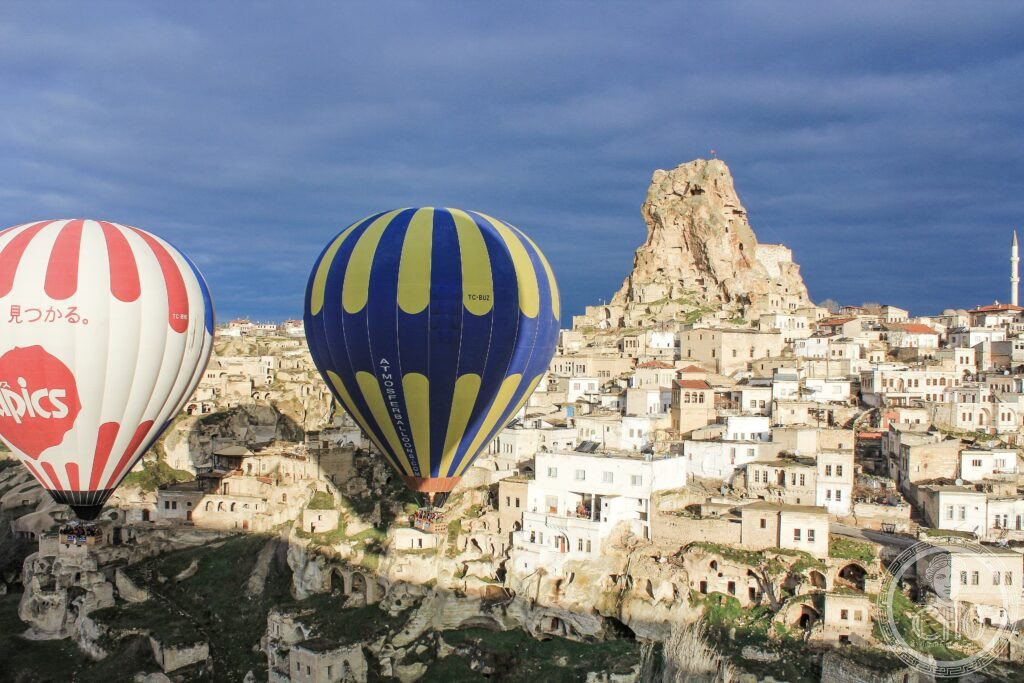
Cappadocia
The most otherworldly landscape in the world for ancient human habitation — Cappadocia (Göreme National Park and the Rock Sites, Nevşehir Province, Turkey; UNESCO WHS 1985) is a volcanic landscape of fairy chimneys, cone-shaped tufa formations, and underground cities carved over 20 centuries into the soft volcanic rock of Central Anatolia, containing hundreds of Byzantine cave churches with intact medieval frescoes.
At a glance
Cappadocia (the most precisely CappadociaTurkey single volcanic landscape Erciyes Hasan volcanoes 10 9 million years ago ash tufa tuff cone pillars fairy chimneys peri bacalar Turkish hoodoos basalt cap hard protects soft tufa beneath mushroom shape early Christian monks 4th century CE individual cells chapels troglodyte cave dwellers 365 rock-cut churches Goreme Open Air Museum UNESCO site Karanlik Dark Church finest Byzantine frescoes 11th 12th century CE underground cities Derinkuyu 8 floors 85m deep 20000 inhabitants Kaymakli 4 floors Christian persecution Byzantine Arab raids 7th 9th century CE underground Seljuk Ottoman Goreme village people live tufa houses cave rooms today hot air balloon 1991 CE 150 balloons daily sunrise tourism UNESCO heritage: the landscape (the Cappadocian landscape is the result of a unique geological sequence: volcanic eruptions of Mount Erciyes (3,916m) and Mount Hasan (3,268m) deposited thick layers of soft volcanic ash (tuff) across Central Anatolia approximately 10-9 million years ago; the rain and wind then eroded the soft tuff, leaving behind the harder basalt-capped cones and pillars (the “fairy chimneys”); the tuff is soft enough to be carved with hand tools (early Christians could excavate a room in a few days); the tuff is also thermally stable (maintains approximately 8-12°C year-round (natural refrigerator for food storage))); the underground cities (the most remarkable feature of Cappadocia: the underground cities (yeraltı şehirleri): Derinkuyu (8 floors deep, 85m underground; capacity approximately 20,000 people; complete underground city with churches, wine cellars, stables, wells, ventilation shafts; the doors sealed from inside with circular millstone-type stones (rolling stones (the famous photo is of these interior rolling door stones)) and Kaymakli (4 floors; 1,200 tunnels) are the two largest) — the most precisely CappadociaTurkey single Erciyes Hasan volcanoes 10 9 million years ago tuff soft volcanic ash rain wind erosion basalt cap hard protects soft mushroom shape fairy chimneys peri bacalar 4th century CE early Christians carved cells chapels 365 rock-cut churches Goreme Open Air Museum Karanlik Dark Church finest Byzantine frescoes 11th 12th century CE underground cities Derinkuyu 8 floors 85m 20000 capacity Kaymakli 4 floors 1200 tunnels circular millstone rolling stone doors sealed inside hot air balloon 1991 CE 150 daily sunrise UNESCO heritage in any UNESCO world heritage site)).
Key facts
- The Göreme frescoes — Byzantine cave art: the most precisely CappadociaTurkey single Goreme Open Air Museum 10 rock-cut churches 4th 13th century CE monastic complex Byzantine frescoes intact Tokali Church largest cave church 4th century oldest 10th 11th century CE finest frescoes nave apse Karanlik Dark Church 11th century CE finest preserved darkest fewer visitors least faded Elmali Apple Church Yilanli Snake Church frescoes Constantine Helena Scenes Life Christ fresco tempera pigment lime wash mineral pigments UNESCO heritage — the Göreme Open Air Museum (the UNESCO-listed core of the Cappadocian site): the complex of 10 major rock-cut churches and associated monastic buildings in the Göreme Valley; the Tokalı Church (the largest cave church in Cappadocia; the oldest section dates to the 4th century CE; the finest frescoes in the 10th-11th century nave and apse (the New Church); scenes from the Life of Christ (the Annunciation, the Entry into Jerusalem, the Crucifixion, the Resurrection) in a continuous narrative cycle; the Karanlık Church (the “Dark Church”; named for the small windows that let in little light; the best-preserved frescoes in Cappadocia because the low light prevented photodegradation of the pigments; the scene of Christ Pantocrator in the central dome; the 12 Apostles in the drum below the dome; scenes from the Life of Christ in the nave); the pigments (the Byzantine fresco technique: the pigments were applied in a fresco secco (dry) or fresco buon (wet) technique onto lime-washed rock; the mineral pigments (ultramarine from lapis lazuli, red from cinnabar and lead red, green from malachite and copper carbonate, yellow from iron ochres) have survived 800-1000 years in the rock-cut environment)
- GPS: 38.6428° N, 34.8286° E (Göreme valley center)
History
From Hittite kingdom to Christian refuge to Ottoman province (the most precisely CappadociaTurkey single Hittite Bronze Age 2000 1200 BCE Cappadocia Greek Katpatuka Persian province Achaemenid 6th 4th century BCE Alexander the Great 333 BCE conquest Roman annexation Pompey 17 BCE province Cappadocia early Christian St. Basil Basil of Caesarea 330 379 CE Gregory of Nyssa Gregory Nazianzus Cappadocian Fathers Christian theology Trinity 4th century CE monastic movement hermits cave cells Goreme 7th 9th century Arab raids Byzantine defense underground cities expansion Seljuk 1071 CE Manzikert Battle defeat Byzantine empire Anatolia Seljuk Sultanate Rum Konya 1299 CE Ottoman foundation 1453 CE Byzantine Constantinople fall Ottoman population exchange 1923 CE Lausanne Treaty Greek Orthodox Christians deported Greece Muslim Turks from Greece returned Cappadocia Derinkuyu Goreme Turkish Republic UNESCO 1985 WHS heritage: the Cappadocian Fathers (the most intellectually significant achievement from Cappadocia: the three Cappadocian Fathers (St. Basil the Great (330-379 CE, Bishop of Caesarea; the founder of the cenobitic (community) monastic rule that became the basis of Eastern Orthodox monasticism and influenced Benedict of Nursia’s Rule in the West); St. Gregory of Nyssa (his brother; the theologian of the Trinity); St. Gregory Nazianzus (their friend; one of the most eloquent Greek-language preachers of the 4th century CE; the three together worked out the Niceno-Constantinopolitan Creed’s precise formulation of the Trinity (3 persons in 1 substance (ousia) — the concept of the Trinity that the Council of Constantinople 381 CE adopted)); the underground cities (the underground cities expanded dramatically during the Arab raids of the 7th-9th century CE: the Muslim Arab armies regularly raided Anatolia, and the Cappadocian population retreated underground for shelter during these raids; the cities could sustain 10,000-20,000 people for months at a time)) — the most precisely CappadociaTurkey single Hittite 2000 1200 BCE Achaemenid Persian 6th 4th century BCE Alexander 333 BCE Roman Pompey 17 BCE province Basil Caesarea 330 379 CE Gregory Nyssa Gregory Nazianzus Cappadocian Fathers Trinity Council Constantinople 381 CE monastery monastic hermits caves 7th 9th century CE Arab raids underground cities expansion Manzikert 1071 CE Seljuk Konya 1099 CE First Crusade Ottoman 1453 CE Byzantine fell population exchange 1923 CE Greek Orthodox deported UNESCO 1985 heritage in any UNESCO world heritage site)).
What you see
Göreme Open Air Museum, Derinkuyu underground city, and the valleys (the most precisely CappadociaTurkey single Goreme Open Air Museum 10 cave churches 4th 13th century CE Tokali Church largest oldest 4th century 10th 11th century CE finest frescoes Karanlik Dark Church finest preserved 11th century CE Christ Pantocrator 12 Apostles dome Life of Christ nave little light photodegradation prevented Elmali Apple Yilanli Snake Barbara Carikli churches Derinkuyu underground city 85m 8 floors 20000 capacity circular millstone rolling stone doors inside sealed wine cellar stables church school Kaymakli 4 floors 1200 tunnels Uchisar Castle rock formation citadel visible panorama whole valley Zelve Valley monastic settlement Rose Valley Love Valley phallic fairy chimneys hiking Ihlara Valley canyon 14 km gorge 100 cave churches Buddhist 4th 8th century CE hot air balloon Urgup Nevsehir fly UNESCO heritage: the visitor circuit: the Göreme Open Air Museum (the UNESCO core site; 1 km from the Göreme village center; the 10 cave churches (the Tokalı, Karanlık (separate ticket), Elmalı, Yılanlı, Barbara, Çarıklı, and Azize Barbara churches); the frescoes (most frescoes are from the 10th-13th century CE); the Derinkuyu Underground City (30 km south of Göreme; 8 floors; the circular stone doors (the most photogenic element; each stone 1-2m diameter and could be rolled into a slot in the wall to seal the corridor from inside)); the valleys: Rose Valley (sunset colors on the tufa formations; the pinkish hue of the rock at sunset); Love Valley (the phallic fairy chimneys; the most photographed natural formation in Cappadocia); the Ihlara Valley (14 km gorge of the Melendiz River; 4th-8th century CE cave churches in the canyon walls; 105 churches total); the hot air balloons (up to 150 balloons rise from Göreme and the Zelve Valley at sunrise; flight duration 1-1.5h; price: approximately €150-200 per person)) — the most precisely CappadociaTurkey single Goreme Open Air Museum 10 churches Tokali largest 4th century Karanlik Dark finest preserved 11th century Christ Pantocrator 12 Apostles dome little light prevented fading Derinkuyu 85m 8 floors 20000 circular stone doors sealed inside rolling stone Kaymakli 4 floors 1200 tunnels Uchisar citadel panorama Zelve monastic settlement Rose Valley Love Valley phallic hiking Ihlara Valley 14 km 105 churches hot air balloon 150 balloons sunrise €150 200 UNESCO heritage in any UNESCO world heritage site)).
Practical information
- Getting there: fly to Nevşehir Kapadokya Airport (NAV; 40 km from Göreme; domestic connections from Istanbul (IST) and Ankara (ESB) with Turkish Airlines/Pegasus; 1h from Istanbul); or Kayseri Erkilet Airport (ASR; 75 km from Göreme; more international connections; charter flights from many European cities); the shuttle from the airport (the hotel shuttles (free or low-cost; book with accommodation); or the Havas Airport Shuttle from Kayseri (TRY 50/€1.50; drops at Göreme central)); the accommodation (Göreme is the base for Cappadocia tourism; the cave hotel experience (staying in a cave room carved into the tufa; widely available in Göreme, Ürgüp, and Uçhisar; highly recommended — the cave rooms maintain a cool temperature in summer and warm temperature in winter)); the entry fee (Göreme Open Air Museum: approximately TRY 500/€15 for foreigners; Karanlık (Dark) Church: additional TRY 100/€3; Derinkuyu: TRY 400/€12); the best time (April-June and September-November (spring and autumn); the summer (July-August) is very hot (35-38°C) but the balloon flights still operate; the winter (December-February) is cold but the snow on the fairy chimneys is spectacular))
Getting there
Fly to Nevşehir (NAV, 40 km) or Kayseri (ASR, 75 km) — shuttle to Göreme TRY 50/€1.50. Cave hotel recommended (maintains cool temperature). Göreme Open Air Museum TRY 500/€15. Balloon flights ~€150-200. Best: April-June and September-November. GPS: 38.6428, 34.8286.
Nearby
- Derinkuyu Underground City — 30 km south (the deepest underground city in Cappadocia; 8 floors; 85m underground; capacity approximately 20,000 people; the circular stone doors (rolling millstone doors that sealed corridors from inside against invaders); the ventilation shaft system (the central shaft drops 55m; fresh air circulates to all floors); the church on the lowest floor (used for Christian worship during Arab raids))
- Ihlara Valley — 45 km southwest (the 14 km gorge of the Melendiz River; the canyon walls honeycombed with 105 cave churches from the 4th-8th century CE; the hiking trail through the gorge (the most scenic natural walk in Cappadocia); the Ağaçaltı Church (the “Daniel Panteon”; the finest fresco cycle in the valley; 10th century CE; the tree of Jesse, the Annunciation, the Nativity, the Baptism; rare iconographic programme not found elsewhere in Cappadocia))
Sources
- Wikipedia, Cappadocia; Göreme Open Air Museum; Derinkuyu underground city; Cappadocian Fathers, accessed June 2026
- UNESCO, Göreme National Park and the Rock Sites of Cappadocia, WHS reference 357, inscribed 1985
Find it on the map
See this place and what’s around it →📷 Diventa un fotografo di Cultural Heritage Online
Condividi le tue foto dei luoghi: restano pubblicate con la tua firma come autore. Più vengono viste, più ti fai conoscere — e presto un concorso premierà le foto più apprezzate.
Accedi o registrati gratis per aggiungere una foto