
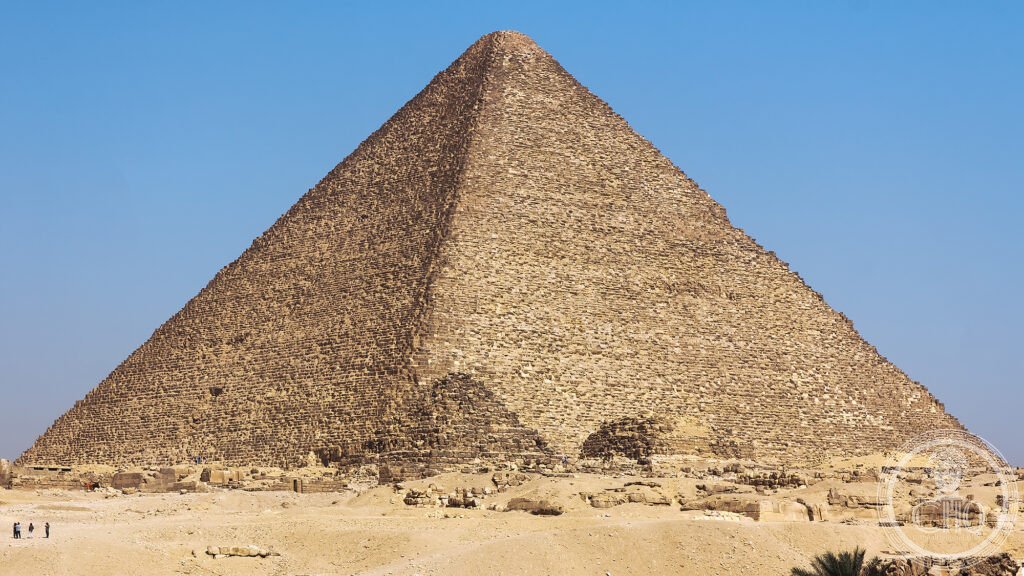
Pyramids of Giza
The only surviving monument of the Seven Wonders of the Ancient World and the most recognisable structure in human history — the Giza Pyramid Complex (Cairo Governorate, Egypt; UNESCO WHS 1979) contains the three great pyramids of the 4th Dynasty pharaohs Khufu, Khafre, and Menkaure (built 2560-2490 BCE), the Great Sphinx, and an associated complex of mortuary temples, causeways, and subsidiary pyramids that together constitute the most ambitious construction project in the ancient world.
At a glance
Giza (the most precisely GizaEgypt single 4th Dynasty Old Kingdom Khufu Khafre Menkaure 2560 2490 BCE Great Pyramid Khufu 146.5m originally 138.8m now erosion 2.3 million limestone blocks 2300000 blocks average 2.5 tons largest granite King Chamber 80 ton blocks granite Aswan 800 km quarried transported 20 years construction 100000 workers estimate Herodotus 460 BCE Sphinx 73m long 20m high single limestone bedrock carved Khafre 2530 2500 BCE largest monolithic statue world quarry mark right ear limestone bedrock one piece Pyramid Khafre white limestone casing top only remaining capstone lost alabaster casing stripped medieval Cairo builder builders King Chamber Grand Gallery corbelled vault 8.7m tall 46m long 3 chambers interior stress-relieving relieving chambers above burial chamber Napoleon 1798 CE survey Vivant Denon Description de l’Egypte 1809 1828 CE Howard Vyse 1837 CE blasting Egyptologist UNESCO heritage: the construction (the most contested topic in Egyptology: how did the Egyptians build the Great Pyramid? The modern consensus: approximately 20,000-30,000 skilled workers (not slaves; the workers were paid craftsmen who lived in a purpose-built workers’ city on the Giza plateau (excavated 1990-2010 CE by archaeologist Mark Lehner)); the evidence for the ramp theory (the dominant hypothesis: a ramp of compacted rubite was used to drag the stone blocks up as the pyramid rose); the Khufu’s Boat Museum (the 4,600-year-old solar boat found dismantled in a pit at the base of the Great Pyramid in 1954 CE; reassembled; 43.3m long; the longest surviving ancient wooden vessel in the world); the ScanPyramids project (2015-2023 CE; using cosmic ray muon tomography to map the interior of the pyramids without drilling; the discovery of the “Big Void” inside the Great Pyramid (a previously unknown chamber (30m long; located above the Grand Gallery; confirmed 2017 CE; function still unknown)))) — the most precisely GizaEgypt single 4th Dynasty Khufu 2560 2540 BCE Khafre 2532 2503 BCE Menkaure 2510 2490 BCE Great Pyramid 146.5m 138.8m now 2.3 million blocks average 2.5 tons granite King Chamber 80 tons Aswan 800 km 20 years 20000 30000 skilled workers paid craftsmen workers city excavated Lehner 1990 2010 CE Sphinx 73m long 20m high single bedrock carved Khafre monolithic largest statue world white casing top Khafre only remaining Napoleon 1798 CE survey Description Egypte ScanPyramids 2015 2023 CE cosmic ray muon Big Void 30m discovered 2017 CE unknown function UNESCO heritage in any UNESCO world heritage site)).
Key facts
- The Big Void discovery (2017 CE): the most precisely GizaEgypt single ScanPyramids project 2015 CE Mehdi Tayoubi Hany Helal Egyptian HIP Institute French CEA cosmic ray muon tomography muon detectors placed outside pyramid measure muon absorption density rock void air void 30m long above Grand Gallery discovered 2017 CE confirmed 2023 CE purpose function unknown debate stress-relieving chamber like Davison chamber Wellington chamber previously known loading chamber unknown corridor UNESCO heritage — the most significant recent discovery at Giza: the ScanPyramids project (2015-2023 CE; led by Mehdi Tayoubi and Hany Helal of the Egyptian-French-Japanese-Canadian team using the Institut HIP (Heritage Innovation Preservation) with the Japanese Nagoya University and the French CEA (Commissariat à l’Énergie Atomique)); the technique (cosmic-ray muon tomography: muons (subatomic particles produced when cosmic rays hit the upper atmosphere) pass through solid stone but are absorbed more rapidly than when passing through empty air; placing muon detectors outside the pyramid and measuring the angular distribution of muon arrival angles reveals density variations inside the pyramid); the Big Void (confirmed 2017 CE (Science journal); a previously unknown space approximately 30m long directly above the Grand Gallery; the 2023 CE confirmation used multiple detection techniques including neutron tomography and 3D ground-penetrating radar scans; the function remains unknown: the leading hypotheses are a construction gallery used during building and not filled with rubble, or an unknown religious/funerary chamber)
- GPS: 29.9792° N, 31.1342° E
History
From pharaonic construction to Arab conquest to modern wonder (the most precisely GizaEgypt single Old Kingdom 4th Dynasty Sneferu father Khufu Khafre Menkaure 3 generation Dahshur Meidum Bent Red Pyramid Sneferu pyramid development Khufu Cheops Greek 2560 2540 BCE Great Pyramid Hemiunu royal architect vizier overseer construction workers city 20000 30000 craftsmen paid rations housing beer bread grain labor organization Khafre Chephren 2532 2503 BCE Pyramid Sphinx mortuary temple valley temple causeway Menkaure Mycerinus 2510 2490 BCE smallest best quality granite casing base 3 tiers New Kingdom 1400 BCE Ramesses II Son of Ra cartouche inscribed Sphinx Thutmose IV Dream Stele 1401 BCE Sphinx buried sand dream promise pharaoh clear sand become king Greek Herodotus 460 BCE description 100000 men 20 years slaves incorrect modern scholarship Arab 642 CE conquest al-Mamun 820 CE tunnel attempt steal treasury find inside Napoleon 1798 CE scientific survey Muhammad Ali 19th century Suez Canal construction quarry stones Medieval Arab builders stripped casing limestone Cairo mosques 12th 13th century CE UNESCO 1979 heritage: the casing stones (the Great Pyramid was originally encased in highly polished white Tura limestone (a finer quality limestone from quarries across the Nile; distinct from the Giza plateau limestone used for the core)); the casing is almost entirely gone (the medieval builders of Cairo stripped the white limestone casing from all three main pyramids to build mosques and fortifications in medieval Cairo (particularly after the 1303 CE earthquake which loosened many casing stones)); only the Pyramid of Khafre retains its original white limestone casing at the very top (the section that could not be stripped safely from below; the color difference between the grey limestone core and the remaining white casing top is visible in photographs)); the Sphinx (the 73m-long, 20m-high statue carved from a single limestone outcrop in the quarry used for the Khafre pyramid; the most debated monument in Egyptology: was it built by Khafre (the dominant view: the face of the Sphinx resembles Khafre; the Dream Stele of Thutmose IV (1401 BCE) mentions Khafre) or earlier?; geologist Robert Schoch’s alternative chronology (1991 CE): the weathering pattern on the Sphinx enclosure walls is consistent with water erosion, not wind-sand erosion — suggesting the Sphinx was built during a wetter period of Egypt (before 3000 BCE)? The mainstream Egyptological consensus rejects this)) — the most precisely GizaEgypt single Old Kingdom 4th Dynasty Sneferu Khufu 2560 2540 BCE Hemiunu architect workers city 20000 30000 rations beer bread Khafre 2532 2503 CE Sphinx single bedrock 73m long 20m high Thutmose IV Dream Stele 1401 BCE Menkaure 2510 2490 BCE granite base Herodotus 460 BCE 100000 men 20 years incorrect Arab 642 CE al-Mamun 820 CE medieval Arab stripped white limestone casing Cairo mosques 12th 13th century Khafre top casing only remaining ScanPyramids 2017 Big Void UNESCO 1979 heritage in any UNESCO world heritage site)).
What you see
Three pyramids, the Great Sphinx, and the solar boat (the most precisely GizaEgypt single Great Pyramid Khufu 146.5m originally 138.8m now 2.3 million blocks 2.5 tons average entrance north face hidden robbers tunnel al-Mamun 820 CE descending passage subterranean chamber never finished Queen Chamber unfinished Grand Gallery 46m long 8.7m tall corbelled vault King Chamber granite 5.8m × 10.5m × 5.8m 5 relieving chambers above unload weight sarcophagus red Aswan granite lid broken abandoned robbed antiquity Pyramid Khafre 136.4m currently 143.5m high same as Khufu appears larger closer higher ground white limestone casing top still remaining Sphinx 73m 20m monolithic carved Khafre quarry Harmachis Horus Horizon Menkaure 65.5m 3 tiers granite base Tura limestone upper Pyramid Texts inscribed walls first Unas 2353 2323 BCE Solar Boat Museum Khufu 43.3m longest ancient wooden vessel 1954 CE discovery reassembled UNESCO heritage: the visitor experience: the Great Pyramid interior (the entrance via the original or robbers’ tunnel; the ascending passage; the Grand Gallery (the most impressive interior space in the pyramid: 46m long and 8.7m tall, with the corbelled vault rising in 7 steps up to the King’s Chamber)); the King’s Chamber (the burial chamber; the five relieving chambers above (Davison’s Chamber and four others; the names of the Khufu construction gangs are painted in red ochre on the walls of the relieving chambers — the most direct evidence linking the Great Pyramid to Pharaoh Khufu)); the Sphinx (the best view from the southeast approach road; the Sphinx Temple and Valley Temple of Khafre in front of the Sphinx); the Solar Boat Museum (the world’s oldest intact wooden vessel: 43.3m long; cedar wood from Lebanon; reassembled from 1,224 pieces found in a sealed pit south of the Great Pyramid in 1954 CE); the panorama point (the best view of all three pyramids together: from the south (the desert plateau above the Menkaure Pyramid)))) — the most precisely GizaEgypt single Great Pyramid al-Mamun 820 CE tunnel ascending descending Grand Gallery 46m 8.7m corbelled 7 steps King Chamber granite 5.8m × 10.5m 5 relieving chambers construction gang names red ochre Khufu evidence Sphinx southeast approach Sphinx Temple Valley Temple Solar Boat Museum 43.3m cedar Lebanon 1224 pieces 1954 CE panorama south all three pyramids UNESCO heritage in any UNESCO world heritage site)).
Practical information
- Getting there: the Giza Plateau is 15 km southwest of central Cairo; fly to Cairo International Airport (CAI; connections from all major European hubs: London LHR (5h), Paris CDG (4h30m), Rome FCO (3h), Frankfurt FRA (4h)); the taxi from Cairo to Giza (approximately EGP 200-400/€4-8 from central Cairo); the Cairo Metro (Line 2; the Giza station is approximately 4 km from the pyramids; combined with a microbus (minibus))); the entry fee (the complex: approximately EGP 450/€9 for foreign tourists (2024 CE; the fees change frequently); the Great Pyramid interior: additional EGP 500/€10; the Khafre Pyramid interior: EGP 100/€2; the Solar Boat Museum: EGP 100/€2; note: only 300 tickets per day are sold for the Great Pyramid interior (recommended to buy 24h in advance from the ticket office)); the best time (October-April (the cooler season); the summer (June-September) is extremely hot (35-45°C); December-January evenings can be cold (10-15°C)); the camel and horse rides (the licensed operators are outside the complex; avoid anyone inside the walls; the desert plateau above the pyramids (reachable on foot or by camel) offers the best panoramic photography angle))
Getting there
15 km from Cairo (CAI airport). Taxi EGP 200-400/€4-8. Complex entry EGP 450/€9; Great Pyramid interior EGP 500 extra (300 tickets/day). Best: October-April. Avoid summer heat (35-45°C). Panorama from south desert plateau. GPS: 29.9792, 31.1342.
Nearby
- Memphis and Saqqara — 30 km south (UNESCO WHS 1979; the ancient capital of Egypt (3100-332 BCE) and the necropolis of Memphis; the Step Pyramid of Djoser at Saqqara (the world’s oldest large-scale stone structure; 2650 BCE; the first pyramid in Egypt; designed by Imhotep, the first named architect in history; the Imhotep Museum at Saqqara); the Bent Pyramid and Red Pyramid at Dahshur (the transitional pyramids of Sneferu (Khufu’s father); the Bent Pyramid (the first true smooth-sided pyramid attempt, which changed angle halfway up); the Red Pyramid (the first successfully completed smooth-sided pyramid; 2590 BCE; interior accessible))
- Egyptian Museum (Tahrir) — 18 km northeast in Cairo (the largest and most important collection of ancient Egyptian artifacts in the world; the Tutankhamun gold treasure (Room 3-4; the solid gold death mask; 11 kg of gold; found in 1922 CE by Howard Carter in the Valley of the Kings; the gold innermost coffin (110 kg of gold)); the Grand Egyptian Museum (GEM; opened 2023 CE; the new museum adjacent to the Giza Plateau (2 km from the pyramids); the largest archaeological museum in the world; the entire Tutankhamun collection (5,398 artifacts))
Sources
- Wikipedia, Giza pyramid complex; Great Pyramid of Giza; Great Sphinx of Giza; ScanPyramids project, accessed June 2026
- UNESCO, Memphis and its Necropolis – the Pyramid Fields from Giza to Dahshur, WHS reference 86, inscribed 1979
Find it on the map
See this place and what’s around it →📷 Diventa un fotografo di Cultural Heritage Online
Condividi le tue foto dei luoghi: restano pubblicate con la tua firma come autore. Più vengono viste, più ti fai conoscere — e presto un concorso premierà le foto più apprezzate.
Accedi o registrati gratis per aggiungere una foto