

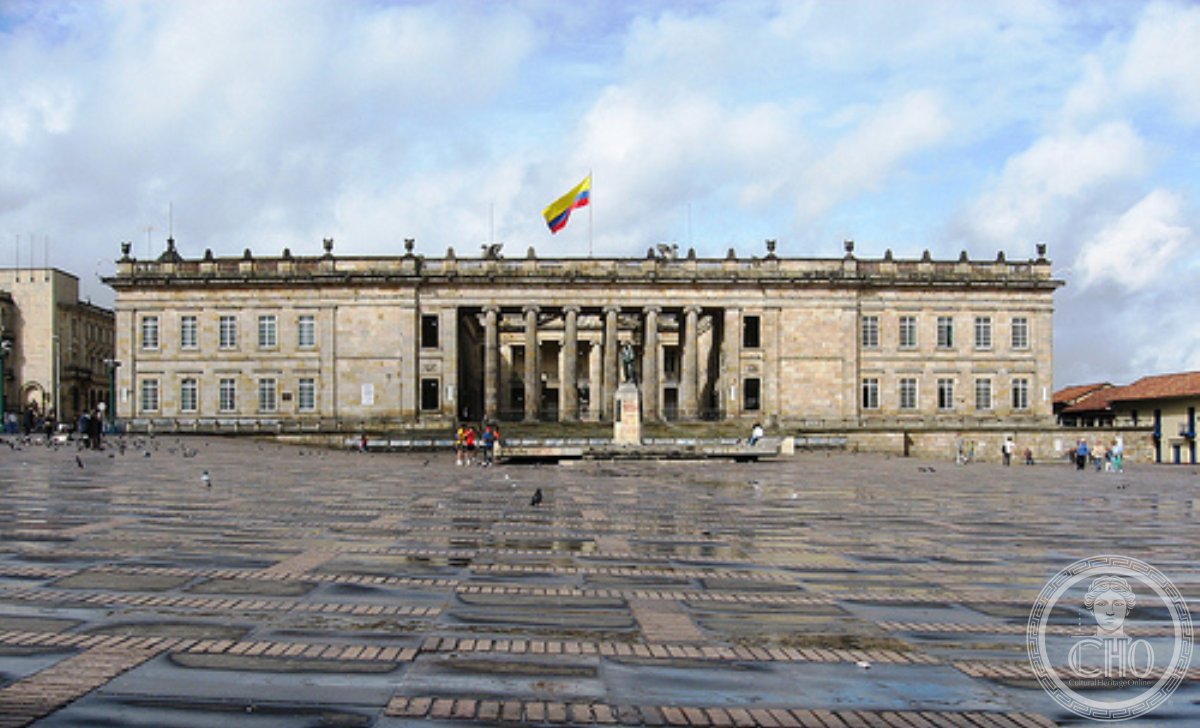
Commanding the southern edge of Plaza de Bolívar in the heart of old Bogotá, the Capitolio Nacional de Colombia is one of the most consequential buildings in South American political architecture. Its severe Greek Revival colonnade — the result of a construction campaign that spanned an extraordinary seventy-eight years — embodies both the aspirations and the contradictions of a young nation building its institutions across decades of war, change, and reinvention. Begun in 1848 to a design by the Irish-born architect Thomas Reed, the building was not inaugurated until 1926, its long gestation interrupted repeatedly by civil conflict and economic crisis. Today it houses both chambers of the Colombian Congress and remains an active seat of national legislative power, a place where architecture and history are inseparable from the daily work of democratic government.
At a glance
- Type
- National Legislature / Capitol Building
- Period
- Construction 1848–1926
- Style
- Neoclassical (Greek Revival)
- Location
- Plaza de Bolívar, La Candelaria, Bogotá, Colombia
- Coordinates
- 4.5975° N, 74.0764° W
- Architect(s)
- Thomas Reed
- Heritage Status
- National Monument of Colombia
Overview
The Capitolio Nacional is the seat of the Congress of Colombia, housing both the Senate and the House of Representatives. It occupies the entire southern flank of Plaza de Bolívar, Bogotá’s historic central square, where it anchors an ensemble that also includes the Cathedral Primada and the Palace of Justice. The building is classified as a National Monument and continues to function as an active legislature, meaning that access for visitors is regulated and generally limited to guided tours and civic events. Its long construction history — spanning nearly eight decades — makes it a singular case study in the challenges of institution-building in nineteenth-century Latin America.
History
The foundation stone was laid on 20 July 1848, the anniversary of Colombian independence, a date chosen deliberately to link the new building to national memory. Thomas Reed, an Irish architect working in Colombia, produced the original design in a severe Greek Revival idiom. Progress was repeatedly halted by the civil wars that punctuated Colombian political life throughout the second half of the nineteenth century. Successive governments resumed and suspended construction across decades, with each new administration leaving its mark on the evolving structure. The building was finally inaugurated on 7 August 1926, seventy-eight years after its foundation — the same date as the national independence celebration — closing one of the longest construction histories in the continent’s architectural record.
Architecture & Design
Reed’s design draws on the Greek Revival mode then fashionable for civic buildings in both Europe and the Americas, deploying a monumental Doric colonnade that stretches the full width of the Plaza de Bolívar facade. The restrained exterior gives way to richly decorated interiors, where the most celebrated space is the Elliptic Chamber, its ceiling vault covered by a large fresco painted in 1947 by Santiago Martínez Delgado depicting Bolívar and Santander at the Congress of Cúcuta during the founding of Gran Colombia. Earlier murals by Ignacio Gómez Jaramillo, dating from 1938, line additional chambers, giving the building a layered artistic identity that accumulated across the same decades as its physical construction.
Cultural significance
The Capitolio Nacional has been the scene of defining moments in Colombian political history: constitutional crises, impeachments, landmark legislation, and the dramatic events of the Bogotazo in 1948, when the assassination of Jorge Eliécer Gaitán triggered nationwide unrest that left the surrounding district in ruins while the Capitol itself survived. In 1947 it hosted the Inter-American Conference, a hemispheric gathering that confirmed Bogotá’s standing as a continental capital. The building is a rare example of a structure whose construction history is itself a document of national history, each resumed phase mirroring a moment of renewed political stability.
Visiting today
The Capitolio Nacional is an active legislature and access is regulated. Guided tours of the public areas, including the principal chambers and mural galleries, are organized by the Congress of Colombia and can be arranged through the official congressional website or at the visitor reception on Plaza de Bolívar. Visits during legislative sessions are subject to security protocols. The building’s exterior and the plaza itself are freely accessible at all hours.
Getting there
Plaza de Bolívar is the historic centre of Bogotá’s La Candelaria district and is well served by public transport. TransMilenio bus rapid transit connects the area via several nearby stations; the closest is Portal del Centro on Carrera 10. Walking from the historic hotel district along Carrera 7 takes approximately fifteen minutes. Taxis and ride-hailing services reach the plaza directly. The surrounding La Candelaria neighbourhood contains numerous colonial-era churches, museums, and the Gold Museum (Museo del Oro), making the Capitolio a natural anchor for a full-day cultural itinerary.
Sources & resources
Find it on the map
See this place and what’s around it →📷 Become a Cultural Heritage Online photographer
Share your photos of places: they stay published under your name as the author. The more they're seen, the more you get noticed — and soon a contest will reward the most appreciated photos.
Log in or sign up free to add a photoIs this page about you?
This page is read by travellers and heritage enthusiasts who find it on Google. Tell us how you are connected to this place and we will take it from there.