
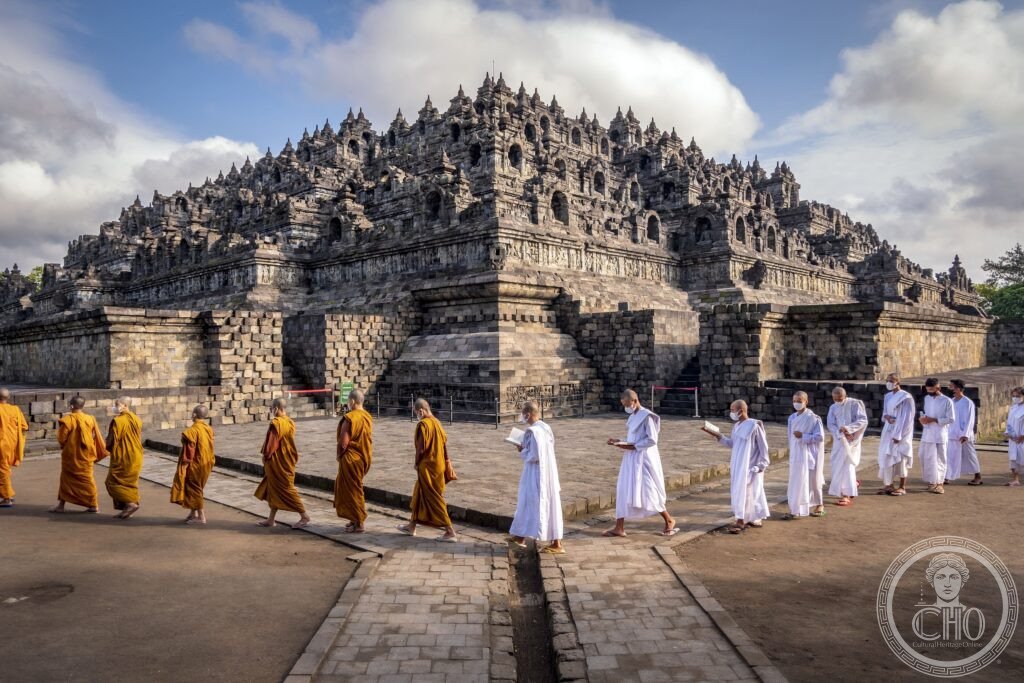
Borobudur Temple
The largest Buddhist temple in the world and the most extensively carved single monument in Southeast Asia — Borobudur in central Java, built by the Sailendra dynasty between 778 and 856 CE, is a 9-level stepped pyramid that encodes the entire Buddhist cosmological journey from the world of desire to Nirvana in stone, containing 2,672 narrative relief panels that together form the most extensive single Buddhist pictorial narrative in the world.
At a glance
Borobudur (UNESCO WHS 1991 as part of the Borobudur Temple Compounds; the largest Buddhist temple in the world (by building volume and by number of carved relief panels: 2,672 panels — the most decorated single monument in Southeast Asia; by comparison, the Bayon temple at Angkor Wat has approximately 1,200 m of bas-relief); the temple (9 platforms in 3 zones: the lower 5 square terraces (the kamadhatu — the world of desire; 160 relief panels narrating scenes of human cause and effect — the most explicitly karmic single narrative programme in Theravada/Mahayana Buddhist architecture); the middle 3 square terraces (the rupadhatu — the world of form; 1,300 relief panels narrating scenes from the life of the Buddha, the Jataka birth stories, and the Gandavyuha Sutra — the most extensive single Gandavyuha visual narrative in any Buddhist monument); the top 3 circular terraces + final stupa (the arupadhatu — the world of formlessness / Nirvana: 72 perforated bell stupas each containing a seated Buddha statue + 1 central great stupa at the summit — the most precisely concentric single Buddhist cosmological model in any stone monument)).
Key facts
- The construction: the most precisely engineered single pre-Gregorian religious building in Southeast Asia — the Sailendra dynasty (the most Buddhist single dynasty of ancient Java: the Sailendra (“Lords of the Mountain”) ruled central Java from approximately 750–850 CE; the most precisely Buddhist-oriented dynasty in Southeast Asian history; Borobudur was built during the reign of King Samaratunga (c. 792–833 CE — the most precisely dated single patron of Borobudur’s construction); the engineering (60,000 cubic metres of andesite volcanic stone (the most precisely quarried single material from the Merapi lava flow plains — the most volcanically sourced single building material in any Buddhist monument in the world); the stones are fitted without mortar (the most precisely dry-set single 9th-century stone construction in Southeast Asia: each stone was shaped and fitted using a system of tongue-and-groove joinery — the most precisely interlocking single building technique in ancient Javanese construction)); the drainage system (the most sophisticated ancient drainage system in any Indonesian monument: 100 water spouts incorporated into the structural design to drain rainwater off the terraces — the most precisely engineered single rainwater management system in any Southeast Asian monument))
- The rediscovery: the most dramatically rediscovered single Buddhist monument in the world — the abandonment (Borobudur was buried under volcanic ash from Mount Merapi and reclaimed by the jungle by approximately 950 CE — the most precisely motivated single natural abandonment of any major world monument: the combination of volcanic eruption (ash burial) and the shift from Buddhist to Hindu/Islamic rule in Java meant the temple was lost for approximately 900 years (the most extensively lost single 9th-century Buddhist monument in the world)); the rediscovery (Thomas Stamford Raffles (the Lieutenant-Governor of Java under British rule, 1811–1816) heard reports of a great buried monument and sent H.C. Cornelius to investigate in 1814 — the most precisely British-colonial single archaeological rediscovery in Southeast Asia; Cornelius found the hill covered in jungle with stone reliefs visible through the undergrowth — the most dramatically underbrush-concealed single monument rediscovery in the history of Buddhist archaeology)); the restoration (the UNESCO/UNDP Borobudur restoration project (1973–1983): the most comprehensive single UNESCO monument restoration in Asia; 1 million stones were dismantled, cleaned, and reassembled with a new drainage system — the most precisely re-interlocked single restoration project in Southeast Asian heritage))
- The relief panels: the world’s most extensive Buddhist pictorial narrative — the reliefs (2,672 decorative relief panels covering 2,500 m² — the most extensively carved single surface in any pre-modern Southeast Asian monument; the Jataka stories (547 birth stories of the Buddha — the most comprehensively illustrated single corpus of Jataka tales in any Buddhist monument in the world; the panels narrate previous lives of the Buddha (the most precisely reincarnated single biographical subject in any religious pictorial narrative); the Gandavyuha Sutra panels (460 panels — the most extensively Gandavyuha-illustrated single narrative in any Buddhist monument: the sutra describes the spiritual journey of the young Sudhana, who seeks enlightenment from 53 successive teachers — the most precisely mentored single Buddhist journey narrative in any visual programme); the scenes of ancient Javanese life (the most precisely documented single visual record of 9th-century Javanese coastal and court life in any monument: the ships depicted in the “Borobudur ship” panels are the most precisely drawn single 9th-century sailing vessel type in any pre-modern Indonesian monument))
- Heritage: UNESCO World Heritage Site, Borobudur Temple Compounds, inscribed 1991
- GPS: -7.6079° S, 110.2038° E
History
The Sailendra dynasty construction (described in Key Facts; c. 778–856 CE); the abandonment and rediscovery (described in Key Facts; c. 950 CE abandoned; 1814 CE Raffles/Cornelius rediscovery); the 19th-century excavation (the Dutch colonial government under Engelhard conducted the first partial clearing in 1804–1810; the most precisely colonial-period single excavation timeline in Javanese archaeology; Ijzerman conducted the first systematic study in 1885 — the most extensively documented single 19th-century Javanese archaeological study; Theodoor van Erp conducted the first major restoration in 1907–1911 — the most precisely Edwardian-era single Southeast Asian restoration); the 20th-century restoration (the UNESCO/UNDP project 1973–1983 described in Key Facts); the tourist history (Borobudur was briefly a free-access site in the 1980s–1990s; the most extensively damaged single Buddhist heritage site by unmanaged tourism: visitor feet wore smooth the carved relief steps; access to the upper circular terraces is now strictly managed and requires an additional fee (the most precisely managed single Buddhist monument top in Southeast Asia)); UNESCO WHS 1991.
What you see
The visit (the most sunrise-dependent single heritage experience in Southeast Asia: the Borobudur sunrise package (the most commercially available single premium heritage experience in Java: tickets sold by the Borobudur Park management for access before dawn — typically 04:30 entrance; the most atmospheric single early-morning heritage visit in Indonesia); the clockwise circumambulation (the most precisely prescribed single Buddhist pilgrimage path: visitors are directed to walk clockwise around each terrace before ascending — the pradaksina (the most universally prescribed single circumambulation direction in Buddhist monument visits: the same direction as the apparent movement of the sun)); the top platform (the most panoramically Buddhist single view in Java: 72 perforated stupas each housing a seated Buddha; Mount Merapi visible to the north and Mount Merbabu to the north-east — the two most visually impressive volcanic cones visible from any Buddhist temple in the world); the relief panels (allow 2 hours minimum to walk the full gallery of reliefs on the first and second terraces — the most educationally rewarding single temple walk in Southeast Asia)).
Practical information
- Getting there: Yogyakarta (Jogja; the most convenient base for Borobudur: 40 km south-east; 1h by tourist shuttle or local bus (the Trans Jawa bus from Jombor terminal); Yogyakarta Adisutjipto Airport (JOG) or the newer Yogyakarta International Airport (YIA; 45 km west); by train from Jakarta (8h Argo Wilis or night train — the most comfortable single overnight train journey in Java)); Prambanan (the most important Hindu temple complex in Indonesia and the finest example of Hindu architecture in Southeast Asia: 17 km east of Yogyakarta; 50 km from Borobudur; the most conveniently co-visited single Hindu temple with a Buddhist temple in the world — Borobudur (Buddhist) + Prambanan (Hindu) are the two largest pre-modern religious monuments in Southeast Asia within 50 km of each other; Prambanan UNESCO WHS 1991: the triple candi of Brahma, Vishnu, and Shiva — the most precisely trimurti-dedicated single temple cluster in Indonesian heritage))
- Mount Merapi: the most active volcano in Indonesia and the most visually associated single mountain with any Buddhist temple in the world — Mount Merapi (Gunung Merapi; 2,930 m; the most frequently erupting single Indonesian volcano: approximately 68 eruptions since 1548 — the most precisely counted single volcano eruption record in Java; the most recent major eruption (2010): pyroclastic flows killed 353 people — the most deadly single Indonesian volcanic eruption of the 21st century; the most consistently monitored single volcano in Southeast Asia; access (guided hike to the rim is possible in quiet periods (the most physically demanding single day trip from Yogyakarta: a 4–6h ascent (5am start) + 2–3h descent; requires a guide; the most precisely altitude-checked single short trekking permit in Java))
- Prambanan Hindu temples (UNESCO WHS 1991): the most architecturally ambitious single Hindu temple cluster in Southeast Asia — Prambanan (described above; the Trimurti temples (the most precisely dedicated single triple temple in Indonesian Hinduism: the northern temple to Brahma; the central and tallest (47 m) to Shiva; the southern to Vishnu — the most precisely trimurti-proportioned single temple sequence in any Indonesian Hindu site); the Shiva temple (the most extensively damaged single Prambanan temple: partially destroyed in the 2006 Java earthquake — the most seismically damaged single UNESCO WHS component in Indonesia; ongoing restoration since 2006 — the most continuously restored single temple in Southeast Asian post-seismic conservation); the Ramayana Ballet (the most dramatically appropriate single open-air performance in any Indonesian heritage site: performed at the open-air Trimurti theatre with the Prambanan temples illuminated behind the stage during the dry season (May–October) — the most visually spectacular single evening cultural performance in Java))
Getting there
From Yogyakarta: tourist shuttle or local Trans Jawa bus from Jombor terminal (1h). Sunrise package: 04:30 entrance, book in advance at borobudurpark.com. Minimum visit 3h; allow a full morning. GPS: -7.6079, 110.2038.
Nearby
- Prambanan Hindu temples (UNESCO WHS 1991) — 50 km east (1h bus/taxi from Borobudur via Yogyakarta); largest Hindu temple complex in Indonesia — described in Practical section; the essential Yogyakarta heritage day: Borobudur (morning, sunrise) + Prambanan (afternoon) + Ramayana Ballet (evening)
- Mount Merapi — 30 km north of Yogyakarta (50 km from Borobudur); most active volcano in Indonesia — described in Practical section
- Bali — Subak Rice Terraces (UNESCO WHS 2012) — 600 km east (1h flight from Yogyakarta); the most precisely culturally managed ancient rice terraces in the world — the Subak irrigation system (the most sophisticated single traditional water-sharing system in Southeast Asia: the Subak manages the allocation of water among terraced rice paddies across multiple villages via a network of water temples — the most precisely religiously-governed single agricultural system in any heritage landscape in the world; the rice terraces of the Jatiluwih plateau (the most photogenically terraced single rice landscape in Bali); the spiritual ecology of the Subak (the most precisely documented single intersection of Balinese Hinduism and agricultural management in any UNESCO heritage site))
Sources
- Wikipedia, Borobudur; Sailendra dynasty; Borobudur ship; Thomas Stamford Raffles, accessed June 2026
- UNESCO, Borobudur Temple Compounds, WHS reference 592, inscribed 1991
- Jan Fontein, The Pilgrimage of Sudhana: A Study of Gandavyuha Illustrations in China, Japan and Java, Mouton, 1967
Find it on the map
See this place and what’s around it →📷 Diventa un fotografo di Cultural Heritage Online
Condividi le tue foto dei luoghi: restano pubblicate con la tua firma come autore. Più vengono viste, più ti fai conoscere — e presto un concorso premierà le foto più apprezzate.
Accedi o registrati gratis per aggiungere una foto