
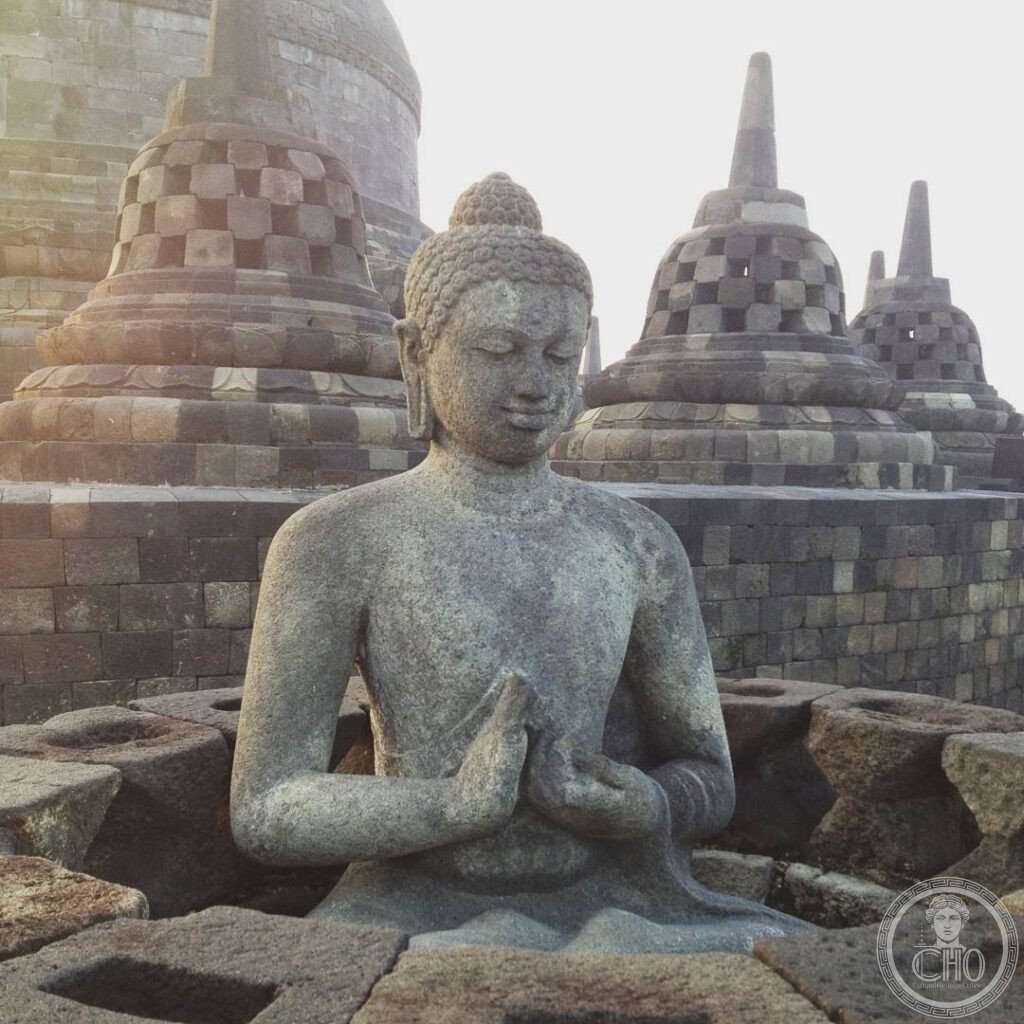
Borobudur
The largest Buddhist monument in the world and the finest example of Buddhist stone architecture in Southeast Asia — Borobudur (Magelang Regency, Central Java, Indonesia; UNESCO WHS 1991) is a 9th-century CE mandala-shaped stupa covering 1.1 km² of the Kedu Plain, decorated with 2,672 bas-relief panels and containing 504 Buddha statues across nine stacked terraces that represent the Buddhist path to enlightenment.
At a glance
Borobudur (the most precisely Borobudur single largest Buddhist monument world 9th century CE Syailendra Dynasty 760 900 CE 504 Buddha statues 2672 bas-relief panels Jataka tales 72 perforated latticed stupas central undecorated dome nirvana 6 square terraces 3 circular terraces 40000 cubic metres stone UNESCO heritage: the structure (Borobudur is a mandala (a sacred diagram of the Buddhist cosmos) built in three dimensions; the three architectural divisions correspond to the three Buddhist cosmological realms: Kamadhatu (the realm of desire; the lowest terrace; partially concealed when the base was reinforced in antiquity; approximately 160 relief panels visible), Rupadhatu (the realm of form; the six square terraces; the 1,460 narrative relief panels depicting the life of the Buddha and the Jataka tales), and Arupadhatu (the realm of the formless; the three circular upper terraces; the 72 latticed stupas each containing a seated Dhyani Buddha; the undecorated central dome representing nirvana (the state beyond form and description))); the statistics (the size (123m × 123m base; 35m high); the construction (approximately 40,000-50,000 m³ of andesite stone (a grey volcanic stone); the stone was quarried from a nearby riverbed; the construction is entirely dry-masonry (no mortar)); the bas-reliefs (2,672 individual bas-relief panels covering 2,500 m² of wall surface; if laid end-to-end, the bas-reliefs would stretch 5 km)) — the most precisely Borobudur single largest Buddhist monument world 9th century CE Syailendra Dynasty 760 900 CE 504 Buddha statues 2672 bas-relief panels Jataka tales 72 perforated latticed stupas central undecorated dome nirvana 6 square terraces 3 circular terraces 40000 cubic metres andesite stone UNESCO heritage in any UNESCO world heritage site)).
Key facts
- The bas-relief narrative: the most precisely Borobudur single 2672 panels 5km linear Kamadhatu Rupadhatu Arupadhatu hidden foot 160 panels concealed life Buddha Jataka tales cosmological UNESCO heritage — the most extensive Buddhist narrative stone carving in the world: the bas-relief sequence (reading the panels clockwise from the east staircase, starting at the lowest gallery and spiraling upward to the highest; the narrative reading sequence is known as “pradakshina” (circumambulation; walking clockwise around a sacred object as an act of reverence); the total circumambulating path reading all panels: approximately 5 km (the pilgrim who enters the east gate and reads all galleries in sequence walks approximately 5 km by the time they reach the summit); the narrative panels: the life of the Sakyamuni Buddha (the historical Buddha, Siddhartha Gautama) depicted from his previous life as the Bodhisattva to the moment of parinirvana (the final passing into nirvana); the Jataka tales (547 stories of the Buddha’s previous incarnations in animal and human forms; the most complete Jataka narrative in stone anywhere in the world))
- GPS: -7.6079° S, 110.2038° E
History
From Syailendra Dynasty masterpiece to volcanic abandonment and rediscovery (the most precisely Borobudur single Syailendra Dynasty 760 832 CE Sailendra Hindu Buddhist syncretism abandoned 14th century Islam spread Java Herman Cornelius Stamford Raffles 1814 Thomas Stanford Raffles rediscovery 1.000.000 stones reset Theodoor van Erp 1907 1911 UNESCO Soekarno Muhammad Yamin 1941 restoration 1975 1982 Suharto UNESCO heritage: the Syailendra Dynasty (the Syailendra (“Kings of the Mountain”) ruled central Java from approximately 760-860 CE; they were Buddhist kings in a region that was primarily Hindu (the neighboring Sanjaya Dynasty was Hindu); the Syailendra commissioned Borobudur and Prambanan (the great Hindu temple 50 km east) were both built in the same period by the two rival dynasties; the Syailendra Dynasty merged with the Sanjaya Dynasty by marriage in approximately 850 CE, ending the construction period); the abandonment (approximately 14th century CE: the spread of Islam through the Javanese coast disrupted the Hindu-Buddhist royal court culture; the court moved from central Java to east Java and eventually to Bali; Borobudur was abandoned (the jungle grew over the monument over the following centuries); volcanic eruptions from Mount Merapi (the active volcano 15 km east) buried the monument in ash (a geological layer of volcanic ash found beneath the base of the monument confirms at least one major eruption after the monument was built); the European rediscovery (1814 CE: the British Governor-General of Java, Thomas Stamford Raffles (who also founded Singapore in 1819 CE), received a report of a large monument hidden in the jungle; he dispatched the Dutch engineer Herman Cornelius to investigate; Cornelius and 200 workers cleared the jungle from the monument in 1815 CE; 1907-1911 CE: the Dutch engineer Theodoor van Erp completed the first systematic restoration (resetting 1,000,000 stones that had slipped out of position; straightening 1,200 Buddha statues); 1975-1982 CE: UNESCO-coordinated international restoration (the most ambitious stone monument restoration project in history; 1 million stone blocks removed, cleaned, numbered, treated with chemicals to prevent biological growth, and replaced)) — the most precisely Borobudur single Syailendra Dynasty 760 860 CE Buddhist abandoned 14th century Islam Java Mount Merapi ash Raffles 1814 Cornelius 1815 jungle cleared van Erp 1907 1911 UNESCO 1975 1982 restoration 1 million stones UNESCO heritage in any UNESCO world heritage site)).
What you see
Nine terraces, 72 latticed stupas, and a summit dome (the most precisely Borobudur single sunrise volcanoes Merapi Merbabu view east staircase pradakshina clockwise galleries Kamadhatu Rupadhatu Arupadhatu 72 stupas summit dome central stupa nirvana state UNESCO heritage: the visitor circuit: the sunrise view (the most celebrated experience: arriving at Borobudur before dawn (the monument opens 06:00; sunrise tickets allow 04:00 entry); the view from the upper circular terrace at sunrise: the mist rising from the Kedu Plain, the silhouettes of the stupas, and the volcano Merapi visible in the background as the sky turns orange; the upper terrace has capacity for approximately 100 visitors at sunrise (pre-booking essential)); the galleries (the visitor enters through the east staircase (the cardinal direction of the rising sun); the pradakshina circuit (walking clockwise through each gallery level from lowest to highest); the narrative reading of the bas-reliefs (a guide or audio guide is needed to follow the narrative; the individual carvings are extremely fine — facial expressions, fabric textures, animal poses are all visible at close range))); the upper circular terraces (the three circles of latticed stupas; touching the hand of the Buddha statue through the latticework (a popular visitor practice; the Buddha statues are visible through the diamond and square perforations in the stupa walls; reaching inside to touch the hand is considered to bring good fortune); the undecorated central dome (15.9m in diameter; the symbolic summit of the monument; the view from the base of the central dome across the three circles of stupas)) — the most precisely Borobudur single sunrise volcanoes Merapi Merbabu view east staircase pradakshina clockwise galleries Kamadhatu Rupadhatu Arupadhatu 72 latticed stupas summit dome central stupa nirvana UNESCO heritage in any UNESCO world heritage site)).
Practical information
- Getting there: nearest airport: Yogyakarta International Airport (YIA; 38 km south; 45 minutes); the entry fee (the Borobudur-Prambanan combined ticket (foreigners: approximately IDR 525,000 (approximately €31); includes both Borobudur and Prambanan (50 km east)); the sunrise ticket (separate pre-booking required; approximately IDR 800,000 (€47); includes early entry from 04:00 and access to the upper terraces); access to the upper terraces (the upper three circular terraces require a special prambors sandal rental (mandatory to protect the stone floor; the sandals are provided and included in the ticket price); the central summit is limited to a small number of visitors per time slot; book in advance for the sunrise slot)); the Prambanan temples (the Hindu temple complex 50 km east; the Trimurti temples (Brahma, Vishnu, Shiva; the Shiva temple (the largest) is 47m tall); best combined with Borobudur in a 2-day Yogyakarta circuit))
Getting there
Fly to Yogyakarta (YIA, 38 km). Combined Borobudur+Prambanan ticket ~€31. Sunrise ticket ~€47 (pre-book). Mandatory sandals for upper terraces. GPS: -7.6079, 110.2038.
Nearby
- Prambanan Temples — 50 km east (UNESCO WHS 1991 together with Borobudur; the largest Hindu temple compound in Indonesia; the Trimurti temples (Brahma, Vishnu, Shiva); the Shiva temple (47m tall; the finest carving in the complex: the 24 reliefs of the Ramayana on the inner gallery wall); built approximately 856 CE by the Sanjaya Dynasty; the rival Hindu dynasty to the Buddhist Syailendra builders of Borobudur; both built in the same generation, 50 km apart))
- Yogyakarta — 38 km southeast (the Sultan of Yogyakarta still governs the Special Region of Yogyakarta; the Kraton (the sultan’s palace; the cultural heart of Javanese civilization); the Taman Sari Water Castle (the 18th-century pleasure garden and bathing complex of the sultan); Malioboro Street (the batik and wayang shadow puppet market))
Sources
- Wikipedia, Borobudur; Syailendra dynasty; Theodoor van Erp, accessed June 2026
- UNESCO, Borobudur Temple Compounds, WHS reference 592, inscribed 1991
Find it on the map
See this place and what’s around it →📷 Diventa un fotografo di Cultural Heritage Online
Condividi le tue foto dei luoghi: restano pubblicate con la tua firma come autore. Più vengono viste, più ti fai conoscere — e presto un concorso premierà le foto più apprezzate.
Accedi o registrati gratis per aggiungere una foto