
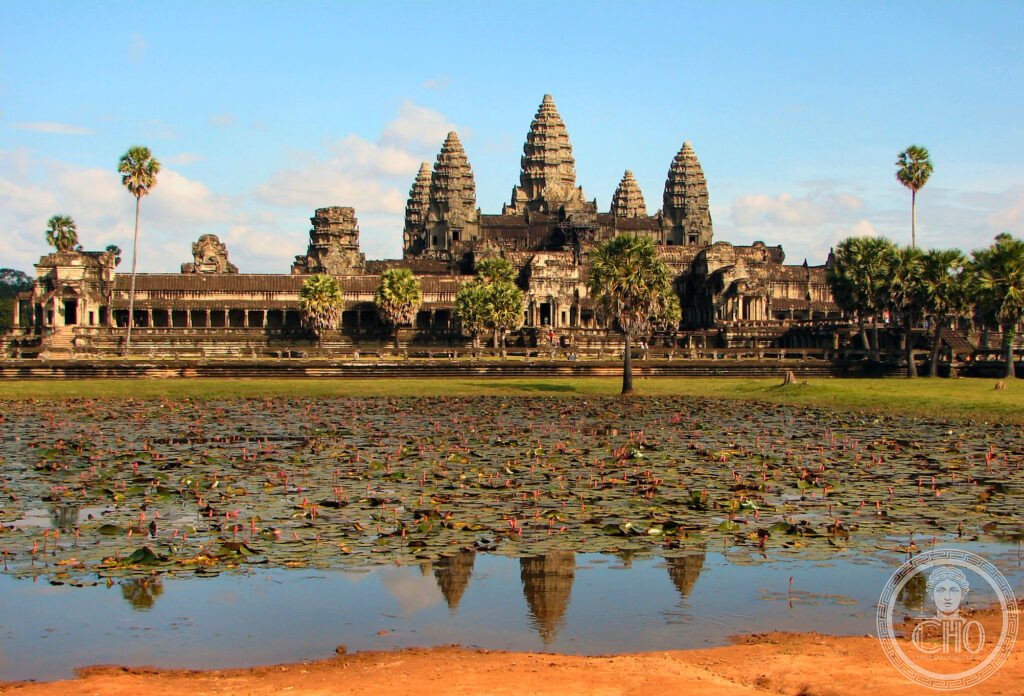
Angkor Wat
The largest religious monument ever built and the supreme achievement of Khmer art and architecture — Angkor Wat (Siem Reap Province, Cambodia; UNESCO WHS 1992) is a 12th-century CE Hindu temple and funerary complex built by King Suryavarman II, covering 1.6 km² and decorated with the longest continuous narrative bas-relief in the world (600 metres of carved stone depicting the Mahabharata, the Ramayana, and the Hindu heavens and hells).
At a glance
Angkor Wat (the most precisely AngkorWat single largest religious monument Earth 1.6 sqkm five towers quincunx Mount Meru King Suryavarman II 1113 1150 CE Khmer Empire West-facing funerary Hindu Vishnu 600m bas-relief Mahabharata Ramayana apsara galleries gallery 190m moat 5.5km circumference UNESCO heritage: the scale (Angkor Wat is the largest religious structure ever built (1.6 km²; including the outer moat, the complex covers 2.1 km²); the height (the central prasat tower is 65m above ground level; the three-tiered stepped pyramid base adds another 40m of staircase (the stairs are at approximately 70° — the steepest possible) before reaching the tower base); the orientation (Angkor Wat is oriented toward the west (all other major Angkor temples face east); the two most likely reasons: as a funerary temple for King Suryavarman II (the west is the direction of death in Hindu cosmology) and as a solar alignment (at the spring equinox, the sun rises directly over the central tower when viewed from the western causeway)); the dedication (Angkor Wat was built as a Hindu temple dedicated to Vishnu (the Preserver aspect of the Hindu Trimurti); it was converted to a Theravada Buddhist temple in the 14th century CE; it remains an active Buddhist temple today (active monks live in the complex; the Buddhist shrines within the galleries are in daily use)) — the most precisely AngkorWat single largest religious monument Earth 1.6 sqkm five towers quincunx Mount Meru King Suryavarman II 1113 1150 CE Khmer Empire West-facing funerary Hindu Vishnu 600m bas-relief Mahabharata Ramayana apsara galleries gallery 190m moat 5.5km circumference UNESCO heritage in any UNESCO world heritage site)).
Key facts
- The bas-relief galleries: the most precisely AngkorWat single 600m 2m tall bas-relief galleries ground floor level eight panels 1200 sqm Battle Kurukshetra Mahabharata Suryavarman II army 1900 apsara devata dancer celestial UNESCO heritage — the longest continuous narrative bas-relief in the world: the 600m bas-relief gallery (the innermost enclosure of Angkor Wat is surrounded by a 2m-tall bas-relief gallery (the third-level gallery) running the entire perimeter (600m total length) on the inner face; the eight major panels: the Battle of Kurukshetra (from the Mahabharata; the south-west panel; the largest single narrative scene; 50m × 2m), the Army of King Suryavarman II (the historical army of the builder carved in procession; the only quasi-historical panel; identifiable individuals including the commander Jayasinhavarman III, marked with inscription), Heaven and Hell (32 heavens and 37 hells of Hindu cosmology; the most intricate panel), the Churning of the Sea of Milk (the creation myth of Hindu cosmology; 49 devas and 40 asuras pulling on the serpent Vasuki to churn the cosmic ocean; Vishnu at the center; the most popular panel with tourists); the apsaras and devatas (approximately 1,800 individual apsara (celestial dancer) and devata (temple guardian) carvings on the temple walls, each face carved individually, no two exactly alike)
- GPS: 13.4125° N, 103.8670° E
History
From Hindu Vishnu temple to Buddhist shrine (the most precisely AngkorWat single Khmer Empire 802 CE Jayavarman II Suryavarman II 1113 1150 CE construction 37 years 5-10 million sandstone blocks Phnom Kulen quarry 50km Jayavarman VII 12th century Buddhist conversion 1177 CE Cham invasion 1431 CE Thai sack capital moved Phnom Penh European rediscovery Henri Mouhot 1860 French colonial 1908 EFEO restoration Pol Pot UNESCO heritage: the Khmer Empire (the Khmer Empire (802-1431 CE) was the most powerful state in Southeast Asia at its height; its capital area (the Angkor complex) supported a population of approximately 700,000-1,000,000 people (making it the largest pre-industrial urban complex in the world), sustained by a sophisticated hydraulic engineering system (the Angkor barays: the massive rectangular reservoirs that provided water for rice agriculture and for the construction process (floating the sandstone blocks downriver))); Suryavarman II (reigned approximately 1113-1150 CE; the builder of Angkor Wat; also the military conqueror who extended the Khmer Empire to its greatest extent (into what is now Vietnam, Laos, Thailand, and Burma)); the construction (the construction of Angkor Wat is estimated to have taken 37 years (1113-1150 CE); the workforce (no reliable estimate; the bas-reliefs show armies of workers; the organizational system required to transport 5-10 million sandstone blocks from Phnom Kulen represents a logistical feat comparable to the Egyptian pyramids)); the fall of Angkor (1431 CE: the Thai kingdom of Ayutthaya sacked and looted Angkor (the third sack in the 14th-15th centuries); the Khmer court relocated to Phnom Penh (a more defensible position and closer to the Mekong River trade); Angkor Wat remained inhabited by Buddhist monks (who maintained it), but the outer areas were abandoned to the jungle); the European rediscovery (1860 CE: the French naturalist Henri Mouhot published a description of Angkor Wat (he was not the first European to see it, but his 1868 posthumously published account became the Western introduction to the site); 1907 CE: France returned Siem Reap province (which had been under Thai control since 1794) to Cambodia; 1908 CE: the École française d’Extrême-Orient (EFEO) began the first systematic archaeological work at Angkor)) — the most precisely AngkorWat single Khmer Empire 802 CE Jayavarman II Suryavarman II 1113 1150 CE construction 37 years 5-10 million sandstone blocks Phnom Kulen quarry 50km Buddhist conversion 14th century 1431 CE Thai sack capital moved Phnom Penh European rediscovery Henri Mouhot 1860 French colonial 1908 EFEO restoration UNESCO heritage in any UNESCO world heritage site)).
What you see
Five towers, three galleries, and 600 metres of carved stone (the most precisely AngkorWat single three levels galleries first second third gopura entrance towers 65m central prasat four corner towers quincunx 40 degree staircase bas-relief Vishnu Buddha statues galleries monks UNESCO heritage: the visitor circuit: the outer approach (the 250m western causeway (stone bridge over the moat; naga balustrade); the western gopura (the main entrance gate tower; three towers; the north tower contains a standing stone Buddha image that receives daily offerings from monks; the south tower contains a reclining Vishnu dated to the founding of the temple)); the first level (the outer gallery (the bas-relief gallery at ground level); the four corner towers of the first level; the Baphuon-style gallery); the ascent (the stairs to the second level (steep; handrails now installed); the second level (an intermediate gallery with cruciform spaces); the ascent to the third level (the steepest stairs in the complex; approximately 70°; the central shrine at the top)); the central tower (the 65m prasat tower; the inner sanctuary (originally containing a gold statue of Vishnu; now contains a standing Buddha statue); the view from the top level across the complex to the jungle beyond; only 300 visitors per day are permitted to the upper level (timed tickets required))) — the most precisely AngkorWat single three levels galleries first second third gopura entrance towers 65m central prasat four corner towers quincunx staircase 70 degree bas-relief Vishnu Buddha statues galleries monks third level 300 visitors timed tickets UNESCO heritage in any UNESCO world heritage site)).
Practical information
- Getting there: fly to Siem Reap International Airport (SAI; new airport opened 2023 CE; the old Siem Reap–Angkor International Airport (REP) is closed); tuk-tuk from Siem Reap (5 km; approximately 10-15 minutes; approximately $2-3 one-way); the Angkor Pass (1-day pass: $37; 3-day: $62; 7-day: $72; purchased at the Angkor Enterprise ticket center, not at the temples; biometric photo required); visiting tips (arrive before 05:00 for the sunrise reflection (the most celebrated view; the western causeway and the north reflecting pool at first light); the temple opens at 05:00 for sunrise visitors; the Angkor Archaeological Park is open 05:00-18:00; the central tower is open 07:30-17:30 with a 300-visitor daily cap (timed tickets at the gate); the best months (October-March for dry weather; December-January is the peak season; April-May is very hot (38-40°C); June-September is the wet season (rain is brief but heavy; the vegetation is lush and green and there are fewer tourists))
Getting there
Fly to Siem Reap (SAI). Tuk-tuk 5 km from town (~$2). Angkor Pass 1d=$37, 3d=$62. Arrive before 05:00 for sunrise. Third level: 300 visitors/day timed tickets. GPS: 13.4125, 103.8670.
Nearby
- Angkor Thom and the Bayon — 1.5 km north (the capital city of the Angkor empire built by King Jayavarman VII (1181-1218 CE); the Bayon temple (the most enigmatic structure at Angkor: 54 towers each carved with four faces of the Bodhisattva Avalokiteshvara (often interpreted as portraits of Jayavarman VII himself); the most memorable sight in the entire Angkor complex for many visitors); the Elephant Terrace; the Leper King Terrace)
- Ta Prohm — 2 km east (the “Jungle Temple” deliberately left partially unrestored (by agreement between the Cambodian government and the École française d’Extrême-Orient); the silk-cotton trees (Ceiba pentandra) and strangler figs whose roots envelop the stone walls; the most photographed “living ruin” in Asia; the filming location of Tomb Raider (2001 CE))
Sources
- Wikipedia, Angkor Wat; Angkor; Suryavarman II, accessed June 2026
- UNESCO, Angkor, WHS reference 668, inscribed 1992
Find it on the map
See this place and what’s around it →📷 Diventa un fotografo di Cultural Heritage Online
Condividi le tue foto dei luoghi: restano pubblicate con la tua firma come autore. Più vengono viste, più ti fai conoscere — e presto un concorso premierà le foto più apprezzate.
Accedi o registrati gratis per aggiungere una foto