
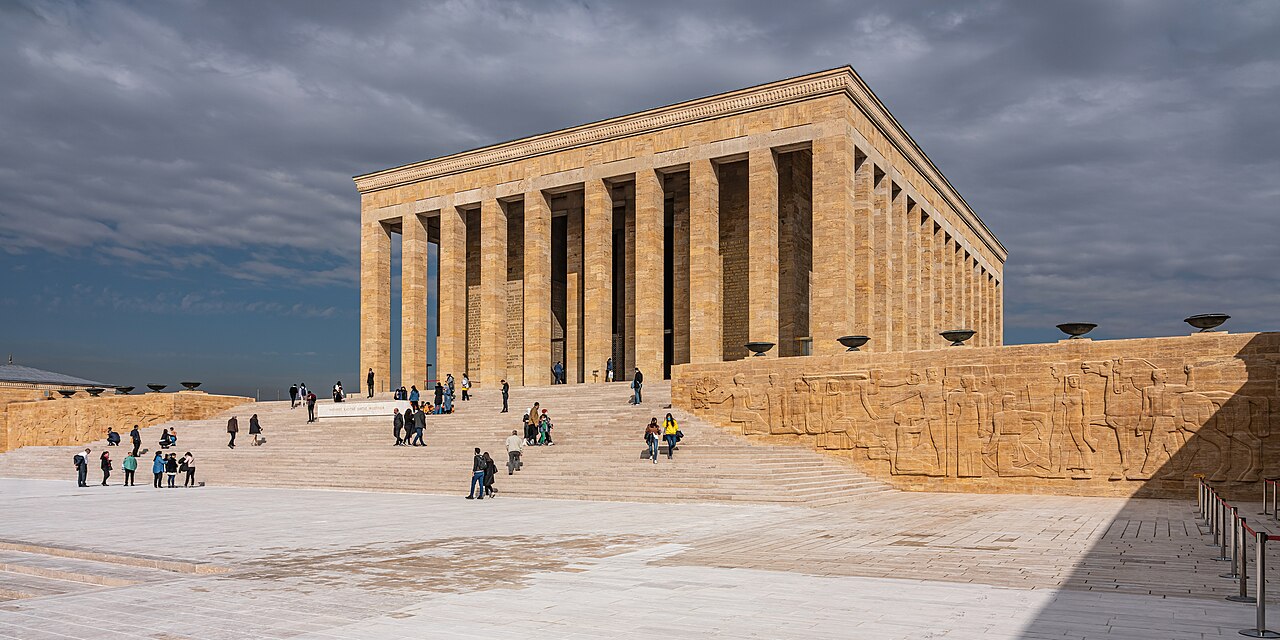
Anıtkabir — literally “the memorial tomb” — is the mausoleum and national monument complex of Mustafa Kemal Atatürk, the founder and first President of the Turkish Republic. It is Turkey's most visited site, receiving over fifteen million people a year, and it functions less as a burial site than as a secular temple to the Republic itself. Built between 1944 and 1953 on the highest hill in Ankara, the complex was designed by architects Emin Halid Onat and Ahmet Orhan Arda following an open competition that attracted 49 entries. The design is a synthesis of two apparently incompatible vocabularies: the stripped Classicism of 1930s European state architecture, and the ancient Anatolian heritage of Hittite and Phrygian monuments. The result is monumental without being pompous, ancient without being archaeological. Forty-two stone lions line the Lion Road approach. The Hall of Honour — where Atatürk's sarcophagus stands on a floor of Turkish marble — is 35 metres high and faced in white travertine. Nothing about the building is coincidental: every dimension, every motif, every material was chosen to say that the Turkish Republic was both new and ancient, both Western and rooted in Anatolian soil.
At a glance
- Type
- National mausoleum and monument complex
- Period
- 1944–1953
- Style
- Monumental Classicism / Hittite Revival
- Location
- Tandogan, Ankara, Turkey
- Coordinates
- 39.9253° N, 32.8375° E
- Architect(s)
- Emin Halid Onat, Ahmet Orhan Arda
Overview
The complex covers an area of approximately 750,000 square metres on Rasattepe hill in Tandogan district. It comprises the central Hall of Honour containing Atatürk's tomb, the Museum of the War of Independence and Atatürk, the Peace Park, and a ceremonial plaza capable of holding hundreds of thousands of people. Guard of honour ceremonies take place daily. The complex was declared a national heritage site and is managed by the Turkish Armed Forces. Entry is free.
History
Atatürk died on 10 November 1938 in Istanbul's Dolmabahçe Palace. His body was temporarily interred in Ankara's Ethnography Museum while the permanent mausoleum was planned and built. A competition was launched in 1941; the Onat-Arda design was selected over 48 others. Construction began in 1944. Atatürk's remains were transferred to Anıtkabir on 10 November 1953 — the fifteenth anniversary of his death — in a state ceremony attended by heads of state from across the world. His mother Zübeyde Hanım and closest political colleague &Imath;smet &Imath;nönü are also buried in the precinct.
Architecture & Design
The approach is via the 262-metre Lion Road, flanked by 24 stone lion sculptures drawing on Hittite iconography from Alacahöyük. The colonnaded Hall of Honour is raised on a podium; its exterior colonnades use a simplified order inspired by ancient Anatolian carved stone portals. The hall interior is sheathed in Turkish marble — travertine, granite, porphyry — sourced from across Anatolia. The sarcophagus, a monolith of 40 tonnes, occupies the geometric centre of the hall beneath a painted ceiling. The Museum of the War of Independence occupies a lower level. The entire complex is oriented along a strict axis, with the Hall of Honour at the culminating point, visible from across Ankara.
Cultural significance
Anıtkabir is not only a mausoleum but a statement of national identity frozen in stone. The architectural fusion of Hittite symbolism and modernist Classicism was a deliberate articulation of the Kemalist thesis: that Turkey was simultaneously an ancient Anatolian civilisation and a modern, secular, Western-oriented nation-state. For Turks, a visit to Anıtkabir is a civic obligation as much as a pilgrimage. For architectural historians, it is one of the finest examples of mid-twentieth-century state architecture anywhere in the world.
Visiting today
Anıtkabir is open to the public daily; hours vary by season (typically 09:00–17:00 in winter, 09:00–19:00 in summer). Entry is free. Respectful dress is expected; shorts are discouraged. The Museum of the War of Independence and Atatürk is inside the complex and is included in free admission. Changing of the guard ceremonies take place at regular intervals and are worth timing a visit around.
Getting there
Anıtkabir is in the Tandogan district of Ankara, approximately 3 kilometres west of the city centre. The nearest metro station is Tandogan on Line M1 (Kizilay–AŞT&Imath;). From Ankara Gar (central railway station) take Line M1 two stops to Tandogan, then a 10-minute walk. Taxis are readily available from central Ankara.
Sources & resources
Find it on the map
See this place and what’s around it →Record researched and written by Luigi De Marchi for Cultural Heritage Online, 2026.
📷 Become a Cultural Heritage Online photographer
Share your photos of places: they stay published under your name as the author. The more they're seen, the more you get noticed — and soon a contest will reward the most appreciated photos.
Log in or sign up free to add a photoIs this page about you?
This page is read by travellers and heritage enthusiasts who find it on Google. Tell us how you are connected to this place and we will take it from there.