
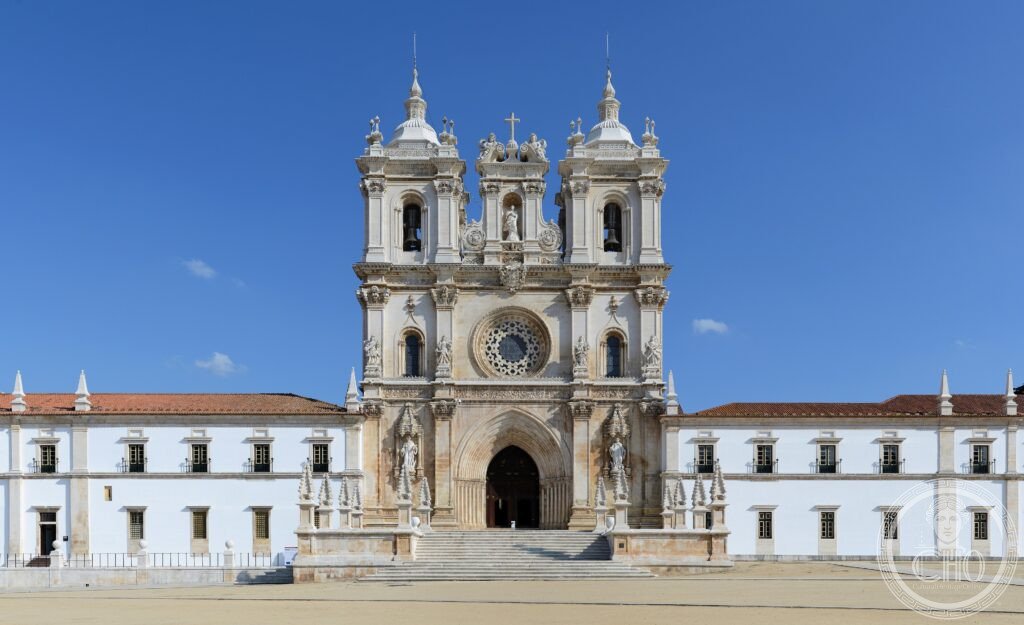
Portugal’s most moving Gothic church and the royal mausoleum of the first dynasty of Portuguese kings — the Mosteiro de Santa Maria de Alcobaça, founded in 1153 by King Afonso Henriques as a vow to St Bernard of Clairvaux, contains the most serenely proportioned Gothic nave in Portugal and the most elaborately carved royal tombs in the Iberian Peninsula, including those of Pedro I and his murdered beloved Inês de Castro, whose love story is the defining tragic narrative of Portuguese history.
At a glance
The monastery is in the centre of Alcobaça town (population approximately 6,000), 120 km north of Lisbon and 65 km south-east of Tomar. The complex includes the Gothic church (the essential visit), the cloister of Dom Dinis (the most beautiful Gothic cloister in Portugal), the chapter house, the dormitory, the refectory, and the extraordinary kitchen (where a branch of the Alcoa river was diverted to run through the room to provide fresh water and cool the larders — a unique medieval engineering solution). The monastery is still active (a small community of monks lives in the secluded eastern wing) and is managed as a public monument; the church and principal rooms are open to visitors daily.
Key facts
- The founding and the Cistercian connection: Alcobaça Abbey was founded in 1153 AD by King Afonso Henriques (the first King of Portugal) as a vow made after the capture of Santarém from the Moors (1147); Afonso gave the land to Bernard of Clairvaux’s Cistercian Order and the first monks arrived from Clairvaux in 1153; the permanent church and monastery were built between 1178 and approximately 1252 following the Cistercian architectural model: an austere, unadorned church with clear glass, plain capitals, no figurative sculpture, and a proportional system derived from mathematical ratios — the Alcobaça nave (106 metres long, 20 metres high, divided into seven bays with alternating compound piers and columns) is the most faithful Portuguese application of the Cistercian Gothic principles of St Bernard and the closest in spirit to Fontenay Abbey (itself a UNESCO WHS; see separate CHO place card) among the Portuguese Cistercian churches
- The Tombs of Pedro I and Inês de Castro (c. 1360–1363 AD): the masterpieces of 14th-century Portuguese sculpture and the most important medieval royal funerary monuments in Portugal — King Pedro I (r. 1357–1367) commissioned two elaborately carved sarcophagi to house himself and Inês de Castro; the sarcophagi (now placed in the transepts of the church, one facing the other so that at the Last Judgement Pedro and Inês will rise looking at each other) are octagonal marble monuments carved with scenes from the Last Judgement, the Wheel of Fortune, angels, and the coat of arms of the Portuguese royal family; they stand on stone animals: Pedro’s sarcophagus rests on lions (royal power), Inês’s on human figures with their feet on dog-like monsters (which have been interpreted as the enemies who caused her death); the level of carving on both tombs (the angels, the figures of the Apostles at the foot of the bier, the decorative borders) is far beyond anything else produced in 14th-century Portugal
- The tragedy of Inês de Castro (c. 1320–1355 AD): the central event of Portuguese medieval dynastic history and the subject of Luís de Camões’s most celebrated passage in the Lusiads — Inês de Castro was a Galician noblewoman who came to Portugal as a lady-in-waiting to the Infanta Constanza (who married the Crown Prince Pedro in 1340); after Constanza’s death in childbirth (1345), Pedro formed a passionate and exclusive attachment to Inês; King Afonso IV (Pedro’s father) was persuaded by his advisors that Inês had too much political influence over Pedro and was a danger to the stability of the kingdom; in January 1355, three Portuguese nobles murdered Inês in Coimbra while Pedro was away hunting (Afonso IV did not order the murder directly but had refused to stop it); when Pedro became king in 1357, he had two of the murderers captured, executed, and their hearts torn out in a public ceremony; he also announced that he and Inês had been secretly married (1354) and demanded that the Pope declare her legitimacy as his queen; in the most celebrated episode, he had Inês exhumed and brought to Alcobaça, where she was dressed in royal robes, crowned, and seated on the throne while the court was compelled to do homage to her corpse; both Pedro and Inês are buried at Alcobaça
- The Cloister of Dom Dinis (Claustro Real, 1308–1311 AD): the finest Gothic cloister in Portugal and one of the most elegant Gothic cloisters in the Iberian Peninsula — the cloister was built under King Dinis I (r. 1279–1325, known as the “Farmer King” and the “Poet King”; one of the most cultured medieval Portuguese monarchs and the founder of the University of Coimbra); the cloister has double-light Gothic windows in the four galleries with fine tracery; in the early 16th century King Manuel I added Manueline elements (the small balcony and the pinnacles) that sit surprisingly harmoniously with the Gothic base
- Heritage: UNESCO World Heritage Site, Monastery of Alcobaça, inscribed 1989
- GPS: 39.5449° N, -8.9790° W
History
The monastery was founded 1153; the permanent buildings were constructed 1178–1252; the royal connection made it the primary royal mausoleum of Portugal until the 15th century (at least eight monarchs are buried here, including Afonso II, Afonso III, Dinis I, Afonso IV, Pedro I, Fernando I, Afonso II and Beatriz); the Battles of Aljubarrota and Nájera in the 14th century were commemorated here; the monastery was damaged in the 1755 Lisbon earthquake (the sacristy and the chapel of the Blessed Sacrament were destroyed); it was severely damaged again by the troops of Junot during the French invasions (1811, when the monks had fled); the religious orders were dissolved in Portugal in 1834 and the monks departed; the buildings were subsequently managed by the state; UNESCO inscription 1989; the cloister and tombs were restored in the 20th century.
What you see
Enter through the western portal (Manueline portal, c. 1500, with the statue of Our Lady of Alcobaça above and the heraldic shields of Manuel I to the sides); the nave of the church is immediately in front (walk the full length to appreciate the extraordinary proportions; look back from the east end to see the diminishing perspective of the nave arches); the transepts (right transept: tomb of Inês de Castro; left transept: tomb of Pedro I; spend time examining both tombs; the carving of the Last Judgement at the foot of Inês’s tomb is especially fine); the sacristy and the Royal Pantheon room (with additional royal tombs of lesser sculptural quality but important dynastic significance); the Cloister of Dom Dinis (the door from the south transept gives access; walk all four galleries; note the Manueline upper storey added c. 1508 by João de Castilho); the refectory (with its Gothic reader’s pulpit, used during meals; the monks ate in silence while one read aloud from Scripture or from the Rule of St Benedict), and the kitchen (where the diverted Alcoa river runs through the room under stone arches — a unique hydraulic solution for medieval food preparation).
Practical information
- Admission: approximately €6 adult (includes all areas of the complex except the cloistered monastic wing); free for EU citizens under 25; open daily 9am–7pm (summer), 9am–5pm (winter); the church is also an active place of worship (Mass is celebrated regularly); the complex is in the centre of Alcobaça town and is walkable from the main square; the town has a good selection of restaurants and cafés for lunch
- Getting there: from Lisbon by bus: Rede Expressos from Campo Grande terminal approximately 1h 30min (several services daily); by car from Lisbon: 120 km north via A8 motorway (1h 20 min); from Batalha: 20 km north (20 min by car); from Tomar: 65 km south-east (50 min by car via IC9); there is no direct train service to Alcobaça (the nearest rail station is São Martinho do Porto, 12 km west)
- The Portuguese monastery triangle: Alcobaça + Batalha + Tomar are the three great monastic UNESCO WHS of central Portugal, all within 60 km of each other and combinable in a single day by car from Lisbon; the circuit (Alcobaça → Batalha → Tomar) is one of the most rewarding heritage days available in Portugal, covering the full range of Portuguese architectural styles from Cistercian Gothic (Alcobaça, 1178–1252) through Mendicant/Royal Gothic (Batalha, 1386–c. 1520) to Templar Romanesque and Manueline (Tomar, 1160–1640)
Getting there
From Lisbon by bus (1h 30min). By car from Lisbon (120 km, 1h 20min via A8). From Batalha (20 km, 20min). GPS: 39.5449, -8.9790.
Nearby
- Mosteiro da Batalha — 20 km south of Alcobaça (20 min by car); the greatest Gothic building in Portugal and the national victory monument (UNESCO WHS 1983) — built from 1386 by King João I to commemorate the Portuguese victory at the Battle of Aljubarrota (1385) that confirmed Portugal’s independence from Castile; the Founder’s Chapel (Capelas do Fundador, by master builder Huguet, c. 1426–1434) is the most magnificent royal funerary chapel in Portugal: the octagonal lantern above João I’s tomb, the surrounding 12 arched bays with the effigies of the royal family, and the pure stone beauty of the pendant vault capitals represent the finest Late Gothic space in Portugal; see separate CHO place card
- Nazaré — 20 km north-west of Alcobaça (25 min by car); the most photogenic fishing village on the Portuguese Atlantic coast and one of the biggest wave locations in the world — the Praia do Norte (North Beach) at Nazaré is the location of the world record surfing wave, surfed on November 1, 2011, by Garrett McNamara (78 foot, later increased to 100 foot in November 2017 by Rodrigo Koxa); the village above the sea (the Sítio, the upper village on the cliff, connected to the lower town by a funicular) preserves a traditional Atlantic fishing village character with colourful houses, drying fish (bacalhau), and the famous striped aprons and black stocking caps of the local fishing tradition; the Fort of São Miguel Arcanjo (16th century) on the Sítio cliff edge is one of the best viewing points on the Portuguese Atlantic coast
- Óbidos — 35 km south-west of Alcobaça (35 min by car via IC9); the most perfectly preserved medieval walled town in Portugal and one of the most charming small towns on the Estremadura coast — the walls of Óbidos (late 12th–15th century; a complete circuit of approximately 1.5 km of battlemented walls walkable at the top) enclose a village of 3,000 people in an area of barely 15 hectares; the main street (Rua Direita, the “Straight Street”) descends from the castle end to the main gate (Porta da Vila, a 16th-century Baroque gatehouse covered in blue and white azulejo tile panels); Óbidos is famous for its Ginjinha (cherry liqueur traditionally served in a small chocolate cup) and for the international literary festival (“Óbidos Vila Literária”) that has established independent bookshops throughout the medieval town
Sources
- Wikipedia, Monastery of Alcobaça; Inês de Castro; Pedro I of Portugal, accessed June 2026
- UNESCO, Monastery of Alcobaça, WHS reference 505, inscribed 1989
- A. H. de Oliveira Marques, History of Portugal, vol. 1, Columbia University Press, 1972
- Filipe Themudo Barata and João Mascarenhas Mateus (eds.), Heritages and Memories from the Sea, CIUHCT, 2015 (Portuguese maritime heritage context)
Find it on the map
See this place and what’s around it →
📷 Become a Cultural Heritage Online photographer
Share your photos of places: they stay published under your name as the author. The more they're seen, the more you get noticed — and soon a contest will reward the most appreciated photos.
Log in or sign up free to add a photoIs this page about you?
This page is read by travellers and heritage enthusiasts who find it on Google. Tell us how you are connected to this place and we will take it from there.