
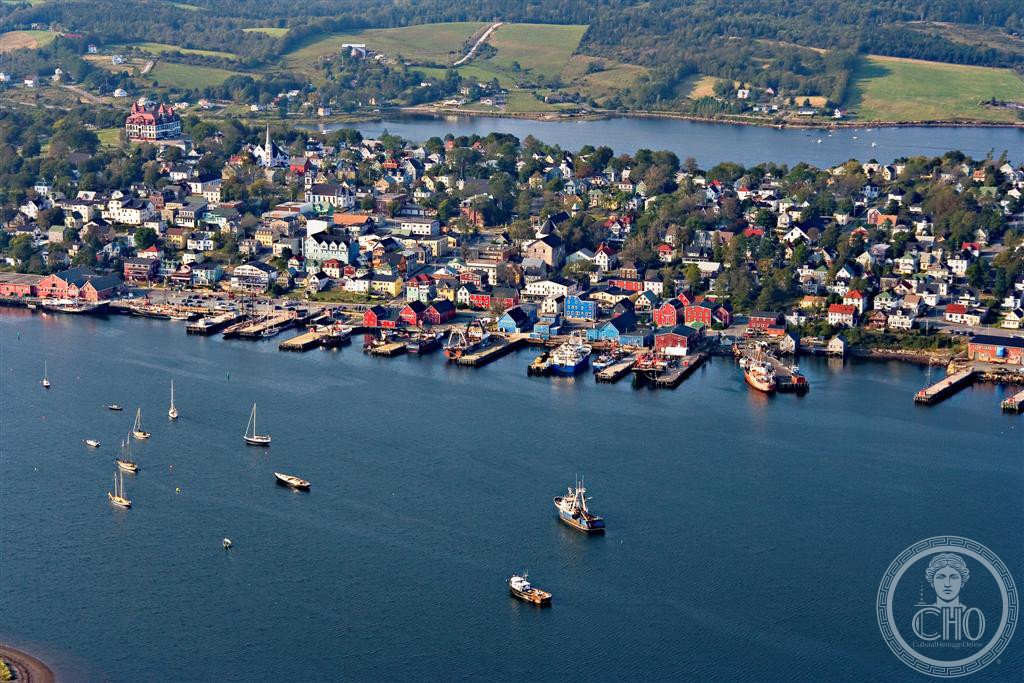
The best-preserved British colonial planned town in North America and one of the most vividly colourful historic townscapes in the Atlantic world. Lunenburg (Nova Scotia), founded in 1753 as the first British colonial settlement outside Halifax, was designed as a “foreign Protestant” town for German, Swiss, and Montbéliard settlers. Its 9-block grid plan, characteristic “Lunenburg Bump” dormers, and brilliantly painted wooden houses on a hillside above a working fishing harbour have remained essentially unchanged since the 18th century.
At a glance
Lunenburg (population approximately 2,500) is 100 km south-west of Halifax on the South Shore of Nova Scotia, on a peninsula in Lunenburg Bay. The Old Town is a compact grid on the hillside facing south over the harbour. It is entirely walkable in half a day (the grid is 9 blocks wide and approximately 4 blocks deep). The town is still an active fishing port (lobster and groundfish). The historic waterfront (Bluenose Drive) has fishing sheds, boat repair facilities, and the Fisheries Museum of the Atlantic. The population is small but the town attracts approximately 200,000 visitors per year (mostly summer).
Key facts
- The “Foreign Protestant” settlement (1753): Lunenburg was established by the British colonial administration of Nova Scotia in 1753 as part of a deliberate policy to settle “Foreign Protestants” (non-English, non-French Protestant immigrants) in Nova Scotia to counterbalance the Acadian French Catholic population. The settlers were recruited primarily from German-speaking areas (the Rhineland Palatinate, Württemberg, and Switzerland) and from Montbéliard (a Protestant principality in Burgundy, then under the sovereignty of the Duke of Württemberg, now part of France). Approximately 1,453 settlers arrived at Lunenburg in 1753. The settlement was planned by the British colonial surveyor Charles Morris, who designed a strict rectilinear grid (9 blocks from east to west, 4 blocks from north to south, with each block divided into 16 lots) on the hillside above the harbour. The grid is still clearly legible in the modern street plan.
- The “Lunenburg Bump” (19th century): the most architecturally distinctive feature of Lunenburg and the primary reason for its UNESCO listing. The “Lunenburg Bump” (also called the “Lunenburg eyebrow” or “Scottish Dormers”) is a distinctive type of dormer window found almost exclusively in Lunenburg. A Lunenburg Bump is a dormer window placed at the ridge of the roof, projecting forward over the main façade and forming a small gabled overhang above the central bay of the front façade. This dormer type appears to have developed locally in Lunenburg in the 19th century and gives the most typical Lunenburg house its characteristic silhouette (the central projecting gable above a 5-bay main façade in wooden clapboard). The architectural origin of the type is uncertain (it may derive from Scottish, German, or New England architectural traditions that were synthesized locally). The Lunenburg Bump appears on over 150 houses in the old town, making it the single most consistent architectural motif in any Nova Scotian settlement.
- The Bluenose schooner legacy: Lunenburg’s most famous cultural contribution to Canadian identity. The Bluenose was a fishing and racing schooner built in Lunenburg in 1921 at the Smith and Rhuland shipyard (still operating on the Lunenburg waterfront). She won the International Fishermen’s Trophy in 1921 and held it undefeated until 1938. She is the most famous ship in Canadian history and her image appears on the Canadian dime (since 1937, the only Canadian coin that has never had its design changed). The original Bluenose was lost in Haiti in 1946. The replica Bluenose II (built in Lunenburg in 1963) is the official ship of Nova Scotia and sails from the Lunenburg waterfront in summer (tours available). The Smith and Rhuland shipyard on the Lunenburg waterfront is the only remaining 19th-century wooden shipbuilding operation in Canada still building vessels.
- The Fisheries Museum of the Atlantic: the primary visitor attraction in Lunenburg, housed in a converted fish-processing plant on the waterfront. The museum (2,800 m²) covers the complete history of the Atlantic fisheries from the earliest Mi’kmaq fishing methods through the Age of Sail, the steam trawler era, and the contemporary groundfish collapse. Exhibits include scale models of the Bluenose and the full-size docked historic vessels at the wharf (including a steam-powered side-trawler of the early 20th century). The museum also has a working aquarium and interpretive demonstrations of traditional fish processing, rope-making, and boat-building.
- Heritage: UNESCO World Heritage Site, Old Town Lunenburg, inscribed 1995.
- GPS: 44.3780° N, -64.3080° W.
History
Lunenburg was founded June 1753. The grid plan was surveyed that same summer. The settlers arrived in autumn 1753. Early years were difficult (raid by Mi’kmaq allies of the French in 1756 killed several settlers and led to the construction of a palisaded fort that determined the current extent of the Old Town). The town grew rapidly as a fishing and trading centre. The 19th century was the economic peak: Lunenburg was one of the leading fishing ports on the Atlantic coast of North America (salt cod exported to the Caribbean and Brazil) and one of the most important wooden shipbuilding centres. The construction of the Bluenose (1921) at the height of this tradition became the symbol of the era. The 20th century brought economic decline as wooden ships were replaced by steel trawlers and the traditional inshore fisheries collapsed. The historic town fabric survived because there was no pressure or capital to redevelop it. UNESCO inscription 1995 recognized the exceptional integrity of the 18th-century settlement pattern and the 19th-century built environment.
What you see
Walk the main street (Montague Street, the central east-west axis of the grid) from the Academy at the top to the waterfront at the bottom. Turn on Lincoln Street and Duke Street to see the residential Lunenburg Bumps in their streetscape context. The Lunenburg Academy (1895, at the top of the grid, Second Empire style, the most important school building in Nova Scotia) gives the best panoramic view over the harbour and the old town. The St John’s Anglican Church (1754, burned 2001 and rebuilt 2005 to the original design, at the corner of Montague and Cumberland) is the most historic church in town. The Zion Evangelical Lutheran Church (1776, the oldest Lutheran church in Canada still in use) represents the German-Protestant heritage of the original settlers. The waterfront (Bluenose Drive): the Fisheries Museum, the Bluenose II berth, the historic fishing sheds, and the lobster pound are all here.
Practical information
- Admission: Fisheries Museum approximately $16 CAD adult (the best single ticket in the town). The old town itself is freely walkable. The tourist information centre (Blockhouse Hill, at the top of the grid) has excellent maps and walking guides. The Lunenburg Bump walking tour (self-guided audio tour, available at the tourist office) is the best introduction to the architectural heritage. Summer (June–September) is the primary visitor season. Winter is quiet but the town is open and gives a more authentic experience of a working fishing community.
- Getting there: by car from Halifax: 100 km south-west via Highway 103/3 (1h 20 min). By bus from Halifax: Maritime Bus service to Bridgewater (30 km from Lunenburg), then taxi or local bus. There is no direct train service to Lunenburg. Car is strongly recommended. Lunenburg is an easy day trip from Halifax but worthy of an overnight stay (several excellent B&Bs and inns in the old town).
- The Nova Scotia South Shore circuit: Lunenburg pairs naturally with the Annapolis Royal (the first permanent European settlement in Canada, founded 1605 by Champlain and Dugua de Mons; the Habitation de Port-Royal is the oldest reconstructed European settlement in North America, now a National Historic Site) and the tidal landscapes of the Bay of Fundy (the highest tidal range in the world, approximately 15–16 metres; the tidal bores, the mudflat and salt marsh wildlife, and the tidal reversals of the rivers are extraordinary natural spectacles visible from several points on the South Shore and along Highway 101).
Getting there
By car from Halifax (100 km, 1h 20min via Highway 103). Bus to Bridgewater (30 km) then taxi. Car strongly recommended. GPS: 44.3780, -64.3080.
Nearby
- Halifax Citadel and Waterfront. 100 km north-east of Lunenburg (1h 20 min). The capital of Nova Scotia and the most important historic port city in Atlantic Canada. The Citadel National Historic Site (star-shaped British fortification, 1749–1856, on the hill above the waterfront; the most visited historic site in Atlantic Canada) gives a panoramic view over the harbour and the city. The Halifax Waterfront Boardwalk (4 km of waterfront development) has the Maritime Museum of the Atlantic (the most important maritime museum in Canada, housing artefacts from the Titanic disaster, 1912 — Titanic victims were brought to Halifax, the nearest port, and many are buried in local cemeteries, including the grave of J. Dawson, misidentified by Titanic film fans as Leonardo DiCaprio’s character). The Historic Properties (a complex of restored 19th-century stone warehouse buildings on the waterfront, now shops and restaurants) are the core of Halifax’s historic architecture.
- Peggy’s Cove. 75 km north-east of Lunenburg (1h by car). The most photographed lighthouse in Canada and one of the most iconic images of the Atlantic coast. The Peggy’s Point Lighthouse (1914, automated 1958; red and white octagonal wooden lighthouse on a granite outcrop above the sea) at the entrance to St Margarets Bay is the definitive image of the Nova Scotia coast. The surrounding granite rock landscape (polished by glaciation, dotted with tidal pools) is exceptional. The village of Peggy’s Cove (approximately 40 residents year-round) is one of the most perfectly preserved small fishing villages in Nova Scotia. It is most beautiful in early morning before the tour buses arrive.
- Mahone Bay. 25 km north-east of Lunenburg (25 min by car). The most photogenic small town on the South Shore, famous for the “Three Churches” view (three 19th-century Protestant churches — St James Anglican, Trinity United, and St John’s Lutheran — their spires and reflections in Mahone Bay forming one of the most-reproduced photographs in Nova Scotia). Mahone Bay has a thriving artisan community (pottery, weaving, jewellery, antiques) and several excellent restaurants. The annual Wooden Boat Festival (August) celebrates the area’s shipbuilding heritage with sailing races, boat-building demonstrations, and traditional craft markets.
Sources
- Wikipedia, Lunenburg, Nova Scotia. Bluenose (schooner). Old Town Lunenburg, accessed June 2026.
- UNESCO, Old Town Lunenburg, WHS reference 741, inscribed 1995.
- Charles Bruce Fergusson, The History of Lunenburg County, Nova Scotia Museum, 1960.
- Parks Canada, Old Town Lunenburg National Historic Site: Management Plan, 2005.
Find it on the map
See this place and what’s around it →📷 Become a Cultural Heritage Online photographer
Share your photos of places: they stay published under your name as the author. The more they're seen, the more you get noticed — and soon a contest will reward the most appreciated photos.
Log in or sign up free to add a photo