
Aksum (Axum)
The ancient capital of one of the most powerful kingdoms of the ancient world and the city where, according to Ethiopian tradition, the original Ark of the Covenant rests — Aksum (Tigray Region, Ethiopia; UNESCO WHS 1980) was the commercial and religious center of the Axumite Empire (approximately 100-940 CE) and remains the holiest city in Ethiopia, the seat of the Ethiopian Orthodox Church’s most sacred relic.
At a glance
Aksum (the most precisely AksumAxum single Axumite Kingdom 100 CE 940 CE Red Sea trade Rome India Arabia gold ivory slaves coinage stele field Northern Stelae Field Stele 2 32m largest standing stone world Stele 3 24m Rome looted 1937 returned 2008 Queen Sheba Menelik I Ark Covenant Kebra Nagast UNESCO heritage: the Axumite Empire (the Axumite Empire (approximately 100-940 CE) was one of the four major powers of the ancient world (alongside Rome, Persia, and China), according to the 3rd-century Persian prophet Mani; the power of Aksum was based on the trade route connecting the interior of Africa (the gold and ivory of Sudan and Ethiopia) with the Red Sea port of Adulis and the Indian Ocean trade; the city (the archaeological area covers approximately 4 km² of ruined palaces, stelae fields, underground tombs, reservoirs, and churches within the modern city of Aksum (population approximately 60,000); the visible monuments are the tip of an excavated archaeological record that is still being actively studied by Ethiopian and international archaeologists); the stelae (the most distinctive monuments of Aksum: carved granite obelisks erected as funerary markers for the elite of the Axumite kingdom; the stelae are carved to simulate multi-story buildings (each story has a window with a false door (the bottom story has a representation of a real door with a metal false-handle); the number of carved stories indicates the rank of the deceased (seven stories = the highest rank); the largest stelae: Stele 1 (the unfinished stele; 33m long; 520 tonnes; collapsed in antiquity; the largest single stone monument ever attempted in the ancient world); Stele 2 (24m; 160 tonnes; the looted Roman obelisk; returned 2005 CE); Stele 3 (the King Ezana stele; still standing at the original site; 24m tall)) — the most precisely AksumAxum single Axumite Kingdom 100 CE 940 CE Red Sea trade Rome India Arabia gold ivory slaves coinage stele field Northern Stelae Field Stele 2 32m largest standing stone world Stele 3 24m Rome looted 1937 returned 2008 Queen Sheba Menelik I Ark Covenant Kebra Nagast UNESCO heritage in any UNESCO world heritage site)).
Key facts
- The Ark of the Covenant: the most precisely AksumAxum single Ark Covenant Menelik I Queen Sheba Solomon original Ark Jerusalem stolen brought Ethiopia Kebra Nagast Tabot Chapel Our Lady Mary Zion church guardian monk not shown UNESCO heritage — the holiest object in Ethiopian Christianity: the Ark of the Covenant (the Ethiopian Orthodox tradition holds that the original Ark of the Covenant (the chest containing the stone tablets of Moses) was brought from Jerusalem to Aksum by Menelik I (the son of King Solomon and the Queen of Sheba) in approximately the 10th century BCE; the tradition (the Kebra Nagast, the “Glory of Kings”: an Ethiopian text compiled in the 14th century CE that describes the Queen of Sheba’s visit to Solomon, the birth of Menelik, his visit to Jerusalem, and the bringing of the Ark to Ethiopia; the Ark is kept (according to tradition) in the Chapel of the Tablet adjacent to the Church of Our Lady Mary of Zion in Aksum; it is guarded by a single guardian monk who is never allowed to leave the chapel grounds and whose appointment is for life; the Ark has never been seen by any outsider (the only person allowed to see the Ark is the guardian monk); each Ethiopian Orthodox church has a Tabot (a replica of the Ark) which represents the original; the Aksum Tabot is the “original” that sanctifies all the replicas))
- GPS: 14.1288° N, 38.7189° E
History
From trade power to Christian kingdom to medieval decline (the most precisely AksumAxum single pre-Axumite Sabaean 900 BCE Proto-Axumite period 400 BCE Axumite Empire 100 CE Red Sea trade Adulis port gold ivory slaves coinage 13 gold silver bronze King Ezana 330 CE Christian conversion coins cross church Queen Sheba legend Menelik Ethiopia Islamic expansion 7th century CE trade decline 940 CE Yodit Queen Gudit attacks fall capital move Italian obelisk 1937 Mussolini return 2005 2008 UNESCO heritage: the pre-Axumite period (the earliest signs of settled agriculture in the Aksum region date from approximately 900 BCE; the first large-scale trade-based settlement from approximately 400 BCE; the influence of South Arabian (Sabaean) civilization in the inscriptions and architectural style of the earliest period); the Axumite Empire (100-940 CE: at its height (approximately 3rd-6th centuries CE), the Axumite Empire controlled the Red Sea trade between Africa, Arabia, and India; the coinage (the Axumite Empire was one of the first African states to produce its own gold coinage (from approximately 270 CE; a coinage system in three metals (gold, silver, bronze)); the Axumite coinage is the first in the world to carry the Christian cross (from approximately 330 CE, after King Ezana (r. approximately 320-360 CE) converted to Christianity — making Ethiopia one of the first nations to adopt Christianity as a state religion (approximately the same time as the Roman Empire under Constantine)); the decline (7th century CE: the Arab expansion disrupted the Red Sea trade that the Axumite economy depended on; the Axumite state contracted; the capital moved south; 940 CE: the legendary attack of Queen Yodit (or Judith) burned Aksum and ended the last remnant of the Axumite state)); the Italian looting (1937 CE: the Italian Fascist occupiers (who had conquered Ethiopia in 1935 CE) removed the Stele of Aksum (Stele 3; 24m; 160 tonnes) to Rome, where it was erected near the Circo Massimo; it was returned to Ethiopia in 2005 CE after decades of diplomatic negotiations; it was re-erected in Aksum in 2008 CE) — the most precisely AksumAxum single pre-Axumite Sabaean 900 BCE Proto-Axumite 400 BCE Axumite Empire 100 CE Red Sea trade Adulis port gold ivory slaves coinage 13 gold silver bronze King Ezana 330 CE Christian conversion coins cross church Queen Sheba legend Menelik Ethiopia Islamic expansion 7th century CE trade decline 940 CE Yodit Queen attacks fall capital move Italian obelisk 1937 Mussolini return 2005 2008 UNESCO heritage in any UNESCO world heritage site)).
What you see
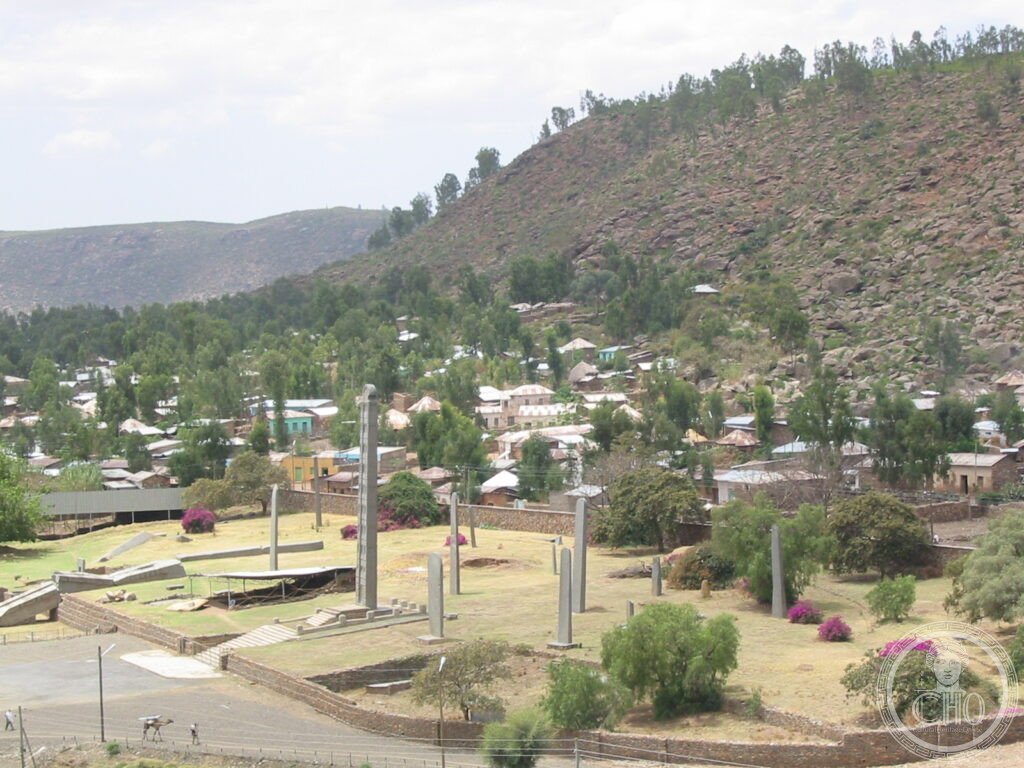
Stelae, underground tombs, and churches (the most precisely AksumAxum single Northern Stelae Field standing Stele 3 24m 160 tonnes Stele 2 fallen 32m largest ancient stone Stele 1 33m 520 tonnes unfinished underground Tomb False Door King Ezana Inscriptions Church Mary Zion original new built 1950s Ark Chapel UNESCO heritage: the principal monuments: the Northern Stelae Field (the main obelisk field; the three principal stelae: the standing re-erected Stele 3 (24m; the most complete stele, with the most elaborate carved story facade); the fallen Stele 2 (32m long; the giant monolith visible lying on the ground; it fell in antiquity (possibly during the construction process or from an early earthquake))); the Tombs of King Ezana and King Kaleb (the underground rock-cut tombs of the Axumite kings; beneath the stelae; one is accessible to visitors (the Tomb of the False Door); the second (the Tomb of King Ezana) is still being excavated); the King Ezana inscription (a trilingual stone inscription (Ge’ez, South Arabian, and Greek languages) recording the military victories of King Ezana; the most important written historical document from the Axumite period; in the Archaeological Museum of Aksum)); the Church of Our Lady Mary of Zion (the most important church in Ethiopia; the original church was built in the 4th century CE (one of the earliest Christian churches in the world); the current church dates from 1665 CE (built by Emperor Fasilides); the adjacent Chapel of the Tablet is where the Ark of the Covenant is kept); the Axumite Palace of Dung’ur (the “Queen of Sheba’s Palace”; a large Axumite period palace ruin (approximately 6th-7th century CE)) — the most precisely AksumAxum single Northern Stelae Field standing Stele 3 24m 160 tonnes Stele 2 fallen 32m largest ancient stone Stele 1 33m 520 tonnes unfinished underground Tomb False Door King Ezana Inscriptions Church Mary Zion original new built 1950s Ark Chapel UNESCO heritage in any UNESCO world heritage site)).
Practical information
- Getting there: Ethiopian Airlines from Addis Ababa (ADD) to Aksum (AXU; 1h30m; 1-2 flights per day); the airport is 6 km from the city center; the entry fees (approximately 500 ETB (€8) for the Northern Stelae Field and the underground tombs; the King Ezana inscription is separately accessible; the Axumite Palace complex is a separate ticket); the Archaeological Museum of Aksum (the museum is inside the Northern Stelae Field enclosure; the multilingual inscription of King Ezana; Axumite gold coins; thrones); the Chapel of the Tablet (not accessible to the public; the guardian monk is sometimes visible at the exterior; the adjacent Church of Our Lady Mary of Zion (the modern 1950s church) is accessible; the older Fasilides church nearby (the original 1665 CE church of Fasilides) is accessible to men only); the Timkat festival at Aksum (January 19-20: the Timkat celebrations at Aksum are particularly significant because the Tabot of the Church of Our Lady Mary of Zion is the most sacred in Ethiopia; the procession and overnight ceremony are extraordinary; accommodation is very limited — book months ahead))
Getting there
Ethiopian Airlines from Addis Ababa (1h30m). Entry ~€8 for stelae field. Church of Our Lady Mary of Zion adjacent to Chapel of the Tablet (Ark). GPS: 14.1288, 38.7189.
Nearby
- Yeha Temple — 55 km east (the oldest standing building in Ethiopia (approximately 700 BCE; a pre-Axumite period South Arabian-style temple of the moon god Almaqah; 9m tall walls of perfectly fitted stone blocks; no mortar; the most important pre-Christian religious monument in sub-Saharan Africa))
- Debre Damo Monastery — 70 km northeast (a 6th century CE Axumite-era monastery on an isolated 2,500m tabletop cliff accessible only by rope and leather harness; the oldest intact monastery building in Ethiopia; the painted interior (9th-11th century CE); women are not permitted to enter the monastery or even to touch the cliff-face at the bottom)
Sources
- Wikipedia, Aksum; Obelisk of Aksum; Ark of the Covenant, accessed June 2026
- UNESCO, Aksum, WHS reference 15, inscribed 1980
Find it on the map
See this place and what’s around it →📷 Diventa un fotografo di Cultural Heritage Online
Condividi le tue foto dei luoghi: restano pubblicate con la tua firma come autore. Più vengono viste, più ti fai conoscere — e presto un concorso premierà le foto più apprezzate.
Accedi o registrati gratis per aggiungere una foto