A 3.5 km, 165-minute walk through central Casablanca reveals French colonial Art Deco buildings that still shape the city's civic and cultural life.

Why Casablanca's Art Deco district matters
Casablanca’s twentieth-century architecture is often reduced to the image of the Hassan II Mosque, yet the city holds one of Africa’s most coherent collections of interwar Art Deco buildings. During the French Protectorate, planners and architects built a new administrative and commercial quarter alongside the old medina, using a distinctive blend of European modernism and Moroccan ornament known as Mauresque. This walk connects five buildings that survive from that period, all within a compact circuit around Place Mohammed V and the port.
What sets Casablanca apart from other colonial cities of the same era is the number of these buildings still in use. Many have been converted or demolished, but the Palais de Justice remains a courthouse, Cinema Rialto still screens films, and Casa-Port station continues to serve passengers. The walk is not a museum trail but a route through working institutions, which makes the architectural heritage part of everyday urban life.
Palais de Justice, the civic blueprint
The Palais de Justice stands on Place Mohammed V, flanked by the Préfecture de Police, the post office, and other monumental buildings from the Protectorate era. Completed in 1925, it was among the first major public buildings on the square, then known as Place de France. Its restrained Art Déco character, expressed through clean geometric volumes, decorative friezes, and a commanding central entrance, set the template for administrative architecture across French Morocco.
The building continues to serve as an active courthouse, giving it a civic vitality that many of its contemporaries have lost to museum or hotel conversion. Urban planner Henri Prost designed the square as the administrative heart of the new European quarter, and the Palais de Justice anchors that ensemble. Its façade is composed of bold horizontal bands punctuated by vertical pilasters, with geometric friezes and carved reliefs overlaying the structural framework.
Wilaya Building, Art Deco with Moorish profiles
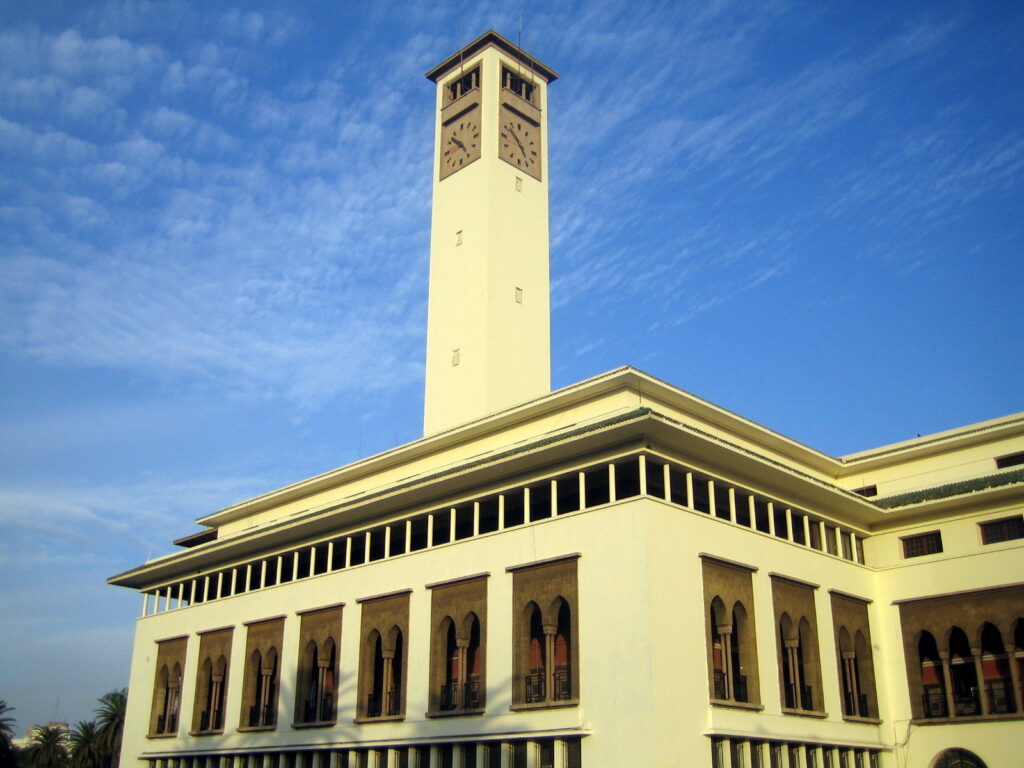
The Wilaya Building, known locally as El-Wilaya, houses the administration of Grand Casablanca Province. Architect Marius Boyer designed it with a tripartite façade: a rusticated base, a central loggia of arched bays framed by pilasters, and a recessed upper storey capped by a low parapet. The arches carry subtle Moorish profiles, slightly pointed and relieved by voussoir contrasts, while surface ornament draws on both Deco geometry and Arabesque interlace.
Construction began in 1928 and was completed nine years later. The white render, now historically maintained, was chosen to respond to Casablanca’s Atlantic light, creating a luminous presence around the square. After Moroccan independence in 1956, the building transitioned into national government use, absorbing its colonial origins into a new institutional identity.
Sacré-Cœur, from church to cultural centre
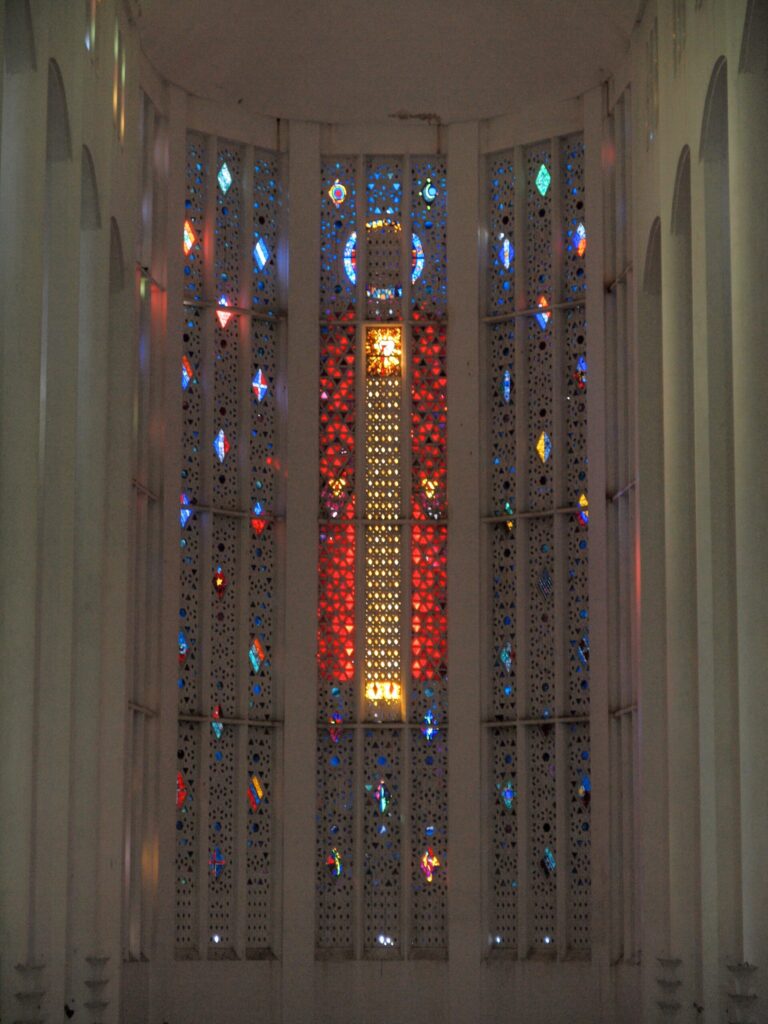
The Sacré-Cœur de Casablanca rises above the greenery of Arab League Park west of the city centre. Designed by Paul Tournon and completed in 1930, it is one of North Africa’s most distinctive interwar Art Deco buildings. Tournon combined Art Deco’s geometric simplicity, vertical lines, and restrained surface decoration with Gothic Revival pointed arches, twin towers, and a sense of upward aspiration. The façade is composed in pale stone.
Despite monumental scale and common use of the term ‘cathedral’, the structure was never the seat of a bishop. Following Moroccan independence in 1956, it ceased functioning as a church and was later repurposed as a public cultural centre. That transformation preserved the architecture while giving the space new civic meaning, hosting exhibitions, performances, and events.

Cinema Rialto, a survivor of the picture palace era
Cinema Rialto occupies a prominent place in Casablanca’s cultural geography. Built in 1929, it belonged to a generation of Art Déco picture palaces in the European quarter, alongside venues such as Cinema Lynx and Cinema Vox, the latter reportedly the largest cinema in Africa at its peak. While many contemporaries were demolished or converted, the Rialto has persisted as an active cinema, making it one of the most tangible survivors of that golden age.
The façade is a well-preserved example of the Art Déco colonial aesthetic, with bold geometric ornament, strong vertical and horizontal composition, and decorative lettering that defined cinema architecture of the period worldwide. Following independence, many historic cinemas closed, but the Rialto survived and was subsequently acquired by the Bouchentouf family, who maintain it as both a functioning cinema and a heritage landmark.

Gare de Casablanca-Port, the railway terminal
Casa-Port station serves as one of two main railway termini in Casablanca, alongside Casa-Voyageurs. Positioned close to the port and the historic centre, it primarily handles suburban and regional trains, including the Train Navette Rapide service to Kenitra and other Atlantic coast cities. The station building, with its characteristic interwar façade, is part of the broader architectural legacy of French urban planning in Casablanca.
Railway infrastructure developed rapidly under the French Protectorate after 1912, and the station at the port end of the city was constructed during the 1920s to serve growing freight and passenger traffic. The station was later integrated into the national ONCF network after independence in 1956. Subsequent modernisation updated operational infrastructure while the original Protectorate-era building fabric was retained as a heritage asset.
Practical notes for the walk
The route covers 3.5 km and takes about 165 minutes at a leisurely pace. The order can follow the sequence above: starting at the Palais de Justice on Place Mohammed V, then moving to the Wilaya Building on the same square, followed by the Sacré-Cœur west of Arab League Park, Cinema Rialto to the east, and finishing at Gare de Casablanca-Port near the harbour.
All sites are in central Casablanca and accessible on foot. The Palais de Justice and Wilaya Building are working government buildings, so exterior viewing is recommended. The Sacré-Cœur is open as a cultural centre, Cinema Rialto operates as a cinema, and Casa-Port is a functioning railway station. Morning or late afternoon light is best for the white render of the Wilaya and the pale stone of the Sacré-Cœur.
The full route, with the order of the stops and the distances, is on the Casablanca Art Deco: a walk through the Mauresque city page.
Sources
- Palais de Justice de Casablanca · https://culturalheritageonline.com/places/palais-de-justice-de-casablanca/
- Wilaya Building · https://culturalheritageonline.com/places/wilaya-building/
- Sacré-Cœur de Casablanca · https://culturalheritageonline.com/places/sacre-coeur-de-casablanca/
- Cinema Rialto · https://culturalheritageonline.com/places/cinema-rialto/
- Gare de Casablanca-Port · https://culturalheritageonline.com/places/gare-de-casablanca-port/
- Casablanca Art Deco: a walk through the Mauresque city · https://culturalheritageonline.com/itineraries/casablanca-art-deco-walk/
Spotted an error? Write to [email protected] and we correct it the same day.