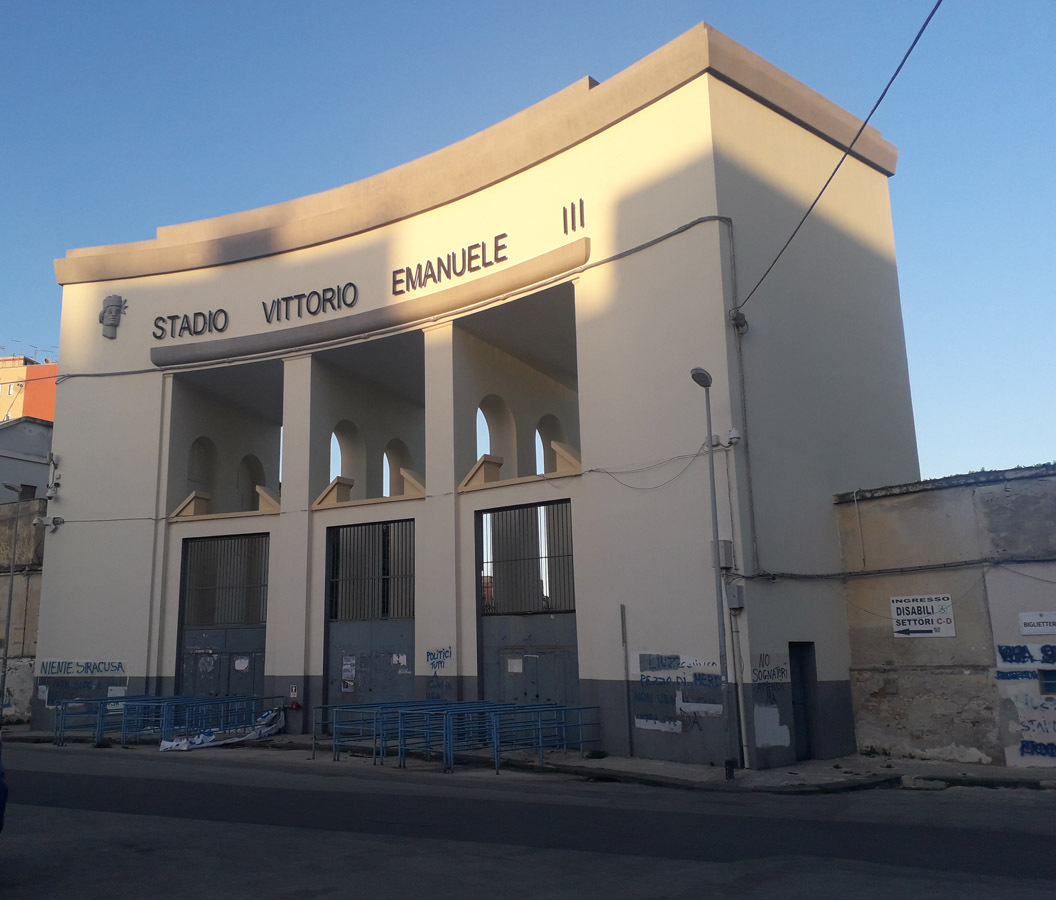
Stadio Nicola De Simone is a football stadium in Syracuse, Sicily, designed by architect Raffaele Leone and completed in 1932, with construction beginning in 1930. Originally named Stadio Vittorio Emanuele III after the Italian king, the stadium stands in the historic Santa Lucia district, near the Basilica of Santa Lucia and the Shrine of Our Lady of Tears.
The structure reflects the architectural language of 1930s Italian Rationalism, evident in its main entrance where period symbols remain visible. When built, the stadium accommodated approximately 8,000 spectators. The stadium was renamed in 1979 to honour Nicola de Simone, a Siracusa player who died following an accidental injury sustained during a match against Palma Campania on 13 May 1979. Capacity was later reduced to its current 5,946 seats following the implementation of anti-violence legislation.
About the Stadium
Stadio Nicola De Simone serves as the home ground of Siracusa football team and remains a significant civic structure within the city’s historic centre, reflecting both sporting and architectural heritage from the interwar period.
Details
- Architect: Raffaele Leone
- Built: 1930–1932
- Location: Piazza Luigi Leone Cuella, Santa Lucia district, Syracuse, Sicily
- Original name: Stadio Vittorio Emanuele III
- Renamed: 1979
- Current capacity: 5,946 spectators
- Original capacity: circa 8,000 spectators
Frequently Asked Questions
Who designed the stadium?
Architect Raffaele Leone designed Stadio Nicola De Simone, completed in 1932.
Why was it renamed?
The stadium was renamed in 1979 in honour of Nicola de Simone, a Siracusa player who died on 13 May 1979 from an accidental head injury sustained during a match against Palma Campania.
Where is it located?
The stadium stands in Piazza Luigi Leone Cuella in the Santa Lucia historic district of central Syracuse, near the Basilica of Santa Lucia and the Shrine of Our Lady of Tears.
Explore more: 16 heritage places in Siracusa