
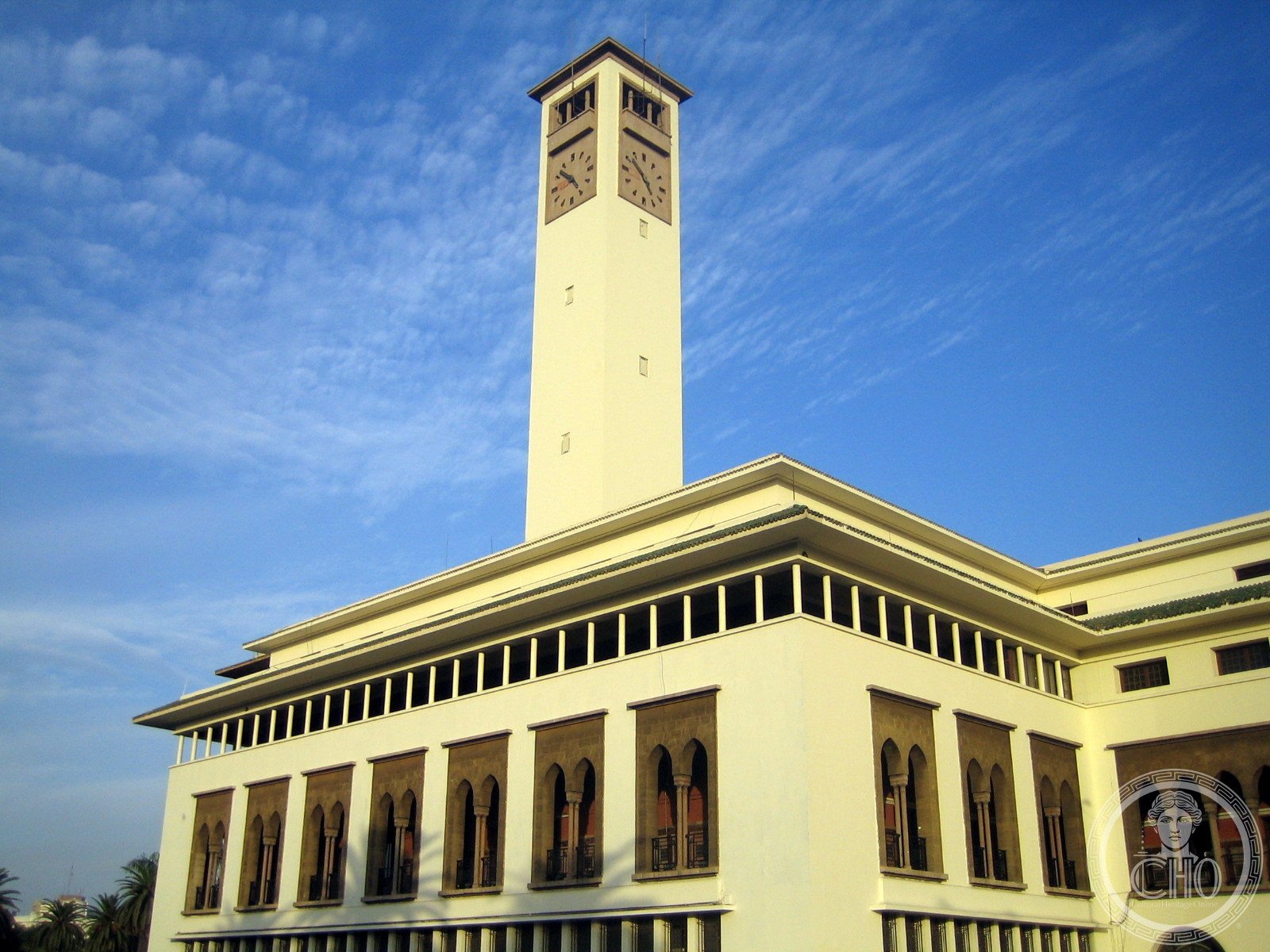
On Muhammad V Square in central Casablanca stands the Wilaya Building, an emblem of a city that rewrote itself in stone and concrete during the French Protectorate. Designed by Marius Boyer and completed in 1937 after nearly a decade of construction, the building serves as the administrative seat of Grand Casablanca Province. Its tiered white façade, rhythmic arched loggia, and Mauresque-inflected ornamentation mark it as one of the finest examples of French colonial Art Deco on the African continent — a style that fused the global Deco vocabulary with North African motifs to produce something entirely its own. Today the building remains in active government use, its silhouette anchoring one of Morocco’s most celebrated public squares and drawing architects, historians, and travellers who come to read Casablanca’s layered twentieth-century identity in its walls.
At a glance
- Type
- Government administrative building
- Period
- 1928–1937
- Style
- French Colonial Art Deco / Mauresque
- Location
- Muhammad V Square, Casablanca, Morocco
- Coordinates
- 33.5903° N, 7.6190° W
- Architect(s)
- Marius Boyer
Overview
The Wilaya Building — locally known as El-Wilaya — houses the administration of Grand Casablanca Province. It occupies a commanding position on Muhammad V Square, the civic heart of the city, alongside the Palace of Justice and the French Consulate. Boyer’s design blends the geometric precision of international Art Deco with horseshoe arches and zellige-inspired decorative bands, creating a visual grammar that the French Protectorate hoped would project both modernity and cultural sensitivity to Moroccan subjects and European settlers alike.
History
Construction of the Wilaya Building began in 1928, four years after the formalization of French Protectorate urban plans drawn up by Henri Prost. Resident General Hubert Lyautey had commissioned Prost to redesign Casablanca along a radial plan, and Muhammad V Square — then Place Administrative — was intended as its administrative crown. Boyer, who had established himself as the preeminent architect of French Morocco, oversaw the nine-year build. The building was completed in 1937 and immediately became a focal point for civic life. After Moroccan independence in 1956 it transitioned seamlessly into national government use, its colonial origins absorbed into a new institutional identity.
Architecture & Design
Boyer’s façade deploys a tripartite composition: a rusticated base, a central loggia of arched bays framed by pilasters, and a recessed upper storey capped by a low parapet. The arches carry subtle Moorish profiles — slightly pointed, relieved by voussoir contrasts — while the surface ornament draws on both Deco geometry and Arabesque interlace. The building’s white render, now historically maintained, was chosen to respond to Casablanca’s Atlantic light, creating a luminous presence around the square. The interior features formal reception halls with coffered ceilings and terrazzo floors, standard for Protectorate civic ambition.
Cultural significance
The Wilaya Building is an anchor of Casablanca’s Art Deco heritage, a body of work recognised by UNESCO and championed by the association Casamémoire. The city’s Deco district — centred on the ville nouvelle around Muhammad V Square — represents one of the most intact colonial-era urban ensembles in Africa. Boyer’s contribution to this ensemble has been reassessed since the 1990s as a complex negotiation between European modernism and North African tradition, making the building a key text in debates about colonial architecture and post-colonial memory.
Visiting today
The Wilaya Building remains a working government office and is not open to public tours. The exterior and Muhammad V Square are freely accessible at all hours and best appreciated in the morning light. The square is a short walk from the Hassan II Mosque and lies at the heart of the Art Deco walking circuit promoted by Casamémoire. Guided heritage tours of central Casablanca regularly include the square as a centrepiece stop.
Getting there
Muhammad V Square is in the centre of Casablanca’s ville nouvelle. The closest tram stop is Place des Nations Unies on Line 1 of the Casablanca Tramway, a two-minute walk. From Casa-Voyageurs or Casa-Port train stations the square is reachable by tram or a 15-minute walk. Taxis from Mohammed V International Airport take approximately 40 minutes.
Sources & resources
Find it on the map
See this place and what’s around it →Record researched and written by Luigi De Marchi for Cultural Heritage Online, 2026.
📷 Become a Cultural Heritage Online photographer
Share your photos of places: they stay published under your name as the author. The more they're seen, the more you get noticed — and soon a contest will reward the most appreciated photos.
Log in or sign up free to add a photoIs this page about you?
This page is read by travellers and heritage enthusiasts who find it on Google. Tell us how you are connected to this place and we will take it from there.