Italian Somalia is the least legible today of Italy’s overseas territories — not because little was built, but because so much of what was built has been consumed by the country’s later history. The colonial capital, Mogadishu, was among the most Italian-built cities of Africa; three decades of civil war have reduced much of that fabric to ruins or memory. What remains is a record worth setting down precisely because it is disappearing.
The context, stated plainly
Italian control of southern Somalia consolidated between the 1890s and the 1920s, first through chartered companies, then as a crown colony. The governorship of Cesare Maria De Vecchi (1923–1928) built churches and public works and is equally documented, by the historiography, for the violence of its “pacification” campaigns — disarmament expeditions in the interior conducted with summary methods. The colony’s plantation economy, in the irrigated districts along the Shebelle river, rested on labour regimes that historians describe as coerced. In 1936 Somalia was folded into Italian East Africa; after the war, Italy returned as administrator of the UN trusteeship (1950–1960) that led the country to independence. All of this frames the buildings below.
Mogadishu, the Italian-built capital
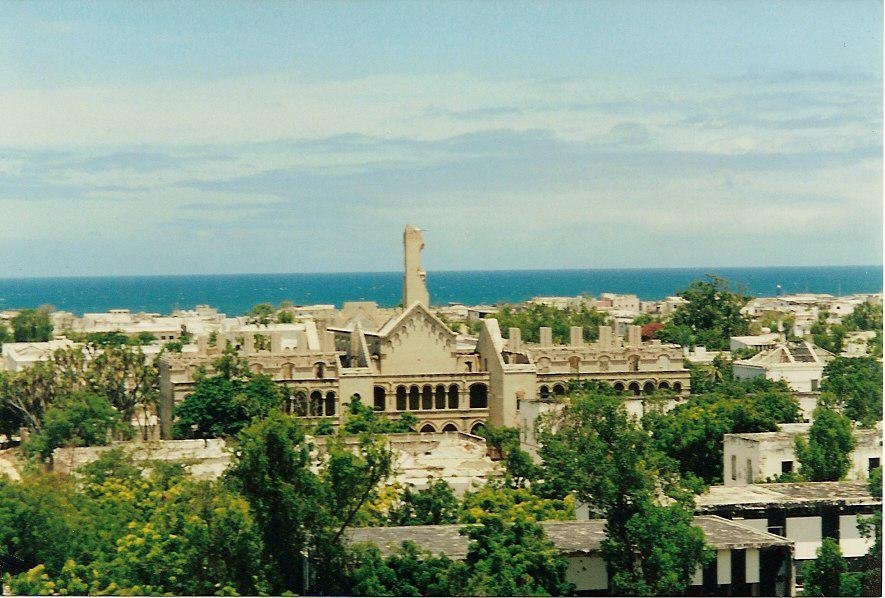
Colonial Mogadishu grew beside the old stone town of Hamar Weyne: a governor’s palace, arcaded streets, offices, the Lido on the ocean shore, and the building that dominated the skyline — the Cathedral, built 1925–1928 to Antonio Vandone’s design on the model of Cefalù’s Norman cathedral, its twin towers rising 37.5 metres. Inaugurated on 1 March 1928 in the presence of Crown Prince Umberto, it was called the largest cathedral in East Africa; today it stands in ruins, wrecked in the civil war — a single building holding the whole century. In 1934, for another royal visit, the city raised a triumphal arch dedicated to King Umberto in the public garden; the old Garesa palace was restored in the same years as the colony’s museum. Fragments of all of this survive in today’s city, alongside the photographs and Luce newsreels that preserve what does not.
The company towns of the Shebelle
Somalia’s most distinctive Italian settlement was agro-industrial. In 1920 the explorer-prince Luigi Amedeo di Savoia, Duke of the Abruzzi, founded the SAIS company (Società Agricola Italo-Somala) and with it the Villaggio Duca degli Abruzzi on the Shebelle river — a plantation town of sugar mills, workshops, housing and a church, today the city of Jowhar. Downstream, the irrigation district of Genale grew bananas and cotton for export. These were the colony’s economic showcase; the historiography documents both their engineering and the coercion of the labour system that ran them. As settlements they belong to the same family as Italy’s own company and foundation towns — a rationalised landscape of production, transplanted to the Horn of Africa.
What remains, and how to read it
The trusteeship years and the first decade of independence kept much of the Italian fabric in use; the state collapse of the 1990s did not. The cathedral is a ruin; the arch and the seafront buildings survive in varying states; Jowhar is a Somali city on an Italian plan. Somalia is where this series’ method matters most: where the buildings themselves are vanishing, the documentary record — plans, photographs, film — is the heritage. This archive records it as such: what was built, who designed it, when, and what happened to it, neither celebrating nor condemning.
The trusteeship: an unusual second act
Somalia’s Italian story has a coda unique in this series. In 1950 the United Nations returned the former colony to Italian administration as a ten-year trusteeship — the AFIS — with the explicit mandate of preparing independence by 1960. The decade produced a different kind of building: schools, technical institutes and the beginnings of higher education in Mogadishu, and the training of the administrative class that took over the independent state. Historians debate the trusteeship’s record — continuity of colonial personnel against genuine institution-building — but the mandate, and the deadline it met, distinguish it sharply from what came before. Somalia thus holds, in one century, every phase of the Italian overseas experience: company rule, crown colony, empire, trusteeship, and the long aftermath.
Places of Italian Somalia in this archive
- Mogadishu Cathedral (1928) — Antonio Vandone; in ruins
- Villaggio Duca degli Abruzzi (Villabruzzi) — the SAIS company town of 1920 on the middle Shabelle, today Jowhar.
- The Garesa museum and the Umberto arch, Mogadishu — cards in preparation
- The Genale barrage and irrigation district — the 1926 intake dam and the canal-fed banana concessions on the lower Shabelle.
This is the fifth piece in the series on Italy’s overseas territories, after Libya, Eritrea, the Dodecanese and Italian East Africa.