
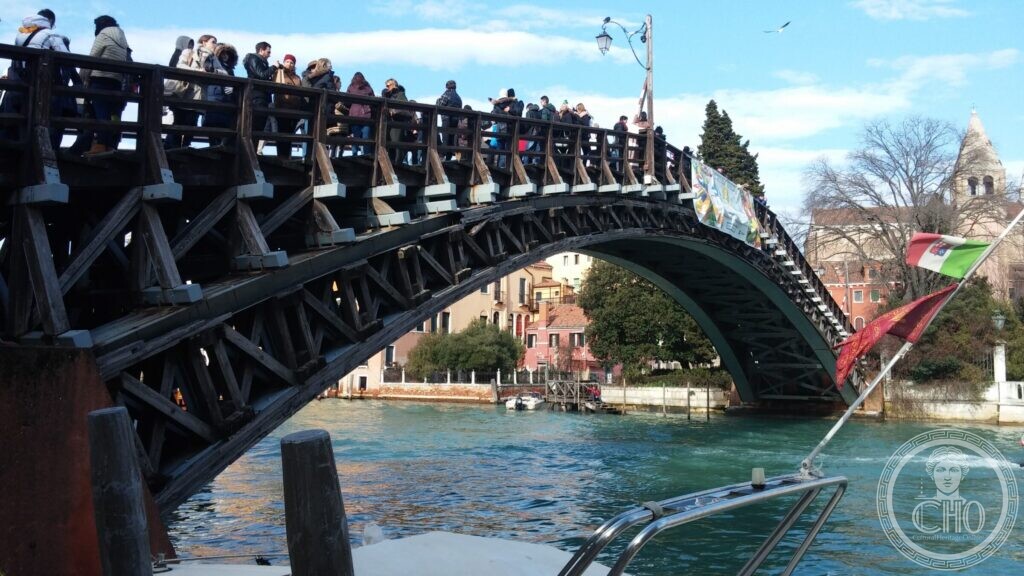
Venice, Veneto · 1933 · Bridge over the Grand Canal
At a glance
The Ponte dell’Accademia is the softest-looking of the four bridges over the Grand Canal: a single timber arch that seems to have been there forever. It was built in 1933 as a stopgap, and it is not quite what it appears. Eugenio Miozzi designed it to stand for a few years while Venice decided what to build instead; the decision never came, and the bridge stayed. What carries the load today is steel, added in two later campaigns and dressed in the wood that gives the bridge its name.
Key facts
- Opened: 19 February 1933
- Designer: Eugenio Miozzi, engineer to the city of Venice
- Replaced: an iron bridge of 1854 by the English engineer Alfred Neville, a single horizontal span of 50 metres, opened 20 November 1854
- Intended as: a temporary crossing, pending a competition for a permanent stone bridge
- 1948: the structural arches carrying the deck were replaced in steel
- 1985: the lattice members connecting the arches were replaced with metal elements
- Owner: Comune di Venezia
- Crosses: from the Sestiere di San Marco to the Sestiere di Dorsoduro
- Coordinates: 45.431678, 12.328942
History
Until the middle of the nineteenth century the Grand Canal had one bridge, at Rialto. The Austrian administration added two more in iron, and the one at the Accademia — designed by the English engineer Alfred Neville and opened on 20 November 1854 — was a flat girder of fifty metres, practical and widely disliked. By the 1930s it was also failing.
Eugenio Miozzi, then the city’s engineer and in the middle of the works that would give Venice the Rio Novo and the bridges along it, was asked for a temporary replacement while a competition chose a permanent design in stone. He produced a timber arch and it opened on 19 February 1933. The competition never produced a bridge. War came, then the cost of building in the canal, and the temporary crossing became the permanent one by simply outlasting the argument.
Wood over salt water has a short life, and the bridge has been rebuilt inside its own shape twice. In 1948 the structural arches under the deck were replaced in steel. In 1985 the lattice members that tie the arches together went the same way. The silhouette Miozzi drew in 1933 has been kept exactly; almost everything that holds it up has been renewed.
What you see
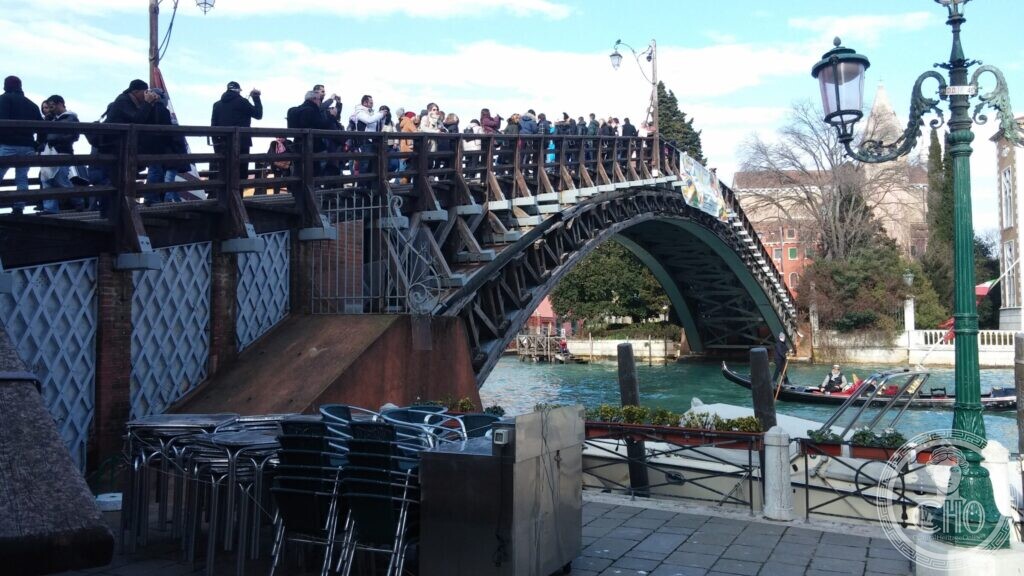
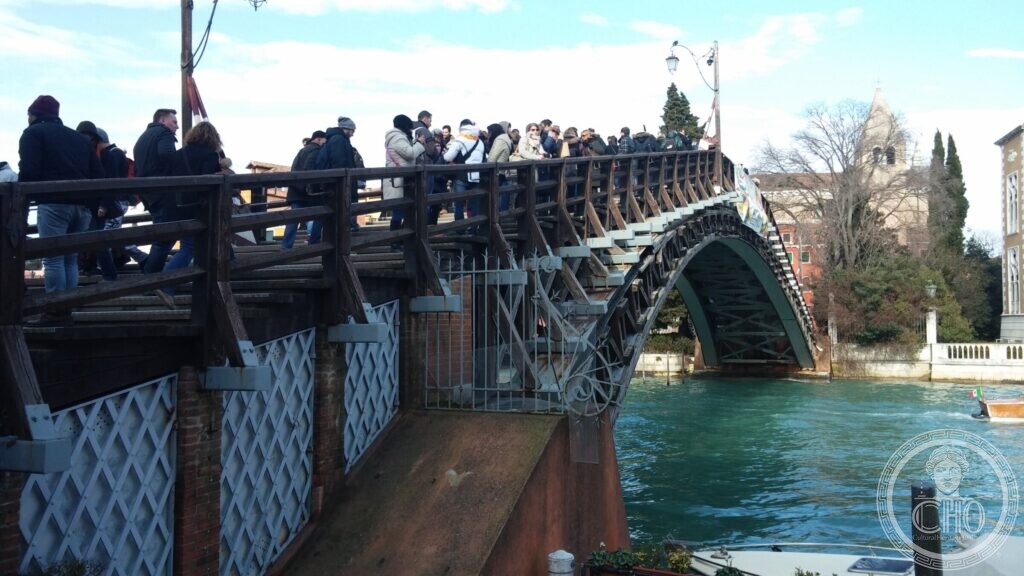
From the water the bridge reads as one shallow timber arch between two brick abutments, with a wide flight of steps on each side and lamps along the parapet. Look underneath and the other bridge appears: a steel arch and a lattice of metal ties, with the timber laid over and around it. A resin layer separates the wood from the metal, so the two materials never touch — the detail that keeps the whole thing standing.
It is the best viewing platform in the city. The bridge looks straight down the Grand Canal to the dome of Santa Maria della Salute, and the crowd on the crown of the arch at any hour of the day is there for that reason.
The bridge today

Practical information
- Open at all hours, free, and always crowded at the top of the arch.
- The steps are steep on both sides and there is no ramp.
- The Gallerie dell’Accademia stand at the Dorsoduro foot of the bridge.
Getting there
Vaporetto line 1 or 2 to Accademia, on either bank. On foot the bridge sits on the main route between Piazza San Marco and the Dorsoduro museums.
Nearby
- Ponte de la Cereria — Miozzi’s Rio Novo, 1933
- Ponte del Pagan — a 1933 bridge on Venice’s Rio Novo
- Ponte degli Scalzi — Miozzi’s stone arch at the station, 1934
Sources
- Art Bonus, Ministero della Cultura — Ponte dell’Accademia: history of the 1854 Neville bridge, the 1933 Miozzi crossing, and the 1948 and 1985 replacements in steel
- Comune di Venezia — owner of the bridge
Record researched and written by Stefano Vigolo for Cultural Heritage Online, 2026.
Find it on the map
See this place and what’s around it →📷 Become a Cultural Heritage Online photographer
Share your photos of places: they stay published under your name as the author. The more they're seen, the more you get noticed — and soon a contest will reward the most appreciated photos.
Log in or sign up free to add a photoRequest to use these images
Each photograph is offered by the person who took it — the seller is the photographer named on the image; Cultural Heritage Online runs the payment and delivers the file on their behalf. Buying gives you the right to use the image in your own project — a website, an article, a presentation — with the file and a written licence. Read the Terms of Sale.
What you receive. The file as it is held in our archive: the photographer's own original, without the Cultural Heritage Online watermark, unretouched and not enlarged. This is a working archive built over many years by many people, so the files differ — some were taken recently, others years ago with the equipment of their time. Older pictures are usually smaller: a camera from fifteen or twenty years ago simply recorded fewer pixels than a phone does today, so the resolution is lower and the print comes out smaller. We say so rather than hide it. The size, weight, format and year of each one are printed below it, and the print size is given at 300 dpi. Nothing is upscaled to make a number look better. Where the picture on this page has been cropped for the layout, the file you receive is the full frame, which may be wider or taller than what you see here.
The whole arch from a boat on the Grand Canal
Sold by Photo: Stefano Vigolo
€3.00
4160 × 2340 px · JPG · 4.0 MB
prints 35 × 20 cm at 300 dpi · taken 2015
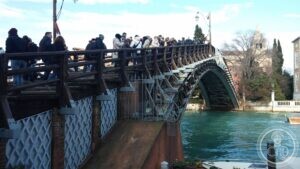
The steel lattice under the deck
Sold by Photo: Stefano Vigolo
€3.00
4160 × 2340 px · JPG · 3.4 MB
prints 35 × 20 cm at 300 dpi · taken 2015
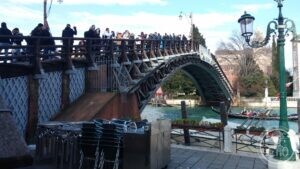
The bridge from the Dorsoduro riva
Sold by Photo: Stefano Vigolo
€3.00
4160 × 2340 px · JPG · 3.8 MB
prints 35 × 20 cm at 300 dpi · taken 2015