
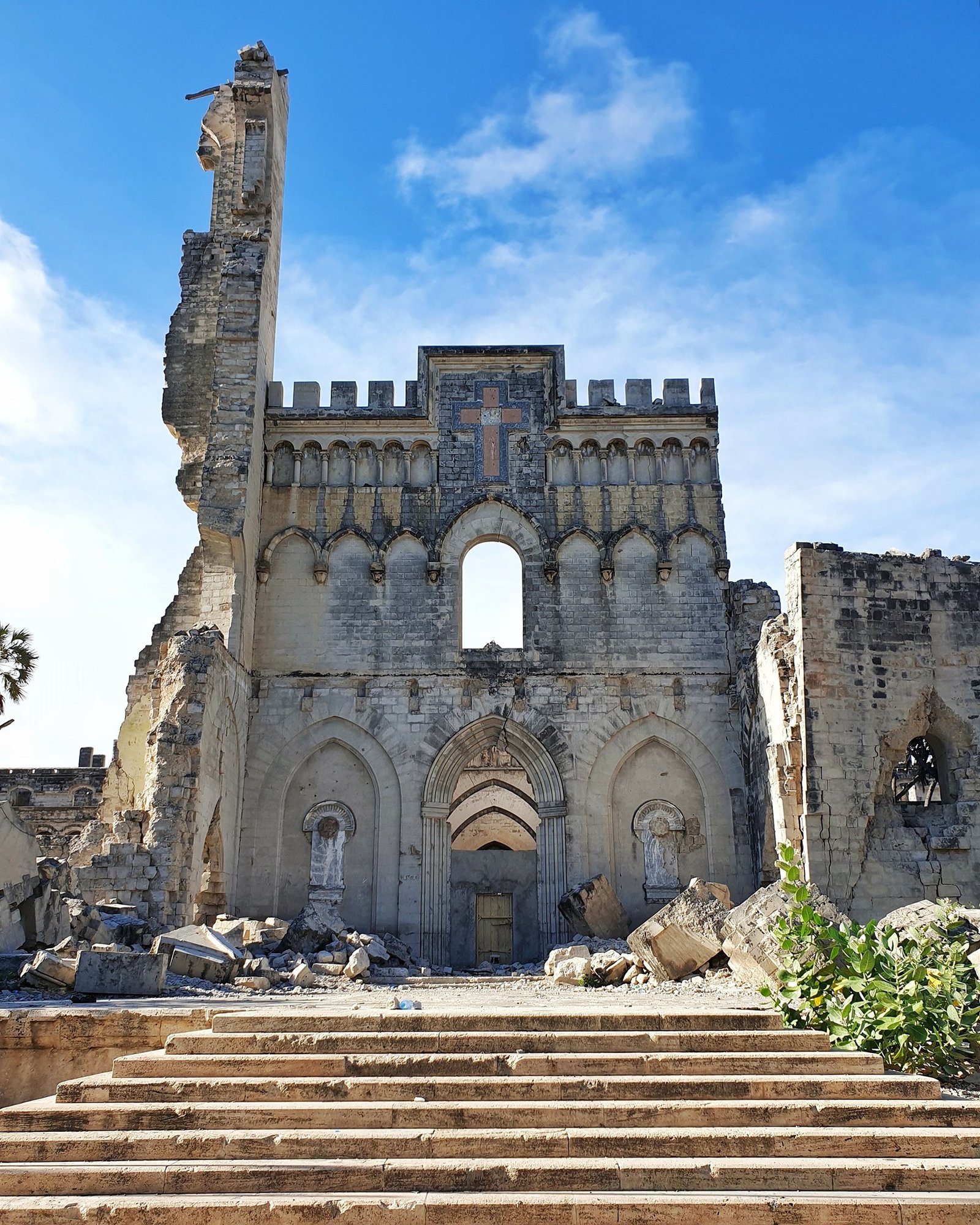
The Norman-Gothic cathedral of Italian Mogadishu, modelled on Cefalù and inaugurated in 1928 — once the largest cathedral in East Africa. Heavily damaged in the Somali civil war, it stands today as a ruin.
At a glance
Mogadishu Cathedral was built between 1925 and 1928 to a design by the architect Antonio Vandone, on the explicit model of the Norman cathedral of Cefalù in Sicily: a Latin-cross plan, three naves under ogival arches, and a twin-towered façade rising to 37.5 metres. Commissioned under governor Cesare Maria De Vecchi (the foundation stone was laid on 28 December 1923), it was inaugurated on 1 March 1928 in the presence of Crown Prince Umberto of Savoy, and was described at the time as the largest cathedral of East Africa. Decades later the building was devastated in the Somali civil war; its roofless walls and truncated towers remain a landmark of the city’s old centre, and a document of two eras at once — the colonial city that built it and the conflict that ruined it.
Key facts
- Architect: Antonio Vandone
- Built: 1925–1928 (foundation stone 28 December 1923)
- Inaugurated: 1 March 1928, with Crown Prince Umberto present
- Style: Norman-Gothic, modelled on the cathedral of Cefalù
- Façade towers: 37.5 metres
- Today: in ruins after the civil war; not restored
History
Italian rule in southern Somalia consolidated in the 1900s and 1920s, with Mogadishu as the colonial capital. The cathedral was the centrepiece of the administration’s building programme of the 1920s under De Vecchi, whose governorship is also documented for the violence of its “pacification” campaigns in the colony’s interior — the two facts belong to the same record. The choice of the Cefalù model tied the colony’s principal church to the Norman architecture of Sicily, a deliberate Mediterranean genealogy.
The cathedral served Mogadishu’s Catholic community through the colonial period, the British occupation, the Italian-administered UN trusteeship (1950–1960) and independence. In 1989 its bishop was assassinated; with the collapse of the state and the civil war of the 1990s the building was sacked and wrecked, and it has remained a ruin since. Proposals for restoration have been made over the years; none has yet been carried out.
What the ruin shows
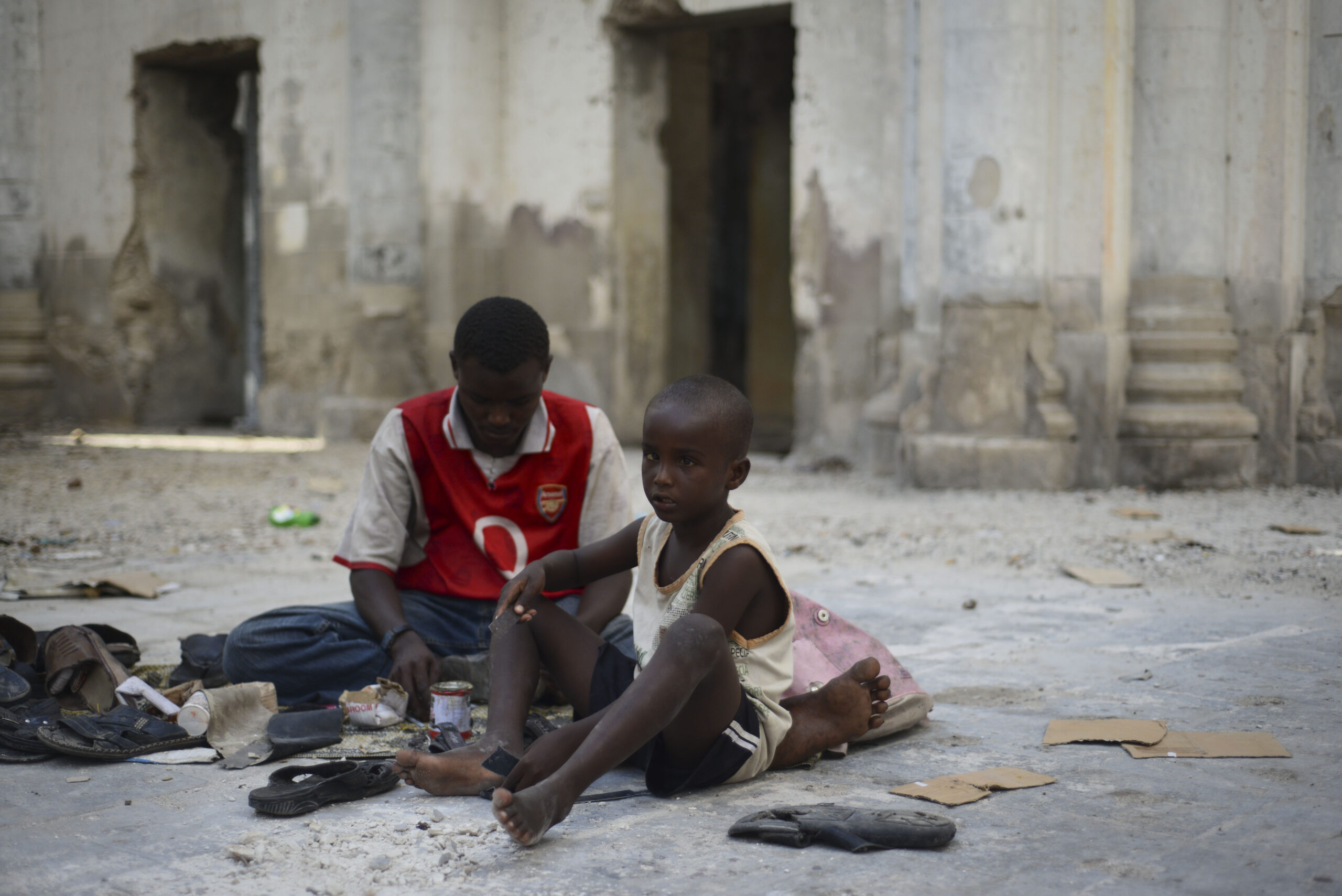
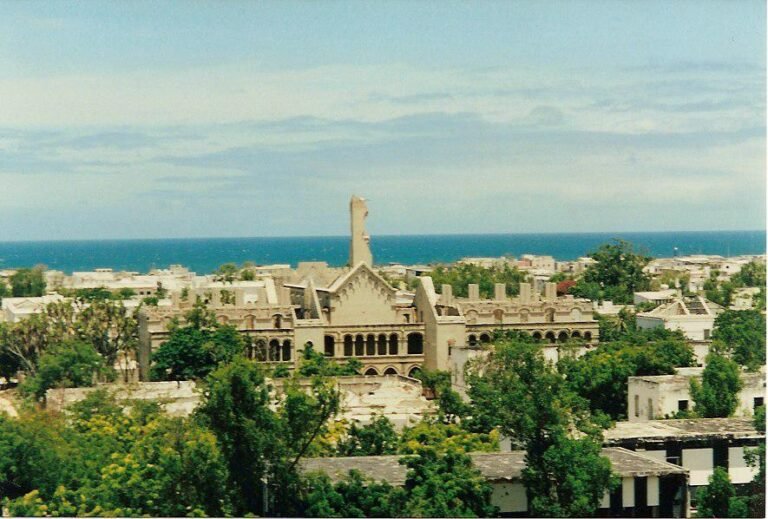
The surviving fabric still reads clearly: the tripartite façade with its two truncated towers, the nave arcades open to the sky, fragments of the rose window’s frame. Period photographs show the building complete — white towers over the low town, a landmark visible from the sea. The comparison between the photographs and the ruin is itself the document: few buildings condense so plainly the twentieth-century history of the Horn of Africa.
The site today
The ruin stands in central Mogadishu near the old town. Somalia remains subject to strict travel advisories; the site is documented here through photographic sources, not as a travel destination. GPS: 2.03574, 45.34161 (Google Maps).
Related places and reading
- Former Tripoli Cathedral — the Libyan counterpart, converted rather than ruined
- Italian East Africa — the AOI frame after 1936
- Istituto Luce — the film record of the colonies
Sources
- Records of the cathedral’s construction and inauguration (1923–1928; period press).
- Documentation on Antonio Vandone’s design and the Cefalù model.
- Reporting and photographic documentation of the building’s destruction in the Somali civil war.
- Wikidata Q962672 (coordinates).
Gallery
Find it on the map
See this place and what’s around it →Record researched and written by Luigi De Marchi for Cultural Heritage Online, 2026.
📷 Become a Cultural Heritage Online photographer
Share your photos of places: they stay published under your name as the author. The more they're seen, the more you get noticed — and soon a contest will reward the most appreciated photos.
Log in or sign up free to add a photoIs this page about you?
This page is read by travellers and heritage enthusiasts who find it on Google. Tell us how you are connected to this place and we will take it from there.