
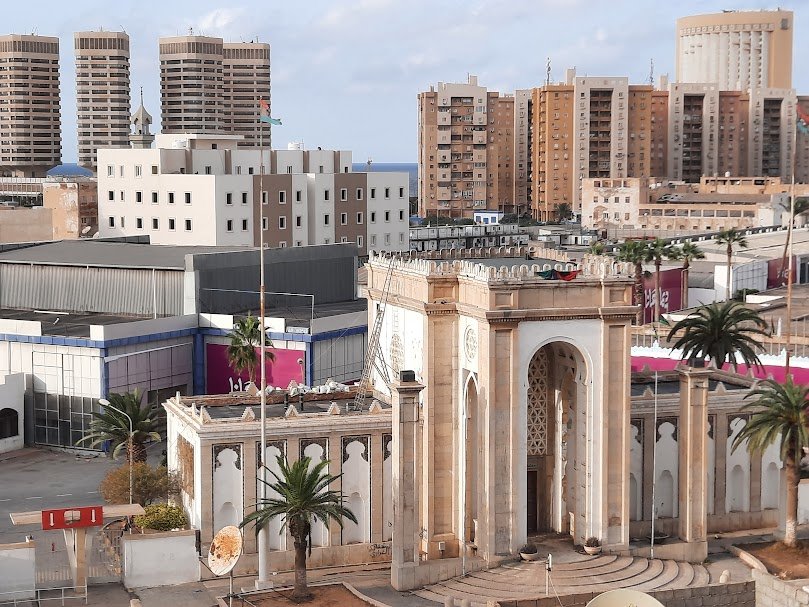
Created by the Italian government in 1927 as the shop-window of colonial Libya, the fair outlived the empire that built it. It still runs on the same walled grounds, the oldest trade fair in Africa.
At a glance
The Fiera di Tripoli was founded in 1927 as an annual sample fair through which Italy presented the economy of its colony to the world. Through the 1930s it ranked among the principal fairs of the colonial world, promoted internationally in tandem with the Tripoli Grand Prix as the showcase of Italian Libya. Its pavilions drew established architects: Alessandro Limongelli (1890–1932) directed the Rome Pavilion works from 1927 and designed its successor, inaugurated in April 1929. Damaged in the Second World War, the fair reopened in the 1950s at reduced scale and never stopped for long: as the Tripoli International Fair it remains an annual event, and the oldest surviving trade fair in Africa.
Key facts
- Founded: 1927 by the Italian government; annual sample fair of the colony
- Status: the oldest surviving trade fair in Africa, still held on the original grounds
- Architecture: Rome Pavilion first directed (1927, project by Felice Nori), then redesigned (1929) by Alessandro Limongelli; triumphal arch and honour tribune added for the royal visit of 1928
- Heyday: the 1934 edition, opened by governor Italo Balbo, was tied to the first flight into the Libyan desert oases and marked by a commemorative stamp
- Propaganda pair: fair and Tripoli Grand Prix (Mellaha circuit, 1933) marketed together as the image of Italian Libya
- After the war: damaged in 1943, reopened in the 1950s; today run by Libya’s General Board of Fairs
History
The context, stated plainly: the fair was a colonial instrument. It opened while Italy was still fighting to control the interior of Libya, and the “pacification” that followed — with its camps and reprisals in Cyrenaica — is documented in detail by the historiography. The fair’s smiling newsreels belong to the same record as those facts, and they are read here as heritage, not endorsed.
As commerce, the fair worked the way world’s fairs did in miniature: national and municipal pavilions, sample goods, official visits staged for the cameras. Limongelli’s Rome Pavilion gave the grounds their flagship building; a triumphal arch and honour tribune went up for the visit of the Italian royals in 1928, and pavilions dedicated to Italian cities — Syracuse among them, in the rationalist brick block the Luce photographers filmed in 1934 — filled out the walled precinct. The eighth edition, opened by Italo Balbo in March 1934, doubled as the send-off for the first flight into the desert oases and got its own postage stamp. Paired with the Grand Prix at the Mellaha circuit and its “Corsa dei Milioni” lottery, the fair sold an image of colonial Libya that commerce alone could not have carried.
The war put the fair out of action and damaged its buildings in 1943. Reopened in the 1950s at a fraction of its former scale, it grew back under independent Libya as the Tripoli International Fair: by 2010 it drew more than a thousand exhibitors from twenty-nine countries. A century on from its founding, the institution created as an imperial shop-window is simply Tripoli’s fair.
What you see
The fairground is a walled precinct on Omar al-Mukhtar Road, a short walk from the seafront of central Tripoli. Its most visible inheritance is the monumental entrance: a high arched gate flanked by an arcaded perimeter wall, in the Arabising manner Italian architects favoured for Tripoli in the interwar years, whitewashed and crenellated against the skyline of hotel towers behind. Inside, working exhibition halls of later decades have replaced most of the interwar pavilions.
The gate is best seen from the road in the raking light of late afternoon, when the arcades throw deep shadows and the fairground reads, for a moment, as the stage set it was designed to be. The surviving Italian-era record of the original pavilions lives above all in photographs and in the Istituto Luce newsreels.
Practical information
- The grounds are a working exhibition venue; access depends on the events calendar of the General Board of Fairs.
- Libya is not, at present, a straightforward destination for leisure travel; check official travel guidance before planning any visit.
- The gate and perimeter can be seen from Omar al-Mukhtar Road at any time.
Getting there
The fairground stands on Omar al-Mukhtar Road in central Tripoli, south-west of the medina and the castle. GPS: 32.88943, 13.17044 · Open in Google Maps.
Related places and reading
- Italian Libya: Architecture, Roads and the Colonial Project of the “Fourth Shore” — the wider frame
- Former Tripoli Cathedral (1928) — Italian building in the capital of the colony
- Arch of the Philaeni — the demolished monument of the coastal road
Sources
- English Wikipedia, “Tripoli International Fair” (founding, colonial promotion with the Grand Prix, Limongelli’s Rome Pavilion, post-war history).
- Italian Wikipedia, “Fiera internazionale di Tripoli” (editions, Nori/Limongelli attributions, 1928 royal visit structures, 1934 oases flight and stamp, 1943 damage).
- Istituto Luce photographic record, VIII Fiera di Tripoli, March 1934 (via Wikimedia Commons: Syracuse pavilion, Balbo inauguration).
- OpenStreetMap Nominatim (coordinates, Omar al-Mukhtar Road).
Find it on the map
See this place and what’s around it →Record researched and written by Luigi De Marchi for Cultural Heritage Online, 2026.
📷 Become a Cultural Heritage Online photographer
Share your photos of places: they stay published under your name as the author. The more they're seen, the more you get noticed — and soon a contest will reward the most appreciated photos.
Log in or sign up free to add a photo