Of all the territories Italy ruled between the wars, Libya was the one the regime invested with the greatest symbolic weight: the “fourth shore” (quarta sponda), an African coastline to be joined to the peninsula by ships, roads and settlement. Occupied from 1911, unified as a single colony in 1934 and governed from that year until 1940 by Italo Balbo, Italian Libya became a laboratory of colonial architecture, town planning and infrastructure. Its record — buildings that still stand, a road that is still the country’s spine, a monumental arch that no longer exists — can be read today, place by place, as documented history: neither celebrated nor erased.
The context, stated plainly
That record cannot be separated from how colonial rule was imposed. The so-called “reconquest” of Cyrenaica between 1929 and 1932, directed by Pietro Badoglio and Rodolfo Graziani, was conducted — as historians including Angelo Del Boca and Giorgio Rochat have documented — through mass deportations of the region’s population to internment camps in the Sirte desert, where tens of thousands died of hunger and disease; the resistance leader Omar al-Mukhtar was captured and hanged in 1931. These are established facts of the historiography, and they are part of the same years and the same administration that built the roads and the buildings described below. Recording both, without rhetoric in either direction, is the documentary method of this archive.
Tripoli, the showcase city
Tripoli was the colony’s front window. Through the 1920s the Italian administration rebuilt the seafront and the centre with arcaded streets, public buildings and churches; the religious centrepiece was the Cathedral of the Sacred Heart, designed by Saffo Panteri and consecrated in November 1928, its 46-metre dome rising over what is now Algeria Square. Since 1970 the building has served as the Jamal Abdel Nasser Mosque — one structure holding the city’s whole twentieth century.
From the mid-1930s the city’s image was largely the work of one man: Florestano Di Fausto (1890–1965), the most important architect of the Italian colonial era, who had earlier shaped Italian building in the Dodecanese and who served as consultant to Tripoli’s municipality under Balbo. Di Fausto’s Tripoli mixed modern planning with Mediterranean and local references — arcades, white volumes, courtyards — in what scholarship calls his “architecture of the Mediterranean”: among his works were the city’s waterfront buildings and the Uaddan hotel and casino (1935), a landmark of colonial leisure architecture.
Two institutions completed the showcase. The Tripoli International Fair, created in 1927, was the instrument for presenting the colony’s economy to the world — it is today the oldest surviving trade fair in Africa. And from 1925 the Tripoli Grand Prix made the colony a stage for international motor racing: in 1933 a new 13.14-kilometre circuit opened at Mellaha, tied to a state lottery — the “Corsa dei Milioni” — that made the race one of the richest of its era. Fair and Grand Prix were, by design, propaganda as much as commerce and sport; the record of both survives in the newsreels of the Istituto Luce, whose crews filmed the colonies extensively.
The Litoranea, 1937: a road as monument
The largest single work of Italian Libya was a road. The Litoranea Libica — soon renamed Via Balbia after the governor — ran some 1,822 kilometres along the coast from the Tunisian border to the Egyptian one, joining Tripolitania and Cyrenaica for the first time with a single paved artery. Sixteen contractors built its sections; the works were completed in little more than a year, and Mussolini inaugurated the road in March 1937.
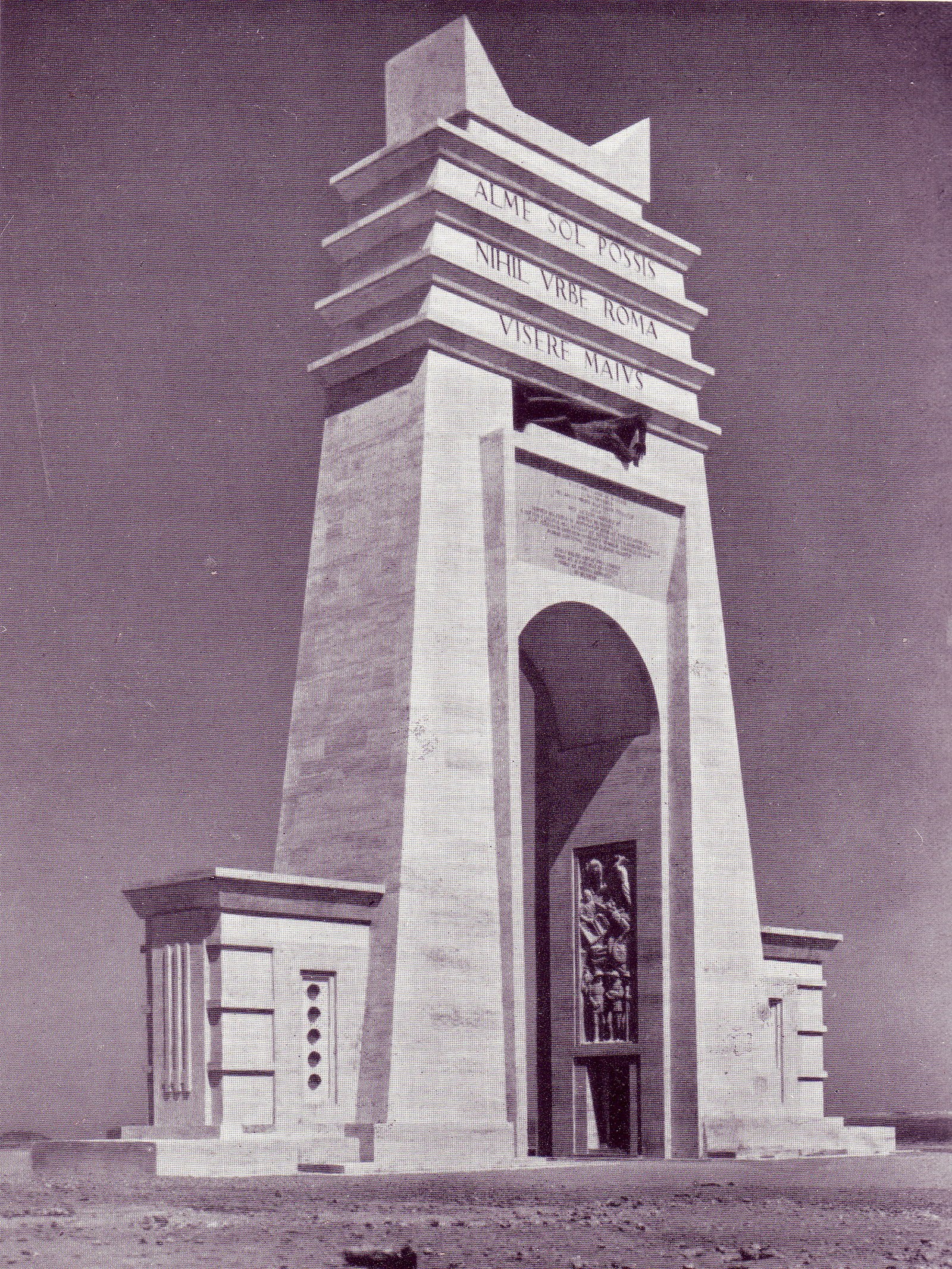
Two details of the Litoranea belong to the history of road infrastructure. First, its service system: along the route the builders erected 65 roadhouses (case cantoniere) for maintenance and for travellers’ refreshment, alongside fuel stations — an integrated road-service network that popular histories of Italian motoring describe as an ancestor of the postwar autogrill. The claim of paternity should be treated with care — Italy’s first true motorway service areas belong to the postwar Autostrade — but the Litoranea’s roadhouse system was, for its time and place, an innovation in how a long-distance road served its users. Second, its monument: at the road’s midpoint, on the historic boundary between Tripolitania and Cyrenaica, Di Fausto raised the Arch of the Philaeni, a 30-metre travertine arch inaugurated on 16 March 1937. British troops of the desert war knew it as the “Marble Arch”; in 1973 the Gaddafi government, which read it as a symbol of foreign domination, demolished it with dynamite. The road remains — as the Libyan Coastal Highway, still the country’s main artery; the arch survives only in photographs and film.
Settlement: the “Ventimila” of 1938
The colony’s other great programme was agricultural settlement. In October and November 1938 the regime shipped some twenty thousand Italian colonists — the “Ventimila” — to purpose-built agricultural villages in Tripolitania and Cyrenaica, each laid out around a church, a school, public buildings and rows of farmhouses. The villages were planned as showcase communities and filmed as such; their remains, in varying states of reuse and abandonment, are still legible in the Libyan landscape. The programme’s other face is equally documented: the land assigned to settlers included land taken from the population displaced in the previous decade.
What remains, and how to read it
Italian rule ended with the Second World War; the last Italian residents were expelled in 1970. What remains is a built record: the former cathedral and the Italian-era blocks of central Tripoli, the fair grounds, the coastal highway, the village churches of the settlement programme, the fragments and photographs of the demolished arch. Like the architecture of the same years in Italy, it belongs to what scholars call difficult heritage — and in Libya the difficulty is doubled, because the heritage is also the trace of a foreign occupation. This archive documents these places as historical sources: what they are, who designed them, when, and what happened around them. The facts speak; the reader judges.
Places of Italian Libya in this archive
- Former Tripoli Cathedral (Sacred Heart of Jesus) — Saffo Panteri, consecrated 1928; today the Jamal Abdel Nasser Mosque
- Arch of the Philaeni (Arco dei Fileni) — Florestano Di Fausto, 1937; demolished 1973
- Tripoli International Fair grounds (1927)
- Uaddan Hotel and Casino, Tripoli (Di Fausto, 1935)
- Mellaha circuit and the Tripoli Grand Prix (1933)
- Benghazi’s Italian-era centre and cathedral
- The agricultural villages of the 1938 settlement — cards in preparation
This piece opens a series on the architecture and infrastructure of Italy’s overseas territories between the wars; the frame for the era as a whole is in Architecture and Power in Fascist Italy and Fascist-Era Architecture in Italy: One Label, Many Styles.