On a wall inside a bar in Mogliano Veneto, a few miles north of Venice, hangs a small permanent display of old photographs. They are reproductions of press and commemorative images made between 1928 and 1941, and photographed there by Stefano Vigolo. We publish them here for study, research and documentary purposes, and we present them for what they show, with descriptive intent: pictures of a town and its people in those years. Almost all of them share one backdrop — the same square — which makes them read, in sequence, as fifteen years in the life of one place.
A square built in the 1920s
The stage for nearly every scene is Piazza dei Caduti, the civic centre Mogliano gave itself in the mid-1920s in place of its old square. It was designed by the architect Mario Fabris (1882–1925), who in 1924 drew the new town hall and the buildings around it. Fabris died of pneumonia in 1925, a year before his municipal palace was inaugurated in 1926.
At the centre of the square, in that same 1926, stood the new war memorial to the dead of the First World War: a winged bronze Victory modelled by the local sculptor Vasco Vian and unveiled on 4 July in the presence of the Duke of Aosta. Mogliano had lost 260 of its men in the Great War, most of them between 1917 and 1918. The town hall and the monument, both still in place today, are the fixed frame around which every photograph that follows turns. Both have their own entries in the project’s international archive — the Palazzo del Municipio and the Monumento ai Caduti.
1928 — the return of the fallen
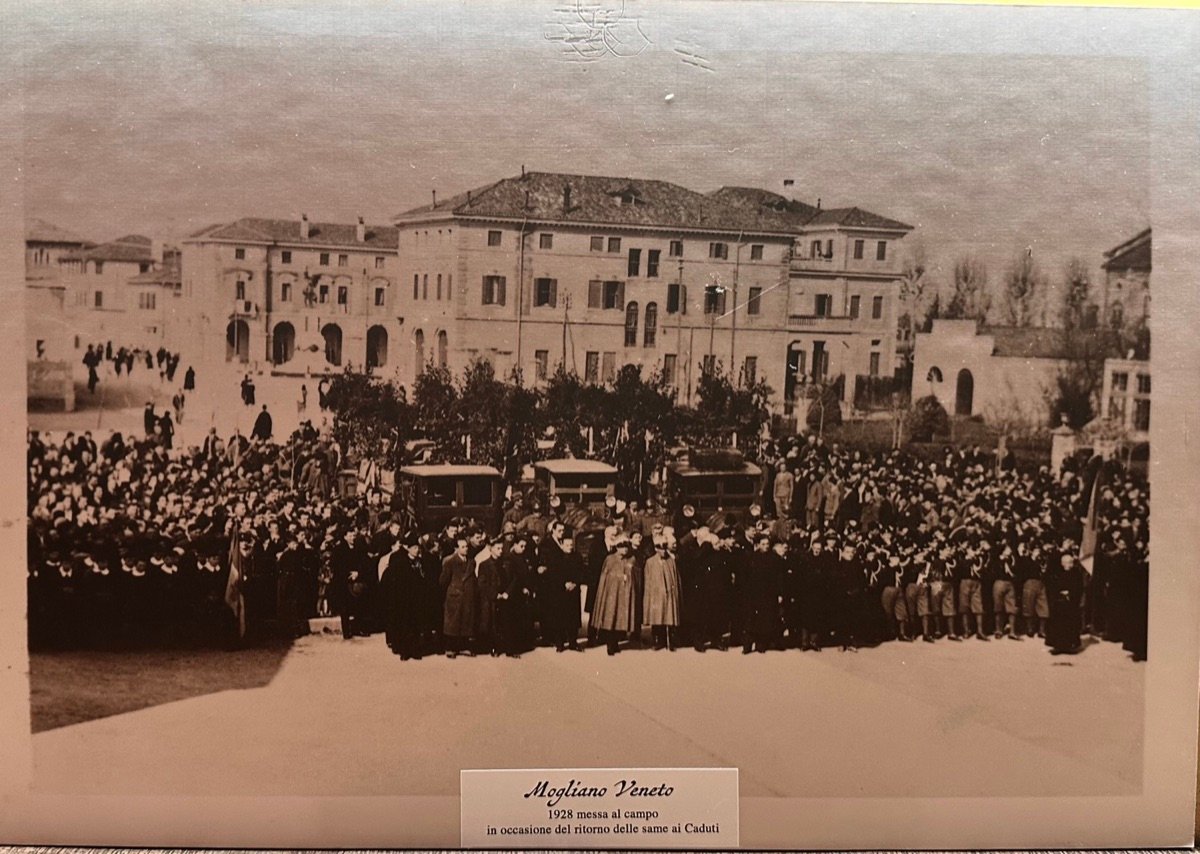
The oldest of the photographs takes us to 1928. The remains of several war dead are brought home and the community gathers for an open-air mass. Religious rite and the memory of the war are still at the centre of the scene, and the newly built square becomes, at once, the place in which the town recognises itself.
1933 — building for the youth organizations
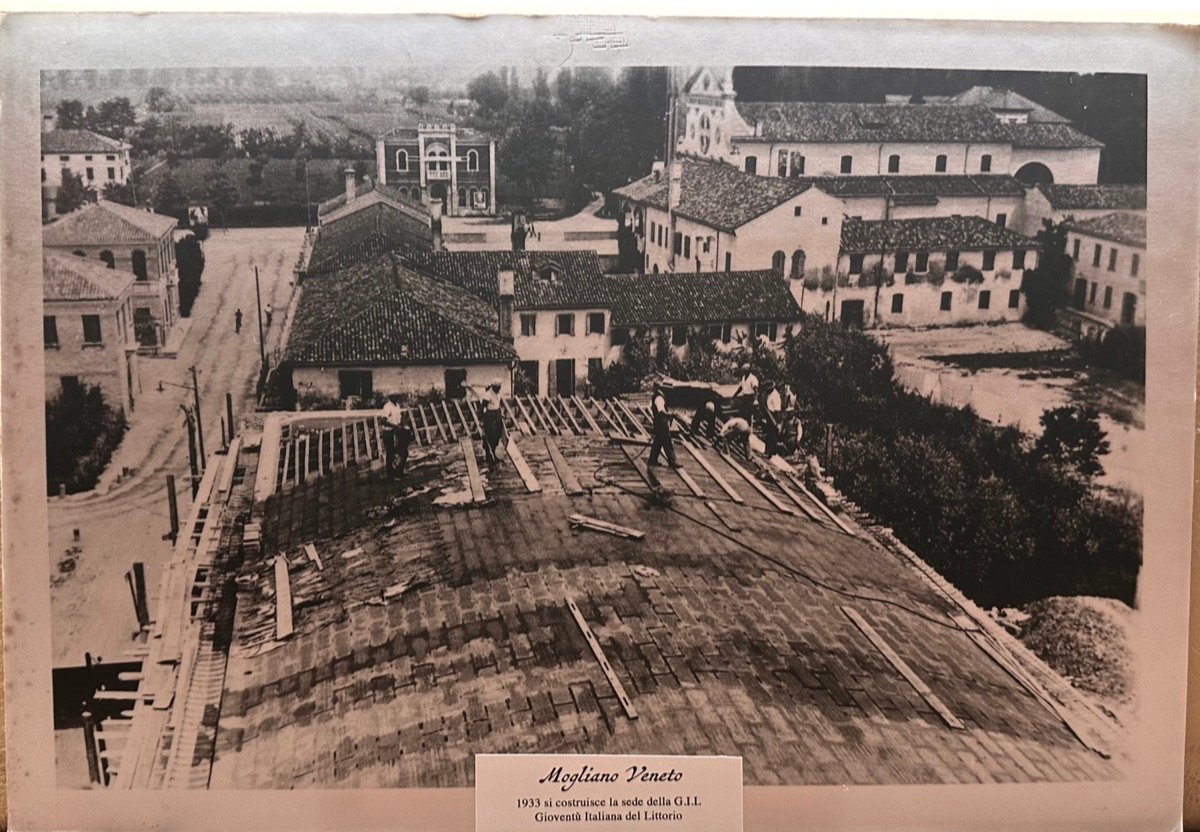
In 1933 a building site roofs over a new hall meant for young people’s activities. The original caption labels it a seat of the G.I.L., the Gioventù Italiana del Littorio; it is worth noting, though, that the GIL was founded only in 1937, and that in 1933 the body responsible was still the Opera Nazionale Balilla. It is one of those small inaccuracies that local sources carry with them, and one worth flagging — a matter of accuracy, not of judgement. The photograph documents the construction of one of the many buildings that rose in these years, across towns large and small, for sport, physical education and the organised activities of the young.
1937 — summer camps in the schoolyards
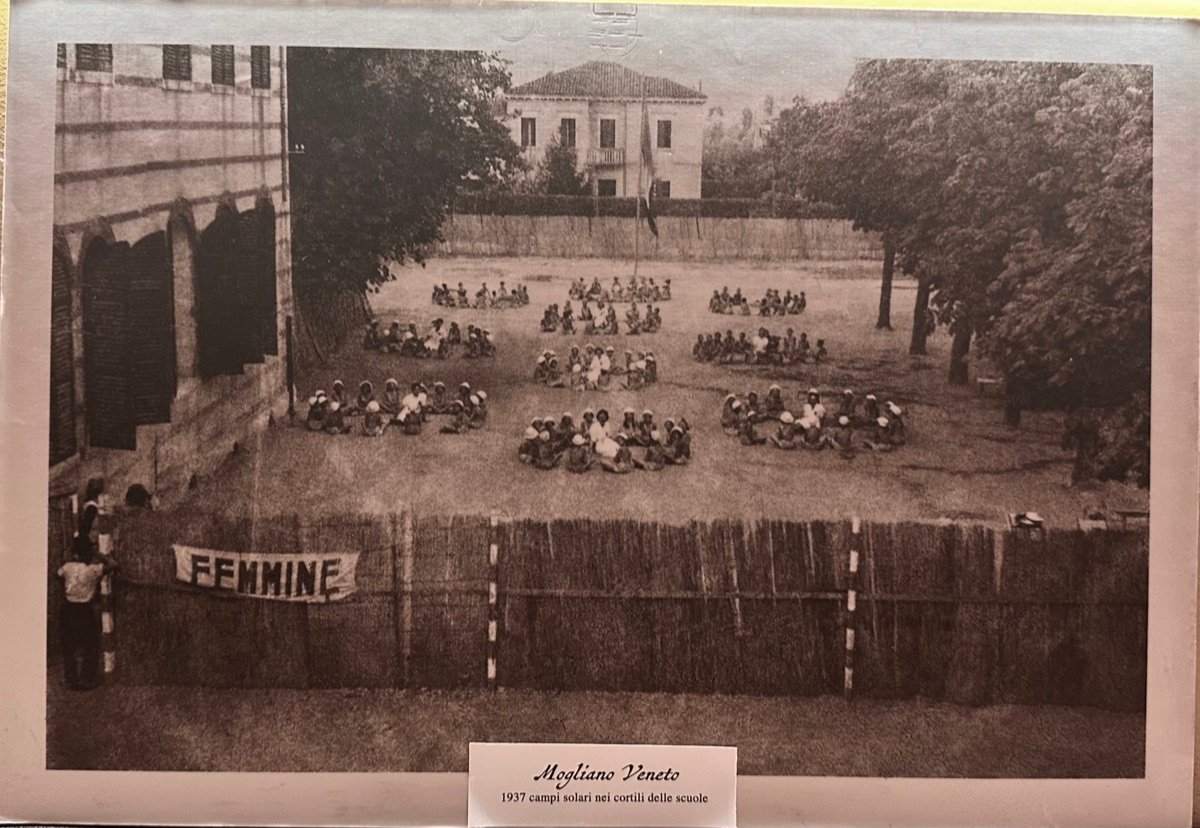
In the summer of 1937 the schoolyards host the campi solari, the summer camps: rows of girls seated in circles on the grass, divided into groups by a banner reading «Femmine» (girls). The summer camps were a welfare programme for children — open air, sun and a meal for the youngest — in years when poverty and malnutrition were still widespread across the Veneto countryside, a land that had been fought over directly in the First World War. Behind the boundary wall, a villa is just visible.
10 June 1940 — the declaration of war
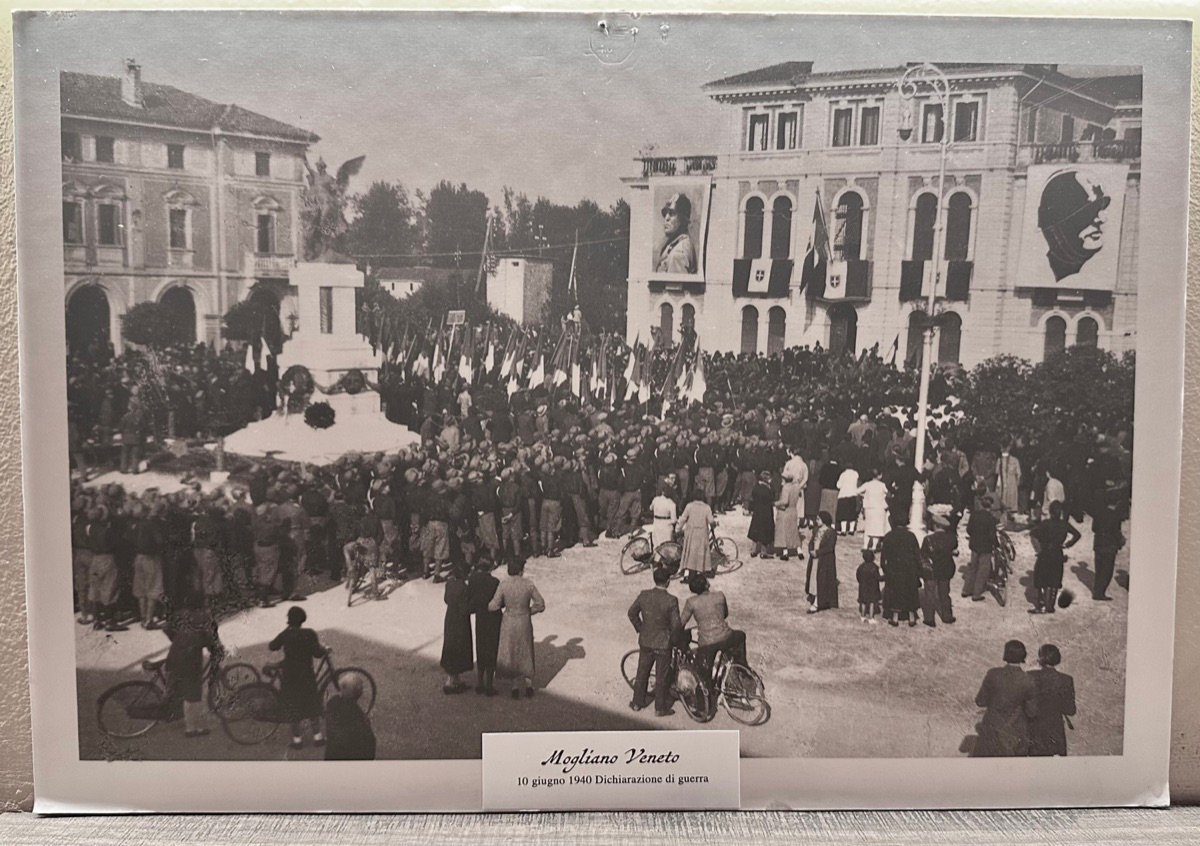
On 10 June 1940 Italy entered the Second World War, and as across the whole country the people of Mogliano gathered in the square to hear the announcement. On the buildings that close the space — the same ones Fabris had drawn fifteen years earlier — hung two large portraits of Mussolini. At the centre stood the Great War memorial: the same community that had commemorated its dead in 1926 now found itself here, on the eve of another conflict.
1941 — the artillery battalion
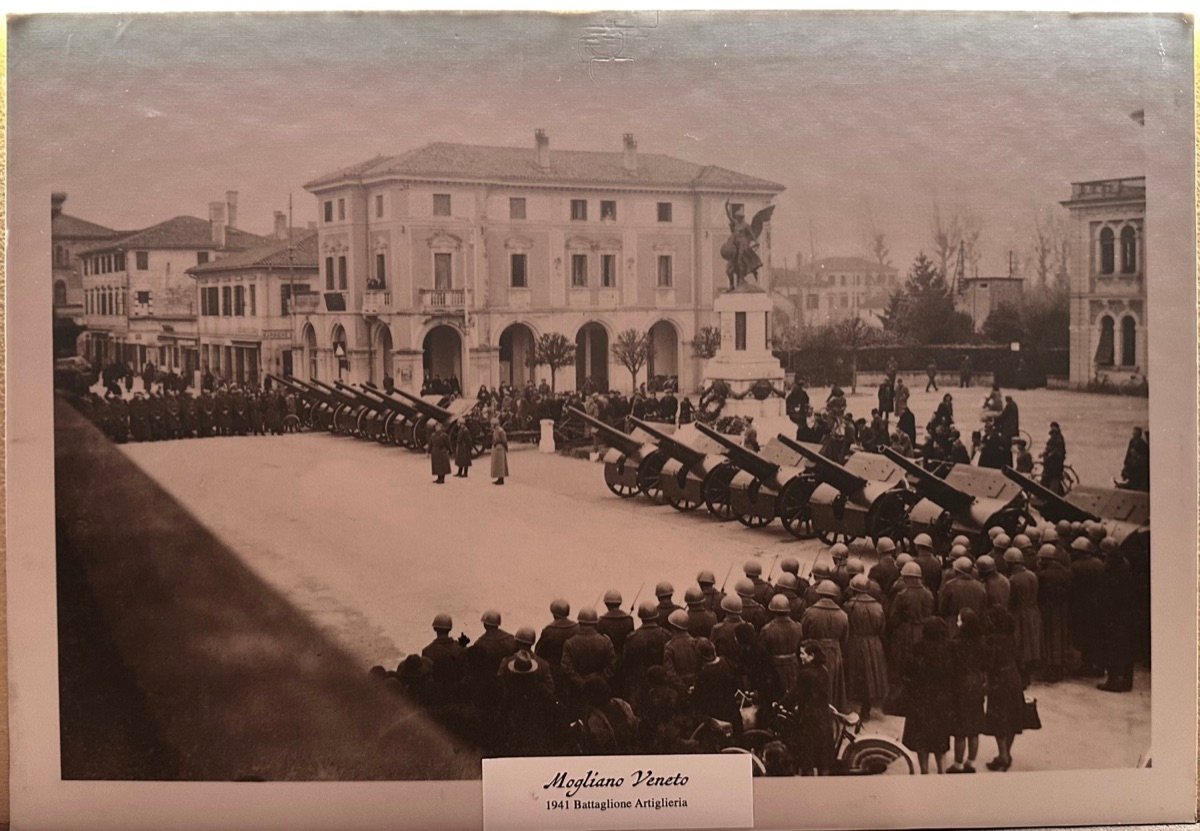
A year later the war has reached the square itself. An artillery battalion lines up its guns before the arcades of the town hall, the crowd pressed to the edges. The photograph is valuable for another reason too: it is the clearest view we have of Fabris’s palace and Vian’s monument as they stood then, with the shops under the arcades and the trees still young.
What remains
Mario Fabris’s town hall and Vasco Vian’s Victory are still there, in their place, in the same square. The youth hall, the summer camps, the rally of 1940 belong instead to a time that these photographs help us to know. That is why we keep them and set them in a row: one square, watched through fifteen years of images, tells the story of a town better than many words. Cultural Heritage Online records these materials as historical sources — describing what they are, who made them and when, without celebrating or condemning them.
Period photographs on public display in a bar in Mogliano Veneto, photographed by Stefano Vigolo (2026) and reproduced for study and documentary purposes under Fair Use (17 U.S.C. § 107) and Art. 70 of Italian Law 633/1941. No commercial use. This article is the English edition of a piece first published in the project’s Italian-language section.
Sources
- S1 — Corner, Paul. Fascism in Ferrara 1915–1925. Oxford University Press, 1975. ISBN 978-0-19-821857-9.
- S2 — Ginsborg, Paul. A History of Contemporary Italy: Society and Politics 1943–1988. Penguin Books, 1990. ISBN 978-0-14-012496-5.
Spotted an error? Write to editorial@culturalheritageonline.com and we correct it the same day.