
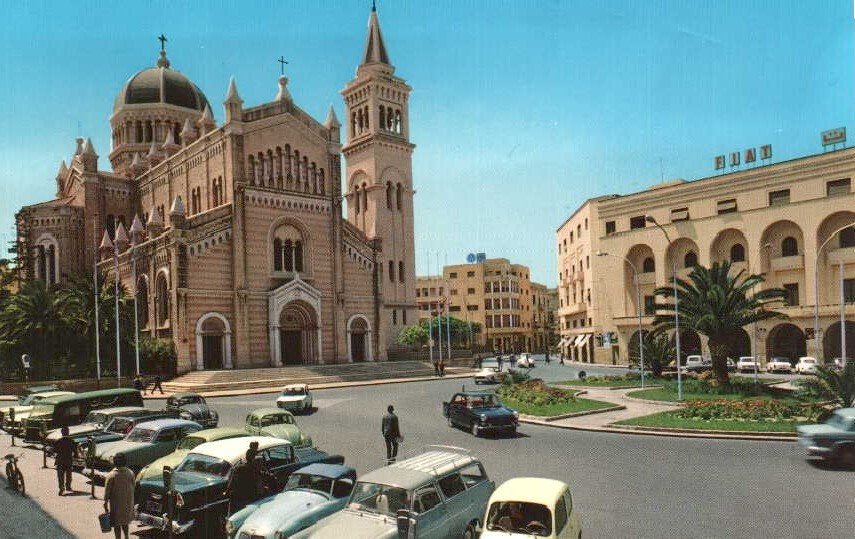
The Romanesque Revival cathedral built by Italian Tripoli in the 1920s: a 46-metre dome and bell tower over Algeria Square. Since 1970 the building has served as the Jamal Abdel Nasser Mosque.
At a glance
The former Cathedral of the Sacred Heart of Jesus is one of the most visible works of Italian colonial architecture in Tripoli. Built in the 1920s to a design by Saffo Panteri and consecrated on 24–25 November 1928, it rises on what was then Piazza della Cattedrale, today Algeria Square (Maidan al-Jazayir), in the Italian-era city centre. Its Romanesque Revival forms, 46-metre dome and slender bell tower made it a landmark of the colonial skyline. After Libyan independence and the 1969 revolution, the building was converted in 1970 into the Jamal Abdel Nasser Mosque, the function it serves today. The building still stands; its silhouette continues to mark the square.
Key facts
- Architect: Saffo Panteri
- Built: 1920s; consecrated 24–25 November 1928
- Style: Romanesque Revival (neoromanico)
- Dome: about 46 metres high, with bell tower
- Location: Algeria Square (former Piazza della Cattedrale), Tripoli
- Today: Jamal Abdel Nasser Mosque (since 1970)
History
Italy occupied Tripoli in 1911; through the 1920s and 1930s the colonial administration rebuilt the city’s seafront and centre with public buildings, arcaded streets and churches. The cathedral was the religious centrepiece of this programme: begun in the early 1920s, it was consecrated in November 1928 with ceremonies recorded by the Catholic press of the time. Under the governorship of Italo Balbo (1934–1940), when the architect Florestano Di Fausto reshaped much of central Tripoli, the cathedral square remained one of the city’s principal public spaces.
After the Second World War and Libyan independence (1951), Tripoli’s Italian community gradually left, and the 1969 revolution was followed in 1970 by the expulsion of the remaining Italians and the confiscation of their property. In that year the cathedral was converted into a mosque named after the Egyptian president Gamal Abdel Nasser. The conversion preserved the building’s mass and dome while transforming its interior and liturgical furnishings. The story of the building is thus, in one structure, the story of the city’s twentieth century.
What you see
The building presents the compact mass and round-arched vocabulary of the Romanesque Revival: a tripartite façade, blind arcading, a great central dome on a drum, and a campanile that was long among the tallest structures of the city. The choice of a medieval Italian idiom — rather than the rationalism or monumentalism then emerging in Italy — reflects the date of its design, in the 1920s, and the intention of giving the colonial city a recognisably Italian religious landmark. Photographs from the 1930s to the 1960s show the building dominating the square and the surrounding Italian-era blocks, many of which also survive.
Visiting
The building stands on Algeria Square in central Tripoli and functions as a mosque; access follows the rules of an active place of worship, and conditions in Libya vary — travel guidance should be checked before any visit. The exterior can be seen from the square. GPS: 32.89061, 13.18603 (Google Maps).
Related places and reading
- Arch of the Philaeni — the demolished monument of the Litoranea Libica
- Architecture and Power in Fascist Italy — the wider frame
- Monumentalism, or Simplified Neoclassicism — the language of State architecture
Sources
- Records of the cathedral’s consecration, Tripoli, 24–25 November 1928 (period Catholic press).
- Studies on Italian colonial architecture in Tripoli and on the urban work of the 1920s–1930s (Saffo Panteri; Florestano Di Fausto era).
- Documentation on the 1970 conversion into the Jamal Abdel Nasser Mosque.
- Wikidata Q1492859 (coordinates).
Find it on the map
See this place and what’s around it →Record researched and written by Luigi De Marchi for Cultural Heritage Online, 2026.
📷 Become a Cultural Heritage Online photographer
Share your photos of places: they stay published under your name as the author. The more they're seen, the more you get noticed — and soon a contest will reward the most appreciated photos.
Log in or sign up free to add a photoIs this page about you?
This page is read by travellers and heritage enthusiasts who find it on Google. Tell us how you are connected to this place and we will take it from there.