
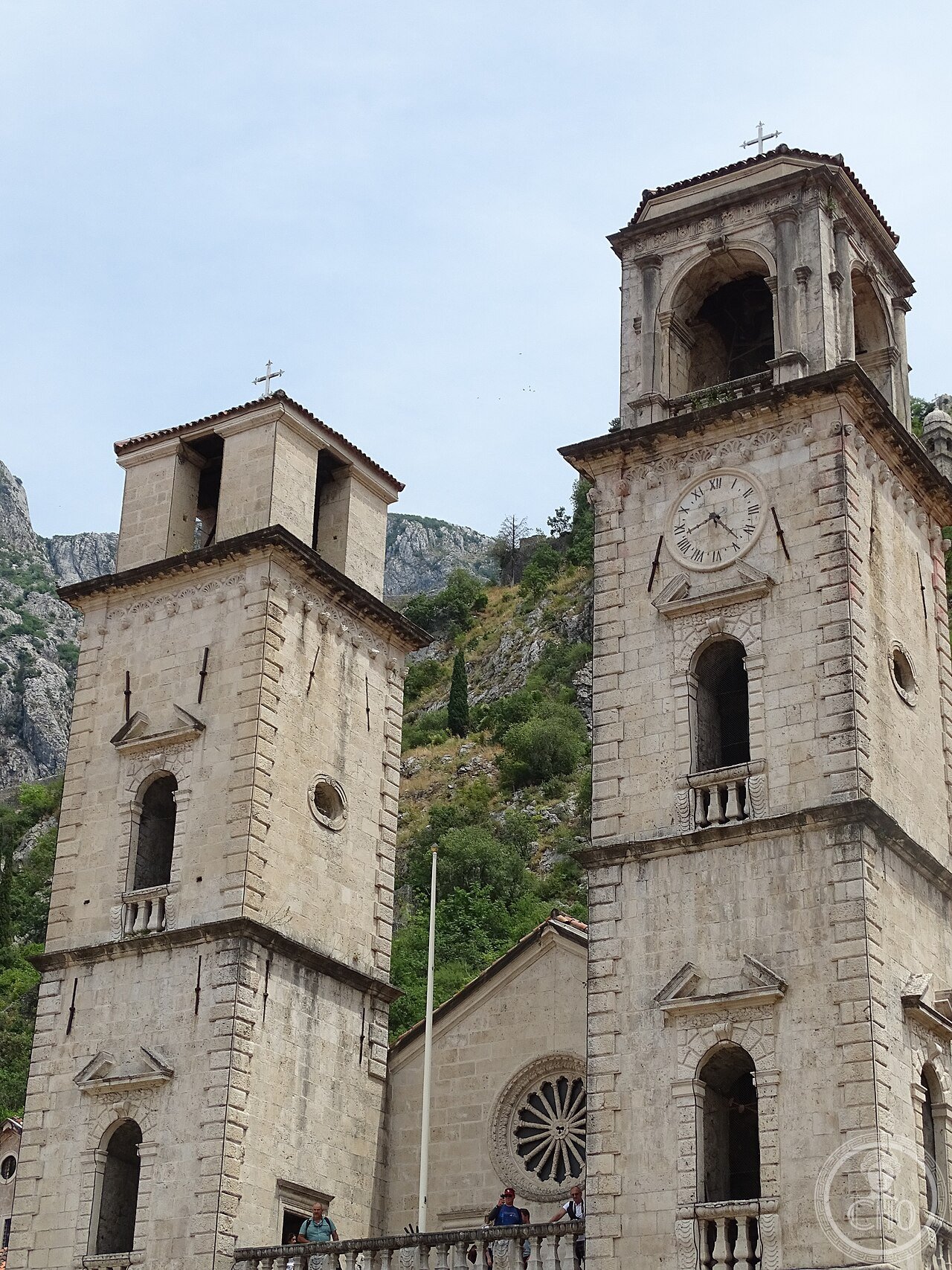
Nell’809, marinai di Kotor acquistarono a Costantinopoli le reliquie di san Trifone, martire cristiano del III secolo, con l’intenzione di rivenderle a Ragusa (l’odierna Dubrovnik). Ma una violenta tempesta impedì alla nave di completare il viaggio, costringendola nella baia di Kotor: un segno, secondo l’interpretazione dell’epoca, che le reliquie erano destinate a restare in città. Il cittadino Andrea Saracenis e sua moglie Maria acquistarono allora le reliquie, incluso il teschio del santo, e fecero costruire una chiesa per custodirle — l’origine dell’attuale cattedrale, consacrata il 19 giugno 1166. Danneggiata gravemente dal terremoto di Dubrovnik del 1667, che distrusse l’intera facciata, la cattedrale fu ricostruita con due nuove torri campanarie barocche: quella di sinistra, per mancanza di fondi, non fu mai completata e resta visibilmente incompiuta ancora oggi. Un secondo terremoto, quello del Montenegro del 1979, causò ulteriori gravi danni. Il tesoro della cattedrale, tra i più antichi d’Europa, custodisce ancora oggi il “Capo Glorioso”: un elaborato reliquiario a forma di busto in oro, argento, smalto e cristallo di rocca, realizzato tra il XV e il XVII secolo per contenere il teschio del santo.
About Kotor Cathedral
The origins of Kotor Cathedral trace back to 809 CE, when sailors from Kotor purchased the relics of Saint Tryphon, a 3rd-century Christian martyr, in Constantinople, intending to sell them onward in Dubrovnik. A violent storm at sea prevented the ship from completing its journey, forcing it instead into the Bay of Kotor — an event interpreted at the time as a clear sign that the relics were meant to remain in Kotor rather than continue to their intended destination, and Tryphon accordingly became Kotor’s patron saint instead of Dubrovnik’s. The relics, including the saint’s skull, were subsequently purchased by the prominent local citizen Andrea (Andreaccio) Saracenis and his wife Maria, who commissioned a church to house them — the direct predecessor of today’s cathedral. This earlier church stood until the present Romanesque cathedral was consecrated on 19 June 1166. The cathedral has survived repeated devastating earthquakes across its history: the great Dubrovnik earthquake of 1667 severely damaged the building, destroying its entire frontage, and reconstruction proceeded with two new Baroque bell towers, though insufficient funds meant the left tower was never fully completed — its unfinished, visibly truncated form remains a distinctive feature of the Kotor skyline today. A further devastating earthquake struck the Montenegrin coast in April 1979, inflicting significant additional damage on the cathedral. Despite these repeated catastrophes, Kotor Cathedral preserves one of the oldest treasuries anywhere in Europe, its most prized possession being the “Glorious Head,” an elaborate bust-shaped reliquary crafted from gold, silver, enamel, and rock crystal between the 15th and 17th centuries, built specifically to house Saint Tryphon’s skull, alongside 14th-century frescoes and a relic said to be a fragment of the True Cross.
Key facts
- 809 CE: Saint Tryphon’s relics purchased in Constantinople, diverted to Kotor by a storm
- Andrea and Maria Saracenis buy the relics and build the first church to house them
- 19 June 1166: present Romanesque cathedral consecrated
- 1667: Dubrovnik earthquake destroys the cathedral’s frontage
- Post-1667: Baroque bell towers added; the left tower remains unfinished
- April 1979: Montenegro earthquake causes further significant damage
- Treasury: includes the “Glorious Head” reliquary of Saint Tryphon’s skull
History
The origin legend of Saint Tryphon’s relics being diverted to Kotor by a storm, at Dubrovnik’s expense, reflects the intense medieval rivalry between Adriatic port cities over relic acquisition, patron saint status, and the civic prestige these brought — a single storm effectively reshaping the religious identities of two competing Dalmatian towns. The cathedral’s repeated damage across nearly a millennium, from the 1667 Dubrovnik earthquake through the 1979 Montenegro earthquake, situates Kotor within the broader seismic history of the Adriatic coast, its permanently unfinished left tower standing as a visible, centuries-old record of the limits of post-disaster reconstruction funding.
The survival of one of Europe’s oldest cathedral treasuries through these repeated disasters, including the elaborately crafted Glorious Head reliquary, testifies to the sustained wealth and civic investment of medieval and early modern Kotor as a maritime trading power in the eastern Adriatic, even as the cathedral’s physical fabric bears the visible scars of the earthquakes it repeatedly survived.
What you see
The Romanesque cathedral’s twin Baroque bell towers, rebuilt after the 1667 earthquake, present an asymmetrical silhouette against Kotor’s old town, with the left tower’s incomplete upper section clearly visible as a legacy of insufficient post-earthquake funding. Inside, 14th-century frescoes and the cathedral’s ancient treasury, including the ornate Glorious Head reliquary of Saint Tryphon, form the building’s most significant surviving artistic and devotional treasures.
Practical information
- Opening hours: generally open daily with seasonal variation; admission fee applies, including access to the treasury; check current hours before visiting
- Address: Pjaca Svetog Tripuna, 85330 Kotor, Montenegro
Getting there
Kotor Cathedral stands within the walled old town of Kotor, on Montenegro’s Bay of Kotor, easily reachable on foot from the town’s main gate. GPS: 42.4242° N, 18.7715° E.
Nearby
- Kotor Old Town — UNESCO World Heritage medieval walled town, surrounding the cathedral
- Kotor city walls — fortifications climbing the hillside above the old town
- Bay of Kotor — the dramatic fjord-like bay surrounding the town
Sources
- Wikipedia — “Kotor Cathedral” (en.wikipedia.org)
- Visit Montenegro — “Saint Tryphon Cathedral” (visit-montenegro.com)
- Mapping Eastern Europe, Princeton — “The Reliquary Casket of St. Tryphon, Kotor” (mappingeasterneurope.princeton.edu)
Find it on the map
See this place and what’s around it →📷 Become a Cultural Heritage Online photographer
Share your photos of places: they stay published under your name as the author. The more they're seen, the more you get noticed — and soon a contest will reward the most appreciated photos.
Log in or sign up free to add a photo