
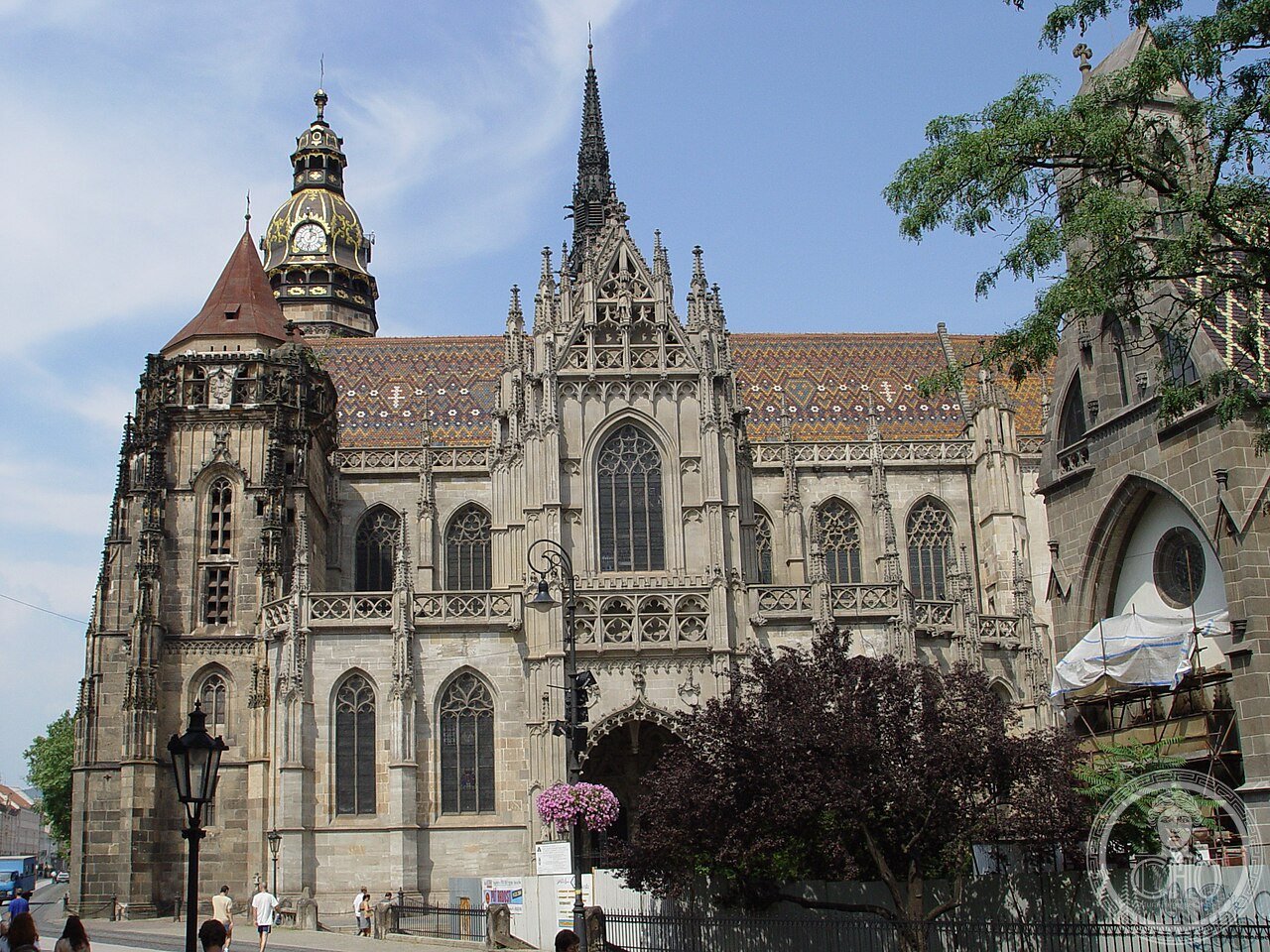
Construction of the Cathedral of St Elisabeth began in 1380 and continued into the twentieth century, with the southern tower completed only in 1906: it is the easternmost Gothic cathedral in Europe, today Slovakia’s largest church, with 1,200 square metres of floor area and a capacity of over 5,000 people. Between 1464 and 1490 the master builder Stephan Lapicidus completed the side aisles, not part of the original design. The 15th-century Gothic Altar of St Elisabeth holds a double spiral staircase, one of only five surviving in Europe. In 1906, to a design by the Hungarian architect Frigyes Schulek, who also worked on the Fisherman’s Bastion in Budapest, a crypt was built beneath the north side aisle to receive the remains of Prince Francis II Rákóczi, leader of the early-eighteenth-century anti-Habsburg uprising, who died in exile in the Ottoman Empire. His bones, together with those of his companions, were carried from Turkey to Košice that same year, to be finally buried at home.
About St Elisabeth Cathedral
The Cathedral of St Elizabeth in Košice is a Gothic cathedral holding the distinction of being among the easternmost Gothic cathedrals anywhere in Europe. Today it stands as the largest church in Slovakia, covering a total area of 1,200 square metres with a capacity exceeding 5,000 worshippers. Construction began in 1380 and continued, through multiple phases and interruptions, all the way into the 19th and early 20th centuries, with the cathedral’s southern tower not finally completed until as late as 1906. Between 1464 and 1490, master builder Stephan Lapicidus directed a significant construction phase, adding side aisles that had not featured in the cathedral’s original floor plan. Among the cathedral’s most remarkable artistic treasures is the Altar of St Elisabeth, dating to the 15th century, which incorporates a Gothic double spiral staircase — one of only five such staircases known to survive anywhere in Europe. A major late 19th-century restoration involved architects who also worked on considerably more famous landmarks, including St Stephen’s Cathedral in Vienna, Karlštejn Castle near Prague, and Budapest’s Parliament Building. In 1906, a crypt was constructed beneath the cathedral’s north side aisle according to a design by the Hungarian architect Frigyes Schulek, purpose-built to receive the remains of Francis II Rákóczi, leader of the early 18th-century anti-Habsburg uprising in Hungary, along with his companions in exile. Rákóczi had died in Ottoman territory, and in 1906 — nearly two centuries after his defeat and death — his remains and those of his companions were finally transported from Turkey to Košice and formally entombed within the cathedral’s newly built crypt, closing a long chapter of political exile with a symbolic homecoming.
Key facts
- 1380: construction of the cathedral begins.
- 1464-1490: master builder Stephan Lapicidus adds side aisles.
- 15th century: Altar of St Elisabeth built, with a rare Gothic double spiral staircase.
- 1906: south tower finally completed.
- 1906: crypt built to designs by Frigyes Schulek for Francis II Rákóczi’s remains.
- Status: largest church in Slovakia, one of the easternmost Gothic cathedrals in Europe.
History
As one of the easternmost Gothic cathedrals in Europe, St Elisabeth’s marks a significant outpost of Western Gothic architectural tradition at the edge of the medieval Hungarian kingdom’s cultural reach, its centuries-long construction timeline — from 1380 to 1906 — reflecting the shifting political fortunes of Košice itself across Hungarian, Habsburg, and eventually Czechoslovak and Slovak rule. Francis II Rákóczi’s 1906 reburial in the cathedral’s newly built crypt, following nearly two centuries of exile and death on Ottoman soil, represents one of the most significant acts of national historical reconciliation in the region’s modern history, transforming a defeated rebel prince into a posthumously honoured national figure.
The involvement of architect Frigyes Schulek, celebrated for his work on Budapest’s Fisherman’s Bastion, in designing Rákóczi’s crypt situates this specific addition to the cathedral within the wider late 19th and early 20th-century Hungarian architectural movement dedicated to reasserting and monumentalising national historical memory through prominent public and religious buildings.
What you see
The cathedral’s Gothic exterior, built in stages from 1380 through to the tower’s 1906 completion, dominates Košice’s Main Street (Hlavná ulica) with its scale and soaring verticality. Inside, the 15th-century Altar of St Elisabeth with its rare double spiral staircase remains a principal artistic focus, while the 1906 Rákóczi Crypt beneath the north aisle houses the tombs of the exiled prince and his companions, brought home from the Ottoman Empire.
Practical information
- Opening hours: generally open daily with seasonal variation; separate admission for the crypt and tower; check current hours before visiting.
- Address: Hlavné námestie 1/4, 040 01 Košice, Slovakia.
Getting there
St Elisabeth Cathedral stands on the Main Square (Hlavné námestie) in the historic centre of Košice, eastern Slovakia’s largest city, easily reachable on foot from the city centre. GPS: 48.7203° N, 21.2582° E.
Nearby
- Hlavná ulica (Main Street) — Košice’s historic pedestrian thoroughfare, surrounding the cathedral.
- Church of St Michael — small Gothic chapel, immediately adjacent.
- Singing Fountain — musical fountain on the main square, nearby.
Sources
- Wikipedia — “Cathedral of St. Elizabeth” (en.wikipedia.org).
- History Hit — “St Elisabeth Cathedral” (historyhit.com).
- Europe Between East And West — “A Cathedral’s Catacomb – Rakoczi’s Crypt” (europebetweeneastandwest.wordpress.com).
Find it on the map
See this place and what’s around it →📷 Become a Cultural Heritage Online photographer
Share your photos of places: they stay published under your name as the author. The more they're seen, the more you get noticed — and soon a contest will reward the most appreciated photos.
Log in or sign up free to add a photo