
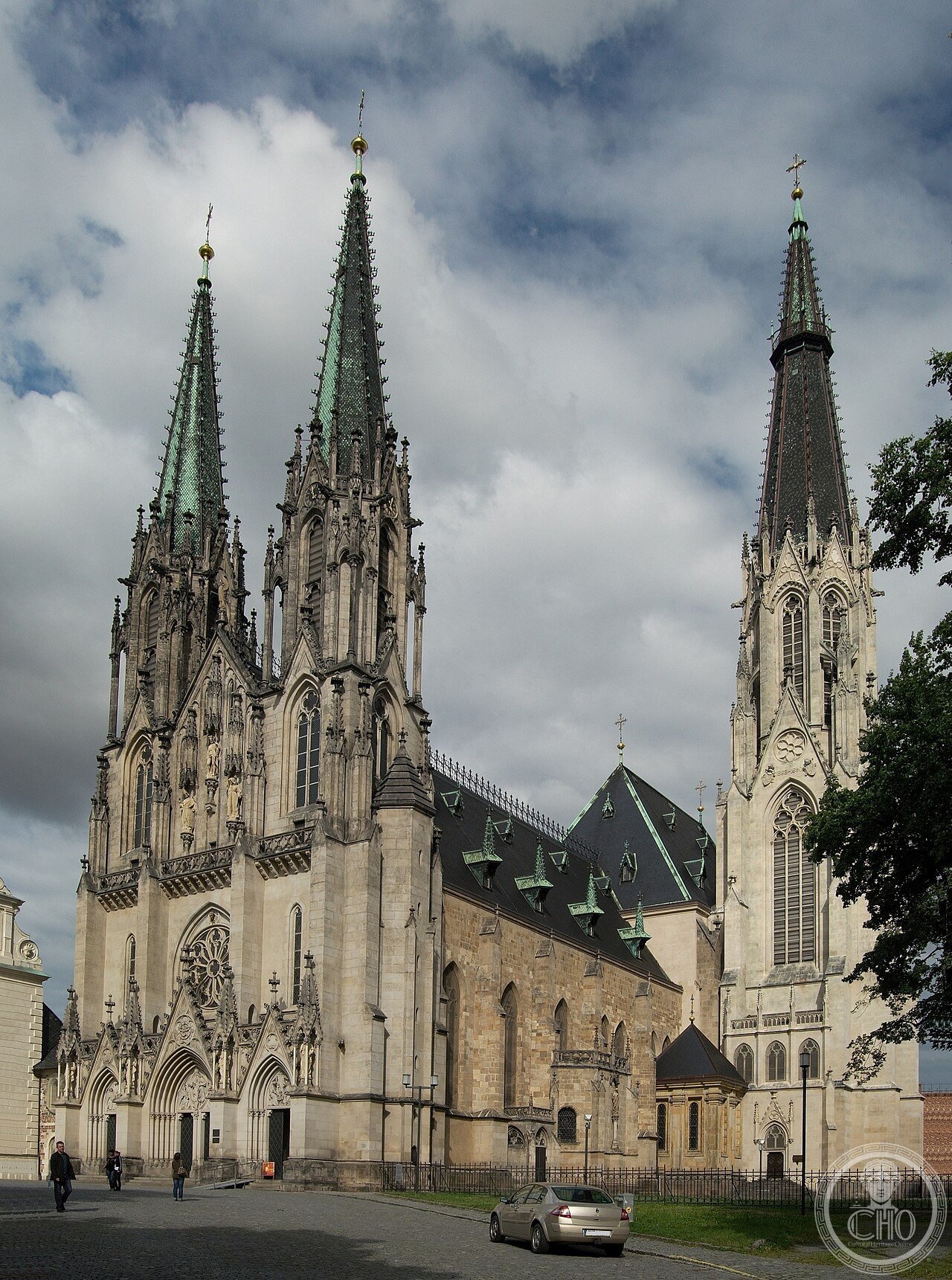
The appanage prince Svatopluk began the building of the cathedral between 1104 and 1107. His son Wenceslas carried it on, handing it over unfinished to the bishop of Olomouc, Jindřich Zdík, before his own death. Consecrated in 1131, it was completed in 1141 as a Romanesque basilica, rebuilt in the Gothic style after a great fire in the thirteenth century, and finally turned into its present Neo-Gothic form between 1883 and 1892. Its southern tower, 100.65 metres high, is the tallest bell tower in Moravia. But it is an event of 1306 that makes this place crucial in Bohemian history: on 4 August of that year King Wenceslas III was stabbed to death in the house of the dean of the cathedral, a few steps from here. The identity of his murderer was never established. A knight, Konrad of Botenstein, was lynched on the spot by the guards without trial, though even among his contemporaries doubts remained about his real guilt. With the death of Wenceslas III the male line of the Přemyslid dynasty, which had ruled Bohemia since the 9th century, came to an end.
About St Wenceslas Cathedral
Construction of St Wenceslas Cathedral was begun by the Appanage Prince Svatopluk between 1104 and 1107; his son Wenceslas continued the project, ultimately handing over the still-unfinished building to Olomouc Bishop Jindřich Zdík before his own death. The cathedral, in its original form, was consecrated in 1131 and fully completed in 1141 as a Romanesque basilica. Following a major fire in the 13th century, the cathedral was extensively rebuilt in Gothic style, and it acquired its present striking Neo-Gothic appearance during a further major reconstruction carried out between 1883 and 1892. The cathedral’s southern tower, standing 100.65 metres tall, is the tallest church tower anywhere in the historical region of Moravia, and the second tallest in the entire Czech Republic, while its three-naved hall preserves the layout of the original medieval church beneath the later Gothic and Neo-Gothic remodelling. The cathedral’s location holds particular significance in Czech and Central European history due to events that unfolded nearby on 4 August 1306: Bohemian King Wenceslas III was fatally stabbed while staying in the house of the cathedral’s dean, Budislav, close to the cathedral itself. The identity of his assassin has never been definitively established, despite numerous contemporary and later theories implicating figures ranging from Albert I of Habsburg, King of the Romans, to Ladislaus the Short of Poland, or even one of Wenceslas’s own drinking companions. In the immediate aftermath, guards in the courtyard beat a knight named Konrad of Botenstein to death without any formal investigation or trial, though even contemporaries expressed serious doubt as to whether he had actually committed the killing. Wenceslas III’s murder brought the male line of the Přemyslid dynasty, which had ruled Bohemia since the 9th century, to an abrupt and permanently unresolved end, with the Luxembourg dynasty subsequently taking control of Bohemia.
Key facts
- 1104-1107: construction begun by Prince Svatopluk.
- 1131: unfinished cathedral consecrated.
- 1141: Romanesque basilica fully completed.
- 13th century: rebuilt in Gothic style after a major fire.
- 1883-1892: major reconstruction gives the cathedral its Neo-Gothic appearance.
- 100.65 m: height of the south tower, the tallest church tower in Moravia.
- 4 August 1306: King Wenceslas III murdered nearby, assassin never identified.
- Result: the male line of the Přemyslid dynasty ends.
History
The cathedral’s nearly millennium-long construction and reconstruction history, from its early 12th-century Romanesque origins through Gothic rebuilding and finally 19th-century Neo-Gothic transformation, reflects the broader pattern of continuous architectural evolution common to major Central European cathedrals across successive medieval and modern eras. Its proximity to the site of Wenceslas III’s 1306 murder places the cathedral at the geographic centre of one of Bohemian history’s most consequential and enduringly mysterious events, an assassination whose perpetrator remains unknown more than seven centuries later.
The abrupt extinction of the Přemyslid male line following Wenceslas III’s murder triggered a significant succession crisis across Bohemia, ultimately paving the way for the Luxembourg dynasty’s assumption of the Bohemian crown — a dynastic transition with consequences that shaped Central European politics for generations, all traceable back to an unsolved killing that occurred within sight of this cathedral’s walls.
What you see
The cathedral’s Neo-Gothic exterior, the product of the 1883-1892 reconstruction, includes the towering 100.65-metre south tower dominating the Olomouc skyline, while the three-naved interior hall preserves the spatial layout established in the original 12th-century Romanesque church. The building stands on Wenceslas Square, close to the historic site associated with the 1306 assassination that ended the Přemyslid dynasty.
Practical information
- Opening hours: generally open daily with seasonal variation; check current hours before visiting.
- Address: Václavské náměstí, 779 00 Olomouc, Czech Republic.
Getting there
St Wenceslas Cathedral stands on Wenceslas Square in Olomouc, Moravia’s historic centre, reachable by train from Prague or Brno and a short walk from the city’s Old Town. GPS: 49.5980° N, 17.2617° E.
Nearby
- Přemyslid Palace — adjoining historic palace complex.
- Olomouc Old Town — UNESCO-recognised historic centre, including the Holy Trinity Column.
- Archdiocesan Museum Olomouc — museum of religious art, nearby.
Sources
- Wikipedia — “Saint Wenceslas Cathedral” (en.wikipedia.org).
- Wikipedia — “Wenceslaus III of Bohemia” (en.wikipedia.org).
- Radio Prague International — “Bohemian royal Přemyslid dynasty died out 700 years ago” (english.radio.cz).
Find it on the map
See this place and what’s around it →📷 Become a Cultural Heritage Online photographer
Share your photos of places: they stay published under your name as the author. The more they're seen, the more you get noticed — and soon a contest will reward the most appreciated photos.
Log in or sign up free to add a photo