
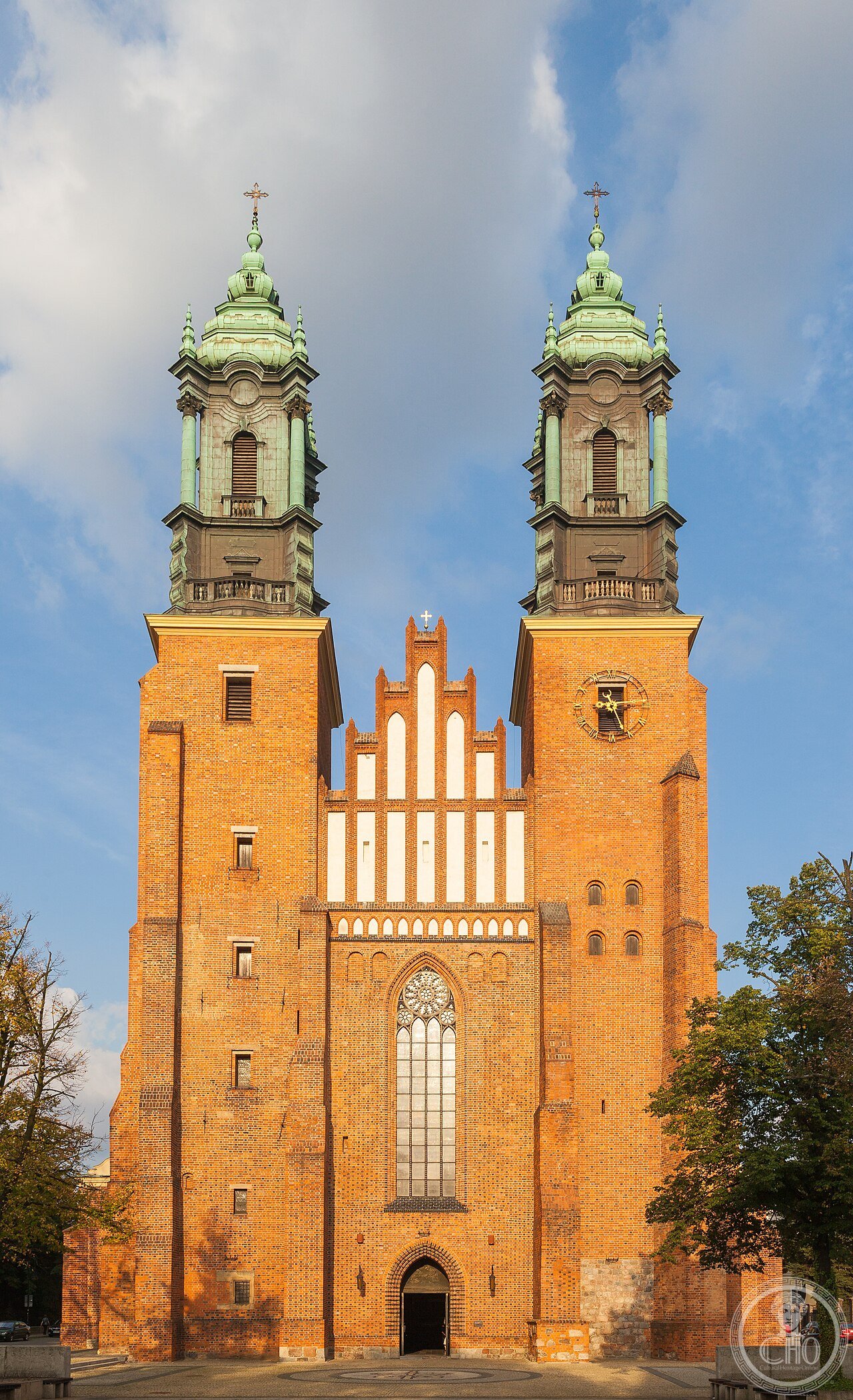
La cattedrale di Poznań, elevata a sede vescovile nel 968 con l’arrivo del primo vescovo missionario Giordano, sorge sull’isola di Ostrów Tumski dalla seconda metà del X secolo ed è la più antica cattedrale di Polonia. Fu qui, secondo la tradizione, che Mieszko I — il primo sovrano storicamente documentato della Polonia — fu battezzato nel 966, un evento chiave nella cristianizzazione e nel consolidamento dello stato polacco. Nella Cappella d’Oro, costruita nell’Ottocento come mausoleo riccamente decorato con dorature, affreschi e sculture bronzee monumentali, riposano ancora oggi Mieszko I e suo figlio Bolesław il Coraggioso, primo re incoronato di Polonia. L’ultimo dei grandi incendi che colpirono la cattedrale scoppiò il 15 febbraio 1945, durante la battaglia di Poznań e la sua conquista da parte dell’Armata Rossa; i danni furono tali che si decise di ricostruirla in stile gotico, riportando alla luce elementi medievali rivelati proprio dalle fiamme. La cattedrale riaprì il 29 giugno 1956.
About Poznań Cathedral
Poznań Cathedral was originally built in the second half of the 10th century within the fortified settlement on Ostrów Tumski (Cathedral Island), and was formally raised to cathedral status in 968 with the arrival of Bishop Jordan, the first missionary bishop sent to Poland. According to tradition, Mieszko I — the earliest ruler of Poland documented in historical sources — was baptised in 966, quite possibly at Poznań itself, an event regarded as a pivotal moment in the Christianisation of Poland and the consolidation of the emerging Polish state under a single ruling dynasty. Mieszko I and his son, Bolesław I the Brave, the first Polish ruler to be formally crowned king, were both buried within the cathedral, and their memory is honoured today in the Golden Chapel, constructed in the 19th century specifically as a mausoleum for the two rulers and lavishly decorated with gilding, frescoes, and monumental bronze sculptures depicting them. Across its long history the cathedral suffered repeated destruction by fire, but the most severe blow came on 15 February 1945, during the Battle of Poznań and the city’s capture by the advancing Red Army, when a devastating fire caused extensive damage to the building. In the aftermath, conservators made the deliberate decision to rebuild the cathedral in Gothic style, drawing directly on medieval architectural elements and relics that the fire itself had exposed beneath later accretions; the fully restored cathedral was formally reopened on 29 June 1956.
Key facts
- Second half of 10th century: cathedral first built on Ostrów Tumski
- 968: raised to cathedral status with the arrival of Bishop Jordan
- 966: Mieszko I, Poland’s first documented ruler, baptised, possibly here
- Burials: Mieszko I and his son Bolesław I the Brave, Poland’s first crowned king
- 19th century: Golden Chapel built as their mausoleum
- 15 February 1945: cathedral severely damaged by fire during the Battle of Poznań
- 29 June 1956: cathedral reopens after Gothic-style reconstruction
History
As the burial site of both Mieszko I and Bolesław I the Brave — respectively the founding ruler of the Polish state and the first Polish king to receive a formal royal coronation — Poznań Cathedral occupies a position in Polish national history comparable to the most significant royal necropolises anywhere in Europe, its Golden Chapel functioning as a specifically 19th-century act of national commemoration for rulers who had died some 800 years earlier. Mieszko I’s baptism, closely associated with this site, marks the symbolic founding moment of Christian Poland, predating by decades the more widely celebrated pilgrimage of Emperor Otto III to Gniezno in the year 1000.
The cathedral’s near-destruction during the Battle of Poznań in February 1945, followed by conservators’ deliberate choice to restore it in Gothic rather than any of its later historical styles, reflects a broader post-war Polish pattern of using architectural restoration to reassert continuity with the country’s medieval and early statehood origins, particularly significant for a building so closely tied to the birth of the Polish nation itself.
What you see
The Gothic cathedral, rebuilt following its near-destruction in 1945 using medieval fabric exposed by the fire itself, presents twin towers rising above Ostrów Tumski, the small island forming Poznań’s historic ecclesiastical core. Inside, the ornate Golden Chapel, with its gilded decoration, frescoes, and bronze statuary, houses the tombs of Mieszko I and Bolesław I the Brave, forming the cathedral’s most significant single monument.
Practical information
- Opening hours: generally open daily with seasonal variation; check current hours before visiting
- Address: Ostrów Tumski 17, 61-109 Poznań, Poland
Getting there
Poznań Cathedral stands on Ostrów Tumski, a small island forming the historic ecclesiastical heart of Poznań, reachable on foot or by tram from the city’s Old Market Square. GPS: 52.4119° N, 16.9494° E.
Nearby
- Ostrów Tumski — the historic cathedral island surrounding the church
- Poznań Old Market Square — the city’s historic main square, a short distance away
- Archdiocesan Museum — museum of religious art, nearby on Ostrów Tumski
Sources
- Wikipedia — “Poznań Cathedral” (en.wikipedia.org)
- Wielkopolska Travel — “Poznań Cathedral” (wielkopolska.travel)
- Medieval Heritage — “Poznań – Cathedral of St Peter and Paul Apostles” (medievalheritage.eu)
Find it on the map
See this place and what’s around it →📷 Become a Cultural Heritage Online photographer
Share your photos of places: they stay published under your name as the author. The more they're seen, the more you get noticed — and soon a contest will reward the most appreciated photos.
Log in or sign up free to add a photo