
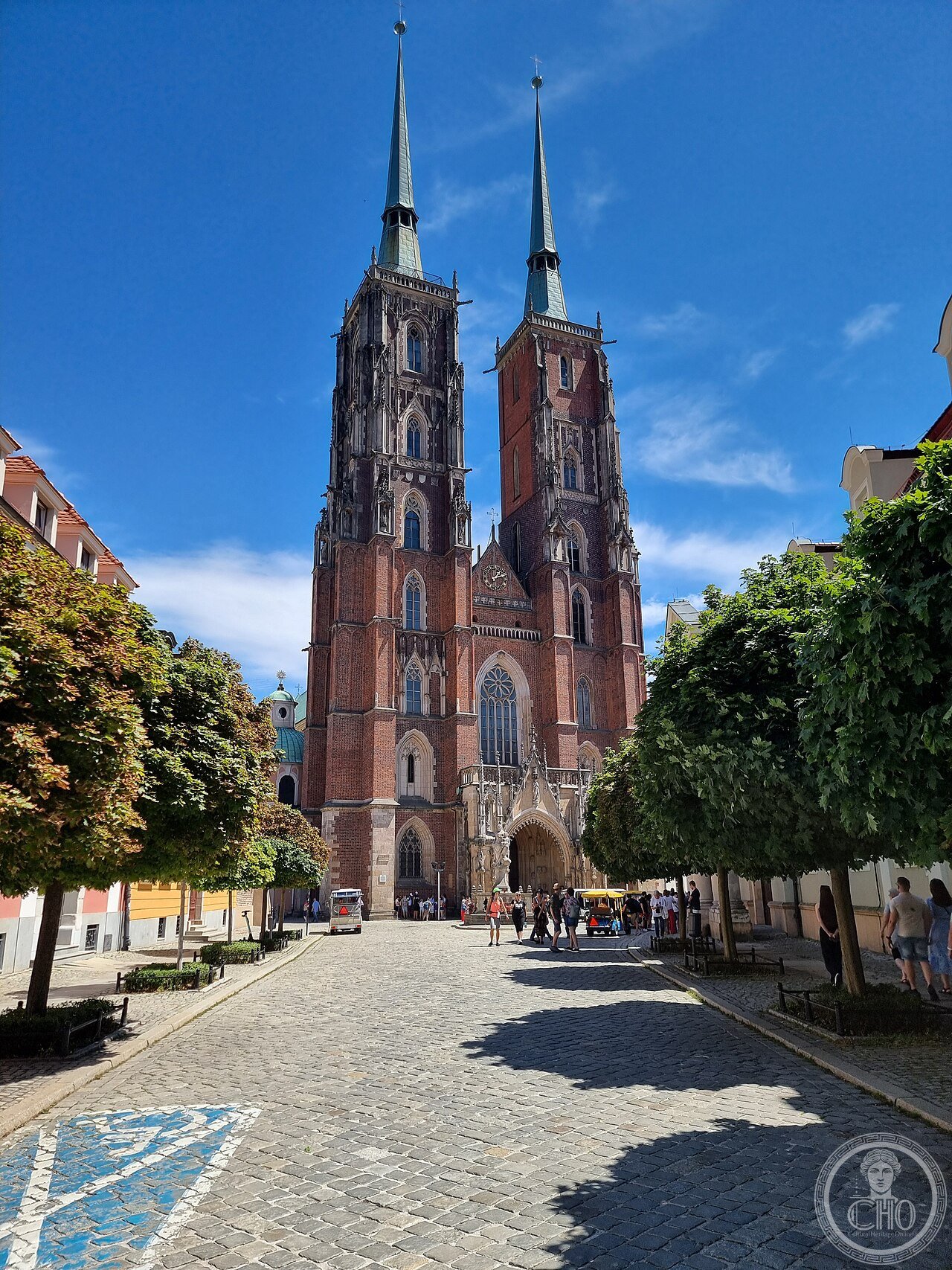
L’attuale cattedrale gotica di San Giovanni Battista è la quarta chiesa costruita sullo stesso sito: la prima, in pietra da campo con un’unica navata di circa 25 metri, risale alla metà del X secolo, sotto il dominio dei Přemyslidi. Durante gli ultimi giorni della Seconda guerra mondiale, l’assedio di Breslavia (Festung Breslau) e i pesanti bombardamenti dell’Armata Rossa distrussero circa il 70% dell’edificio: crollarono le volte della navata, bruciò il prezioso organo storico, andarono perdute gran parte dei dipinti e gli stalli barocchi, mentre tetto ed elmi delle torri furono rasi al suolo. La struttura gotica medievale, tuttavia, sopravvisse. La prima fase di ricostruzione di tetto e volte si concluse nel 1951, quando l’arcivescovo Stefan Wyszyński riconsacrò la cattedrale; ma la forma conica originale delle torri fu restituita solo nel 1991, 46 anni dopo la distruzione.
About Wrocław Cathedral
The Archcathedral of St John the Baptist, seat of the Archdiocese of Wrocław and one of the defining landmarks of the city, is in fact the fourth church to have stood on this site. The earliest church here, built under Přemyslid rule in the mid-10th century, was a modest fieldstone building with a single nave roughly 25 metres in length, featuring a distinctive transept and apse. Over subsequent centuries the site saw successive rebuildings, culminating in the Gothic cathedral whose core structure survives today. The building’s most severe trial came in the final days of the Second World War, during the Siege of Breslau (Festung Breslau) and the heavy bombardment inflicted by the advancing Red Army, which left roughly 70 percent of the cathedral — measured by damage to its vaults, roof, spires, and decoration — destroyed. The roof and the conical helmets atop the towers were ruined, the nave’s vaults collapsed, the cathedral’s priceless historic organ burned, and most of its paintings along with its valuable Baroque choir stalls were lost. Remarkably, the underlying medieval Gothic structure itself survived this devastation. An initial reconstruction of the roof and vaults continued until 1951, when the rebuilt cathedral was formally reconsecrated by Archbishop Stefan Wyszyński, later Poland’s Primate and a central figure in the country’s 20th-century Catholic Church. Full restoration, however, took far longer: the towers’ original conical spires, lost in 1945, were not rebuilt in their historic form until 1991 — a full 46 years after the wartime destruction, and only after the fall of Poland’s communist government made comprehensive restoration of religious architecture a more viable civic priority.
Key facts
- Mid-10th century: first church on the site, built under Přemyslid rule
- Present cathedral: the fourth church built on this location
- 1945: roughly 70% of the cathedral destroyed during the Siege of Breslau
- Losses: historic organ burned, most paintings and Baroque choir stalls destroyed
- 1951: roof and vaults rebuilt, cathedral reconsecrated by Archbishop Stefan Wyszyński
- 1991: original conical tower spires finally restored, 46 years after their destruction
History
The cathedral’s status as the fourth successive church on a site continuously used for Christian worship since the mid-10th century places it among the longest-standing sacred sites in this part of Central Europe, its layered rebuildings tracing the region’s shifting political control between Piast Poland, Bohemia, the Habsburg Empire, Prussia, and finally post-war Poland. The 1945 Siege of Breslau, among the most destructive urban battles fought on German soil in the closing months of the Second World War, reduced much of the city — and the cathedral along with it — to ruins, making the building’s survival and eventual restoration a significant symbol of the city’s own post-war reconstruction as Wrocław, now firmly within Polish borders.
The 46-year gap between the cathedral’s 1951 basic reconsecration and the 1991 restoration of its original tower spires illustrates the practical and political constraints facing religious architectural restoration under communist-era Poland, where full reconstruction of prominent church buildings often had to wait for the political and economic changes of the post-1989 period.
What you see
The cathedral’s twin Gothic towers, rebuilt to their original conical form only in 1991, rise above Ostrów Tumski, Wrocław’s historic cathedral island, marking the building’s medieval silhouette against the post-war city skyline. Inside, the rebuilt nave and vaults, reconstructed following 1945’s near-total roof collapse, house replacement furnishings and artwork alongside surviving medieval and Baroque elements that predate the wartime destruction.
Practical information
- Opening hours: generally open daily with seasonal variation; separate admission for the Baroque chapels and tower viewpoint; check current hours before visiting
- Address: Plac Katedralny, 50-328 Wrocław, Poland
Getting there
Wrocław Cathedral stands on Ostrów Tumski (Cathedral Island), the historic heart of Wrocław in southwestern Poland, reachable on foot from the city’s Market Square. GPS: 51.1142° N, 17.0460° E.
Nearby
- Ostrów Tumski — Wrocław’s historic cathedral island, surrounding the cathedral
- Wrocław Market Square — the city’s main square, a short walk away
- Centennial Hall — UNESCO-listed early modernist landmark, elsewhere in Wrocław
Sources
- Wikipedia — “Wrocław Cathedral” (en.wikipedia.org)
- Explore Your Life — “Wrocław Archcathedral: the heart of Ostrów Tumski” (exploreyourlife.eu)
- Szlaki Kulturowe — “The Roman Catholic Cathedral of Saint John the Baptist” (szlakikulturowe.dolnyslask.pl)
Find it on the map
See this place and what’s around it →📷 Become a Cultural Heritage Online photographer
Share your photos of places: they stay published under your name as the author. The more they're seen, the more you get noticed — and soon a contest will reward the most appreciated photos.
Log in or sign up free to add a photo