
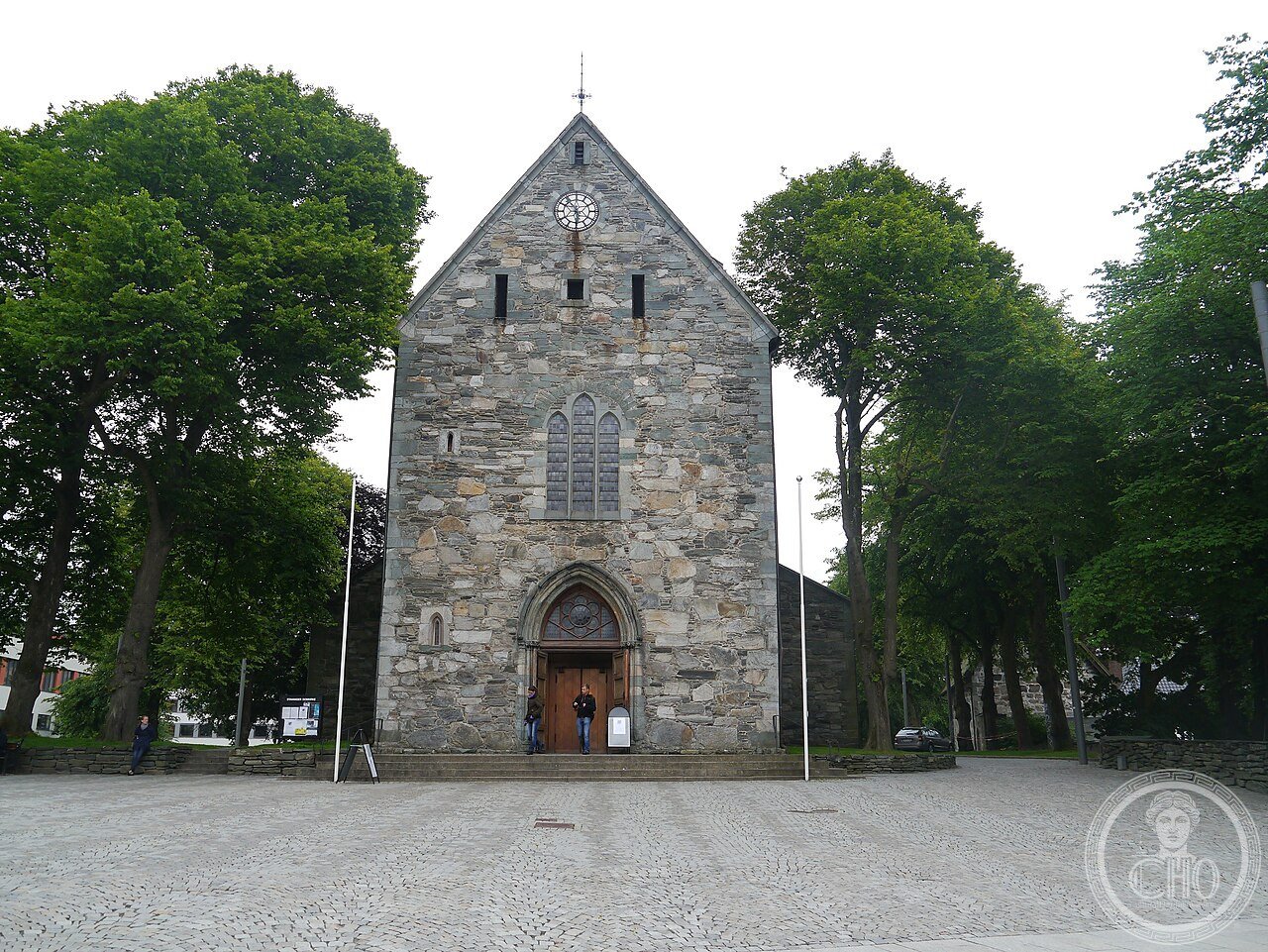
La cattedrale più antica di Norvegia fu iniziata intorno al 1100 dal vescovo Reinaldo e completata verso il 1150, costruita in stile anglo-normanno, probabilmente da maestranze inglesi. Dopo un incendio nel 1272, il coro e il vestibolo furono ricostruiti in stile gotico, ampliando l’originaria struttura romanica. La cattedrale è dedicata a san Swithun, vescovo anglosassone di Winchester del IX secolo, il cui braccio — secondo la tradizione — fu portato a Stavanger dallo stesso vescovo Reinaldo intorno al 1100. Il reliquiario che custodiva quella reliquia si credeva perduto dalla Riforma protestante, finché nel 2024 un’équipe di archeologi dell’Università di Stavanger, scavando nella cripta, non ha riportato alla luce i suoi resti: una placca di rame dorato con l’immagine di una chiesa, un medaglione d’argento dorato e gemme di vetro decorative, in vista dell’esposizione per il 900° anniversario della cattedrale nel 2025.
About Stavanger Cathedral
Stavanger Cathedral, also known as St. Swithun’s Cathedral, holds the distinction of being the oldest cathedral in Norway. Bishop Reinald is credited with beginning its construction around 1100, with the building substantially completed by around 1150. Unusually for Norway, the cathedral was built in Anglo-Norman style, most likely by English artisans, giving its Romanesque nave a distinctive character of robust stone masonry and rounded arches that sets it apart from other Scandinavian churches of the period. Following a devastating fire in 1272, the cathedral’s choir and vestibule were rebuilt on a larger scale in the Gothic style, layering a new architectural phase onto the original Romanesque structure. The cathedral’s patron saint, Swithun, was an Anglo-Saxon bishop of Winchester in 9th-century England, renowned for posthumous miracle-working; following his death in 863, his relics were distributed among various shrines, with one portion believed to have been brought to Stavanger by Bishop Reinald around 1100, becoming one of the cathedral’s founding relics. The reliquary that once housed this relic was long believed lost, presumed destroyed or dispersed during the Protestant Reformation of the 16th century. That belief was overturned in 2024, when a research team from the University of Stavanger’s Museum of Archaeology, led by Sean Denham alongside researchers Margareth Hana Buer and Bettina Ebert, rediscovered the reliquary’s remains within a crypt beneath the cathedral. The excavation recovered a trove of artefacts including a gilded copper plate decorated with a depiction of a church building — an X-ray revealing details of its tower, roof, columns, and windows — a gilded silver medallion featuring an animal motif, and decorative glass gems. These finds were scheduled for public display in a 2025 exhibition marking the cathedral’s 900th anniversary.
Key facts
- c. 1100: construction begun by Bishop Reinald, Anglo-Norman style
- c. 1150: cathedral substantially completed
- 1272: fire damages the cathedral, prompting Gothic rebuilding of the choir and vestibule
- Patron saint: Swithun, 9th-century Anglo-Saxon bishop of Winchester
- c. 1100: a relic of Swithun reportedly brought to Stavanger by Bishop Reinald
- 16th century: reliquary believed lost during the Protestant Reformation
- 2024: reliquary’s remains rediscovered beneath the crypt by University of Stavanger archaeologists
- 2025: finds displayed for the cathedral’s 900th anniversary
History
The cathedral’s distinctly Anglo-Norman architectural character, unusual within the wider context of medieval Norwegian church building, reflects the close ecclesiastical and cultural ties between Norway and England during the early 12th century, likely mediated through the same English craftsmen and clerical networks that brought Saint Swithun’s cult itself across the North Sea to Stavanger. The choice of a Winchester saint as patron for a newly founded Norwegian cathedral situates Stavanger within a broader pattern of Anglo-Scandinavian religious exchange in the period immediately following Norway’s Christianisation.
The 2024 rediscovery of the long-lost reliquary, its very existence forgotten for roughly five centuries since the Reformation, represents an exceptionally rare case of a medieval cathedral recovering physical evidence of its own founding relics through modern archaeology rather than documentary record alone, timed remarkably to coincide with the cathedral’s own 900th anniversary commemorations.
What you see
The cathedral’s Romanesque nave, dating to its original Anglo-Norman construction around 1100-1150, features the robust masonry and rounded arches characteristic of English-influenced building of the period, while the Gothic choir and vestibule, rebuilt after the 1272 fire, present a visibly later architectural phase. Beneath the cathedral, the crypt where the 2024 reliquary discovery took place forms part of the site’s deepest archaeological layers, connecting the standing building directly to its earliest medieval foundations.
Practical information
- Opening hours: generally open daily with seasonal variation; check current hours before visiting
- Address: Kongsgata, 4006 Stavanger, Norway
Getting there
Stavanger Cathedral stands in the centre of Stavanger, on Norway’s southwestern coast, easily reachable on foot from the harbour and old town. GPS: 58.9696° N, 5.7334° E.
Nearby
- Stavanger Old Town (Gamle Stavanger) — historic wooden-house district, a short walk away
- Stavanger harbour — the city’s waterfront, nearby
- Museum of Archaeology, University of Stavanger — home to the rediscovered reliquary finds
Sources
- Wikipedia — “Stavanger Cathedral” (en.wikipedia.org)
- Archaeology News Online Magazine — “Lost reliquary of Stavanger’s patron saint unearthed” (archaeologymag.com)
- Science Norway — “Spectacular archaeological finds in Norwegian Cathedral” (partner.sciencenorway.no)
Find it on the map
See this place and what’s around it →📷 Become a Cultural Heritage Online photographer
Share your photos of places: they stay published under your name as the author. The more they're seen, the more you get noticed — and soon a contest will reward the most appreciated photos.
Log in or sign up free to add a photo