
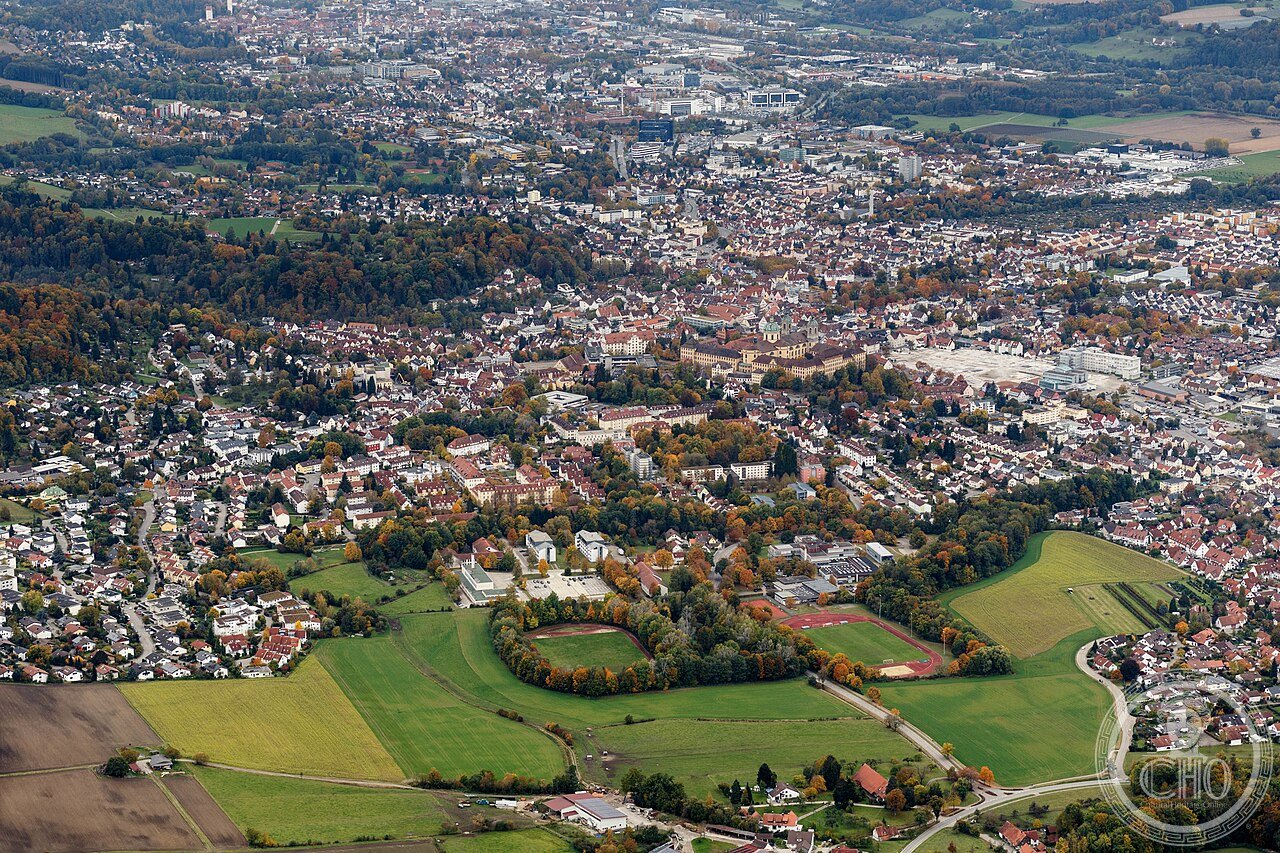
Nel 1056, Guelfo I di Baviera fondò un’abbazia benedettina sul Martinsberg. Nel 1094, la nobildonna Giuditta di Fiandra donò ai monaci una reliquia del sangue di Cristo, giunta a lei attraverso l’imperatore Enrico III. Da allora, ogni anno il venerdì dopo l’Ascensione — il “Venerdì di Sangue” — fino a 3.000 cavalieri in redingote e cilindro accompagnano il “Cavaliere del Sangue Santo” in una processione seguita da oltre 30.000 spettatori: la più grande processione a cavallo d’Europa.
About the Basilica of Weingarten
In 1056, Welf I, Duke of Bavaria, founded a Benedictine monastery on the Martinsberg overlooking the village of Altdorf, settling it with monks brought from Altomünster Abbey. The monastery’s most significant treasure arrived through a chain of aristocratic gift-giving connected to the Holy Roman Empire: when Emperor Henry III died in 1056, a relic of the Holy Blood was bequeathed to Baldwin V, Count of Flanders, as a gesture of reconciliation; Baldwin passed the relic to his relative Judith of Flanders, who by then was married to her second husband, Welf I of Bavaria, the abbey’s own founder. In 1094, Judith formally gave the Relic of the Holy Blood to Walicho, Abbot of Weingarten, establishing the monastery as its permanent custodian. The relic’s solemn presentation took place in 1090, on the Friday following the feast of the Ascension, and it was stipulated that the relic should thereafter be carried in solemn procession annually on that same day, which became known as Blutfreitag, or “Blood Friday.” Though the procession was prohibited in 1812, it was revived in 1849 and has continued every year since, evolving into the Blutritt — regarded today as the largest equestrian procession anywhere in Europe. Each year, between 2,000 and 3,000 horsemen, dressed in formal tailcoats and top hats and organised into more than 100 riding groups, escort the Rider of the Holy Blood on horseback through Weingarten and the surrounding countryside, watched by over 30,000 pilgrims and spectators lining the route; the relic, set within a gemstone-studded cross, is used by the Rider to bestow a blessing upon the houses, farms, and fields along the way. Weingarten’s abbey church, rebuilt in the Baroque style in the early 18th century, is today recognised as Germany’s largest Baroque church, and the monastery remains part of the Beuronese Congregation of the Benedictine Confederation.
Key facts
- 1056: Benedictine monastery founded by Welf I, Duke of Bavaria
- 1090: the Holy Blood relic’s solemn first presentation
- 1094: Judith of Flanders formally gives the relic to Abbot Walicho
- 1812: the Blutritt procession prohibited
- 1849: the procession revived, continuing annually since
- 2,000-3,000 riders: the scale of the modern Blutritt, Europe’s largest equestrian procession
- Today: the basilica is Germany’s largest Baroque church
History
The Holy Blood relic’s journey — from Emperor Henry III’s death, through the Count of Flanders, to Judith of Flanders and finally to the Weingarten monks — traces a distinctive chain of aristocratic and imperial relic transmission characteristic of 11th-century European dynastic and religious politics, in which the possession and gifting of major relics served as instruments of both piety and political reconciliation. The Blutritt’s survival across nearly a millennium, including its temporary 1812 suppression and 1849 revival, situates the procession among the most enduring popular religious traditions in German-speaking Europe, its continued annual gathering of thousands of horseback riders representing one of the largest sustained expressions of communal Catholic devotion still practised anywhere on the continent.
Weingarten’s status as Germany’s largest Baroque church, achieved through an extensive early 18th-century rebuilding of the medieval monastery, reflects the wealth and prestige the abbey had accumulated as custodian of one of medieval Europe’s most significant blood relics, funding an architectural ambition matched by relatively few other German ecclesiastical building projects of the period.
What you see
The basilica’s monumental Baroque exterior and interior, rebuilt in the early 18th century, present one of the grandest ecclesiastical spaces in Germany, its scale reflecting the abbey’s historic wealth and prestige as custodian of the Holy Blood relic. The relic itself, set within a jewelled cross, is displayed within the church and carried out annually during the Blutritt procession, while the surrounding monastery complex preserves further monastic and later administrative buildings from across the site’s near-thousand-year history.
Practical information
- Opening hours: generally open daily with seasonal variation; check current hours before visiting; free admission
- Address: Kirchplatz 1, 88250 Weingarten, Germany
Getting there
The Basilica of St. Martin is located in the town of Weingarten, near Ravensburg in Baden-Württemberg, reachable by road or rail. GPS: 47.8092° N, 9.6446° E.
Nearby
- Ravensburg — the nearby historic town
- Lake Constance (Bodensee) — a short distance to the south
- Weingarten town centre — the surrounding settlement
Sources
- Wikipedia — “Weingarten Abbey” and “Blutritt” (en.wikipedia.org)
- Catholic Encyclopedia — “Weingarten” (newadvent.org)
- Bargain Travel Europe — “St Martin Abbey Weingarten” (bargaintraveleurope.com)
Find it on the map
See this place and what’s around it →📷 Become a Cultural Heritage Online photographer
Share your photos of places: they stay published under your name as the author. The more they're seen, the more you get noticed — and soon a contest will reward the most appreciated photos.
Log in or sign up free to add a photo